Analysis: U.S., Iran continue strikes as both sides contemplate escalation
As military action continues, the U.S. and Iran are weighing whether to escalate the eight-month war and what that escalation might look like, according to reports.
But threats from Iran…

As military action continues, the U.S. and Iran are weighing whether to escalate the eight-month war and what that escalation might look like, according to reports.
But threats from Iran and ongoing attacks are making it difficult for the U.S. to ignore the Islamic Republic – which may be the point of the escalation from Tehran.
CNN reported that some “hardliners” within the regime may be seeking to play “spoiler” to prolong the war.
“These threats have substantially increased,” Director of National Intelligence Jay Clayton told lawmakers Wednesday, according to Reuters. “Our women and men abroad, our women and men here in the United States, are under greater threat.”
U.S. data networks, including air traffic control systems, banking systems and utilities, have experienced outages that have led some to suspect an Iranian cyberattack, leaving Americans searching for answers, Heartlander News reported.
U.S. intelligence agencies have said they have evidence of some Iranian cyberattacks targeting utilities but are doubtful Iran is responsible for all the network outages.
Intelligence estimates widely circulated by U.S. media have also indicated that Iran has targeted U.S. officials for assassination and considered using a “dirty bomb” in a major American metropolitan area.
The reports come as the U.S. has launched retaliatory strikes against Iranian missile launch sites in self-defense, as Heartlander News previously reported.
“We take it very seriously because they happen to be crazy,” President Donald Trump told reporters about the “dirty bomb” threat as he departed for a diplomatic trip to Asia. “But this is why they can’t have a nuclear weapon, by the way, in case people had any questions.”
The president’s comments came a day after Asif Merchant, 48, of Pakistan, was sentenced to 27.5 years in prison for coordinating with Iran on assassination attempts against Trump and other U.S. officials.
Although Merchant was sentenced this week, he was recruited for the assassination plot in 2022, before the current war, according to the U.S. Department of Justice.
Earlier this month, the DOJ announced the indictment of three Iranian-backed Hezbollah members accused of involvement in a planned terrorist plot against the American military at a British Royal Air Force base in Fairford, United Kingdom. The alleged plot necessitated the withdrawal of U.S. forces from the base.
U.S. and Israel weigh further military action
Trump has been considering a joint attack with Israel aimed at degrading Iran’s ability to develop nuclear weapons and its ability to attack neighboring countries, according to Axios.
The director of Israel’s spy agency Mossad, Roman Gofman, traveled to the U.S. last week to consult with CIA Director John Ratcliffe about Iranian plans related to chemical weapons development.
“Gofman’s argument was that if the U.S. and Israel don’t act now, they will have to take military action at a later stage but under more difficult conditions,” a source told Axios.
The New York Times reported that the U.S. “has a window in which it has significant military firepower in the region” that it could use in “a four- to seven-day campaign of airstrikes against Iran,” according to sources briefed on the matter.
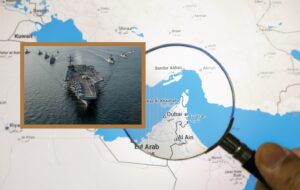
The U.S. now has two carrier strike groups in the region, the USS George H.W. Bush and the USS Theodore Roosevelt, according to the Associated Press.
Israel’s Institute for National Security Studies (INSS) noted that the naval forces available are comparable to those deployed for the initial March campaign against Iran, although fewer American land-based aircraft are in the region.
“According to the INSS Data Center’s assessment, an air campaign on the scale of March would require the redeployment of bombers and fighters to the theater,” the think tank warned.
Meanwhile, U.S. Central Command has announced Task Force Iron Gate, based in Tampa. The task force will help interdict advanced weapons systems, dual-use technologies, sanctioned materials and illegal revenue streams entering Iran by land or across the Caspian Sea from Russia.
Trump has specifically asked the Pentagon how Tehran would respond if the U.S. resumed an aggressive air campaign against Iranian sites, according to Axios.
Gulf states urge restraint as economic pressure mounts
Regional Gulf state partners have urged the president to maintain his current defensive approach and continue choking off Iranian logistics rather than resume a full-scale shooting war.
Some Iranian officials appear to argue that the blockade and economic sanctions are working and that the only way to break the blockade is to resume fighting – in part because the oil market is moving against Iran.
“Despite repeated predictions by hardliners that oil prices would climb to $150 a barrel and cripple the American and European economies,” Iran International reported, “crude prices have moved in the opposite direction in recent weeks, falling again slightly in Monday’s trading.”
The launch of Task Force Iron Gate and the administration’s public statements appear to point to a preference for letting the blockade and sanctions do their work.
“As President Trump and Secretary [of State Marco] Rubio have stated, our economic pressure campaign is devastating Iran to such an extent that the President does not have any need to conduct major combat operations,” a U.S. official told Axios.
Trump has also publicly signaled that he prefers to maintain the ongoing low-grade pressure campaign rather than escalate a war he believes Iran is slowly losing.
“So it’s highly unlikely I’ll have to” escalate, Trump told CNN. “They’re withering away financially. We’ve hit them militarily. We could finish them off.”