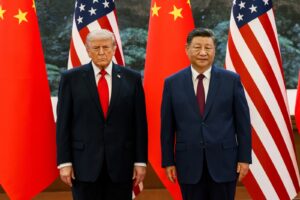
Analysis: Trump sends China signal on Taiwan, Indo-Pacific stability ahead of summit
President Donald Trump’s summit with his Russian and Chinese counterparts will dominate headlines this week, but his visit to the Philippines has already strengthened America’s negotiating…
President Donald Trump’s summit with his Russian and Chinese counterparts will dominate headlines this week, but his visit to the Philippines has already strengthened America’s negotiating position.
Trump landed in China early Wednesday, ahead of his meeting with Chinese President Xi Jinping and Russian President Vladimir Putin, after spending less than 24 hours in the Philippines.
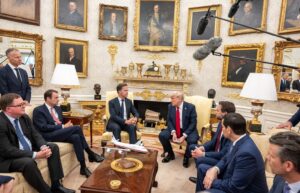
After arriving in the Philippines, the president met with Prime Minister Sanae Takaichi, Indian leader Narendra Modi and Australian Prime Minister Anthony Albanese at the first formal summit of the Quad alliance in two years and the first ever attended by Trump, The Japan Times reported.
While the U.S. State Department describes the alliance as a “partnership between the United States, Australia, India, and Japan committed to fostering a free and open Indo-Pacific,” it is openly a military effort to deter China’s territorial ambitions in the region.
Xi has been increasingly belligerent in support of the People’s Republic of China’s (PRC) claims to Taiwan, invoking messianic-sounding rhetoric to advance what he calls the “unwavering historical mission” of China’s Communist Party to annex Taiwan, according to Reuters.
“The tide of history cannot be stopped,” Xi added a week ago. “The complete reunification of the motherland must be realized, and it will certainly be realized.”
Taiwan, for its part, has said it will never submit to PRC rule.
Japan-China tensions over Taiwan
The meeting comes as Japan’s Takaichi and China’s Xi have been engaged in an increasingly tense confrontation over Taiwan.
The Japanese prime minister has characterized a crisis in the Taiwan Strait as a “survival threatening situation for Japan” that could require a military response, according to the South China Morning Post.
In a statement, the Quad leaders meeting in the Philippines pledged to oppose efforts to change the Indo-Pacific status quo through force, coercion or economic pressure while protecting freedom of navigation and regional stability.
They also committed to strengthening critical supply chains, advancing emerging technologies, securing maritime trade routes and cooperating on disaster relief.
Democrats have recently claimed Trump puts his personal relationship with Xi ahead of national security and Taiwan.
In a statement, Democratic U.S. senators accused the president of “rolling out the red carpet” for the Chinese president during a state visit to the White House while ignoring Taiwan’s defense needs.
“America’s support for Taiwan’s self-defense is non-negotiable and crucial to preventing a cross-strait conflict that would destabilize the region and threaten the global economy,” said the joint statement by the Democrats in September.
The statement called for the Trump administration to release financial and military aid to Taiwan immediately.
Bipartisan support for Taiwan
But one expert said there is bipartisan support in Congress, as well as support from the White House, for military aid and financial assistance to Taiwan to push back against China’s claims.
“Secretary of State [Marco] Rubio and his team remain central figures, and their overall strategy towards the Indo-Pacific, Asia, and the wider global situation is unlikely to change substantially,” Chen Fang-yu, associate professor at Taipei’s Soochow University, told Reuters.
Prior to his appointment as secretary of State, Rubio served as chair of one of Washington’s most prominent bodies focused on the PRC, the Congressional-Executive Commission on China.
“Congress created the Commission in 2000 to monitor China’s compliance with international human rights standards, to encourage the development of the rule of law in the PRC, and to establish and maintain a list of victims of human rights abuses in China,” the commission’s website says.
One former State Department official said Rubio put together the Quad meeting in the Philippines ahead of the presidential summit in Shenzhen, China, as a signal of American intentions on Taiwan before the sit-down with Xi and Putin.
“Part of what he (Rubio) is thinking is that this is probably the best possible signal if you’re going to go into a trilateral meeting,” Kurt Campbell, a former U.S. deputy secretary of state, told Reuters, referring to Thursday’s U.S.-China-Russia talks.
Rubio is accompanying Trump on the foreign visits.
Trade deals add to Trump’s agenda
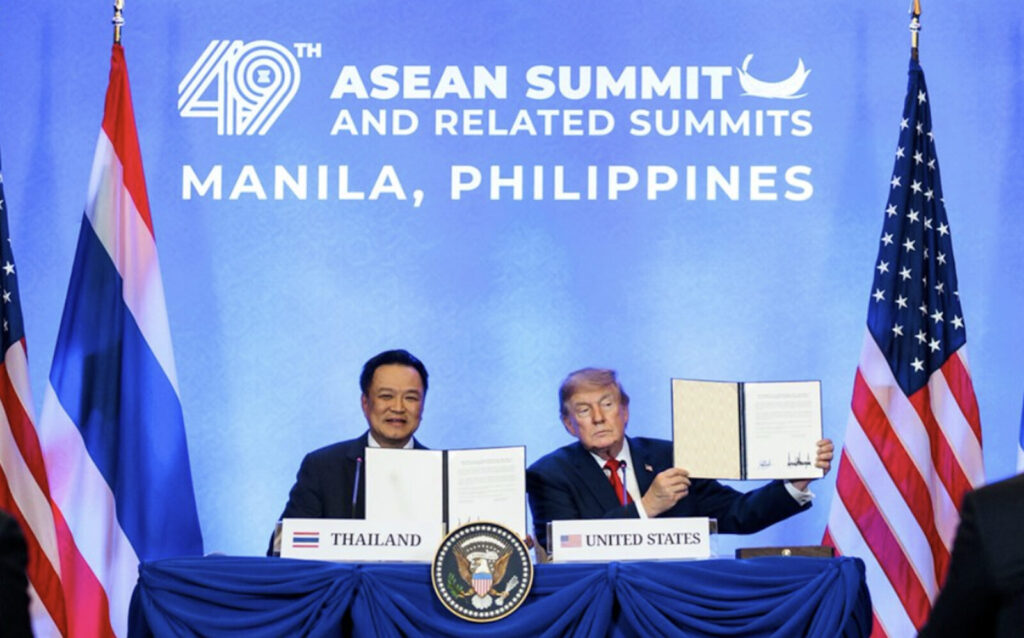
In addition to putting pressure on China by emphasizing military cooperation in the Indo-Pacific, Trump also completed trade negotiations with Thailand and the Philippines, according to the president.
“We’ve just consummated a very big trade deal, the biggest trade deal we’ve ever made so far, and it is a fair deal for both countries,” Trump told a state lunch event at the Philippine presidential palace.
Reuters said an agreement had been reached on some trade issues, but nothing had been signed, according to Philippine sources.
The president previously announced a trade deal with Thailand on Tuesday.
“I am now heading to China, from the Philippines, where we had a wonderful meeting on Trade, National Security, and other subjects,” said Trump via Truth Social. “I am pleased to announce that we made a new and completely different Trade Deal with the Philippines.”
(Image credit: Screenshot/X/White House)