Analysis: Record midterm turnout stacks up as youth vote sags in one key race
Early voting points to record turnout in the 2026 midterms as both parties try to reach voters who rarely cast ballots. Voter turnout in the last two midterm elections has ranged from…
Early voting points to record turnout in the 2026 midterms as both parties try to reach voters who rarely cast ballots. Voter turnout in the last two midterm elections has ranged from 46-49%.
It’s still unclear whether early-vote numbers predict final turnout better than polls do, or what either signal means for Democrats and Republicans.
One early signal may already matter: Young voters, a group Democrats are counting on, are lagging in at least one prominent battleground race.
Polls have their own blind spots, said Chris Wilson, CEO of data intelligence company EyesOver.
“You’ve got the polling aggregators, you’ve got media organizations that don’t understand sampling and end up interviewing way too many highly educated people compared to lesser college graduates,” Wilson told Heartlander News.
Wilson added that media surveys are undersampling older voters and oversampling younger voters. Meanwhile, media analysts are publicizing the results, which could give a skewed picture of any given race.
Early voting efforts
So far, both political parties have been successful in deliberately boosting the early vote.
In a 2025 memo, the GOP said it would be conducting “a multi-state, multi-year initiative to build, test and scale” a get-out-the-vote (GOTV) operation targeting low-propensity voters.
“Republicans have become the party of low-propensity voters,” the memo said. “Many of our strongest supporters – primarily working-class, rural and non-college-educated Americans – are deeply aligned with our values and priorities.”
The GOP attributed the drop-off in GOTV in midterms to the absence of President Donald Trump on the ballot.
“When the President isn’t running, they are significantly less likely to participate, regardless of their support for our candidates or agenda,” the memo added about low-propensity voters.
At the same time, Democrats announced a program to target voters who turned out in record numbers in the 2020 election but have been absent since.
The Democrats conducted nearly 10,000 interviews in 61 congressional battleground districts, speaking to voters who participated in the 2020 election but did not vote in 2024.
“Through our national Local Listeners program,” said Democratic National Committee Chair Ken Martin, “we are not only engaging and turning out thousands of 2020 voters who sat out in 2024, but also equipping campaigns in battleground districts with the information, tools and strategies they need to win these voters.”
So far, it looks like both approaches are yielding results.
The University of Florida Election Lab (UFEL) reports that as of Nov. 1, 54.5 million early votes have been cast nationwide. That marks a 17% increase over the 2022 midterms and a 37% increase over the 2018 midterms.
Still, measured against the presidential elections in 2020 and 2024, the 2026 early vote has yielded just 63% and 53% of the presidential-year totals.
Because midterms lack a national candidate at the top of the ticket, the off-year elections tend to have more Election Day voting.
Thus, the midterm elections will likely be decided based on who shows up on Election Day.
And Election Day figures have varied widely in terms of which party they favor.
A 55% Election Day vote share would bring the total number of ballots to 121 million, breaking the 2018 midterm record.
| Election | Early votes | Final total votes | Early vote share | Election Day share |
| 2018 | 39,054,218 | 118.6 million | 32.90% | 67.10% |
| 2020 | 101,453,111 | 161.3 million | 62.90% | 37.10% |
| 2022 | 48,508,702 | 112.0 million | 43.30% | 56.70% |
| 2024 | 85,903,679 | 158.0 million | 54.30% | 45.70% |
But neither early voting nor Election Day voting automatically confers an advantage on either party.
In 2018, Democrats made significant inroads in the House of Representatives while Republicans defended the Senate, as the Election Day share of the vote hit nearly 70%.
In 2022, the GOP won the House while failing to control the Senate, as early voting approached 50 million votes.
In the last five midterm elections, the president’s party has lost control of at least one chamber of Congress, while two-thirds of congressional elections since 1970 have resulted in divided government.
While vote-tracking websites such as UFEL record that Democrats have an advantage in early voting in 2026, only 27 states actually break down early voting by party.
UFEL currently shows Democrats with a 3 million-vote advantage in early voting, but 16 of the 27 states tracked by the lab have Democrat registration advantages.
Other websites try to make up for the lack of data by developing sophisticated computer modeling that estimates voter turnout by party.
But Heartlander News reported extensively about problems with public polling websites that use questionable models to predict outcomes.
Beyond allegations of fake polls, a real modeling problem surfaces when analysts try to predict elections.
“The people who are upset and angry and frustrated may not be more likely to vote, but they’re more likely to participate in the polling and therefore the polling tends to be in favor of the insurgents,” veteran political consultant Dick Morris told Heartlander News.
Michigan’s Senate race
The early voting from Michigan demonstrates the problems with the math.
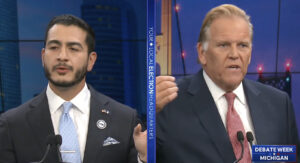
A Rasmussen poll shows Democrat Abdul El-Sayed ahead of Republican Mike Rogers by 5 percentage points in the U.S. Senate race in Michigan.
The crosstab model shows voters ages 18 to 39 accounting for 26% of the electorate, with support for El-Sayed ranging from 55% to 64%.
But the early voting data from UFEL shows that early voters ages 18-40 have turned out at just 14.7% so far.
In 2024, Michigan voters under 40 accounted for 20.5% of absentee ballots and 31.3% of early in-person votes, respectively.
The number of pre-election votes in Michigan in 2022 (1.8 million) was similar to the number in 2026, which would imply about 4.5 million votes in total in 2026.
To hit the 26% mark predicted by the survey, youth voters would have to show up on Election Day and account for about 34% of the remaining vote.
That’s a lot.
For sure, Michigan is a top state when it comes to under-29 voting. And because it is, it could be a warning to Democrats.
Nationwide, only 37% of all voters ages 18-29 voted in person on Election Day, and the total under-29 vote is half the number of votes cast by 30-39-year-olds.
The math needed to produce the results Rasmussen is pointing to, using the assumptions in the poll, is difficult, at least in Michigan.
AARP noted in its October survey that the GOP has a 10-point advantage among voters age 50 and older, while Democrats have a 26-point advantage among voters under 50.
In the 50-and-older group, 83% said they were extremely likely to vote, while 66% of those under 50 said they were extremely likely to vote.
That’s not to say Democrats won’t win the Michigan Senate seat or any other seat just because one poll failed to adequately model the electorate thus far in early voting.
But if Rasmussen and others get the results right, it will be because an entirely different group from those under 40 cast a vote for El-Sayed and other Democrats on Election Day.
“I think that the older voters are definitely going to be the heavier influence in this election, no doubt in my mind,” said El-Sayed’s rival, Republican U.S. Senate candidate Mike Rogers, discussing his chances.