Analysis: Peace push gains urgency as Democrats prepare to take control of Congress
Leaders in the U.S., Europe, Ukraine and Russia appear to be moving toward another round of peace talks before Democrats take control of Congress in January.
The change in Washington is one…
Leaders in the U.S., Europe, Ukraine and Russia appear to be moving toward another round of peace talks before Democrats take control of Congress in January.
The change in Washington is one reason for urgency, though each party has its own reasons to consider a deal now.
U.S. negotiators warned Russia in mid-November that reaching an agreement could become more complicated for the Trump administration and Moscow once Democrats take control of Congress.
The Kyiv Independent reported that U.S. envoys Steve Witkoff and Jared Kushner warned both Ukraine and Russia that “the current round of peace talks could be the last realistic opportunity to secure a deal before political dynamics in Washington shift.”
Terms Russia finds attractive now might no longer be available if a new Congress presses for a tougher approach and calls U.S. envoys to testify, the outlet reported.
A potential breakthrough hinges on whether Russia would accept security guarantees for Ukraine and whether the U.S. and Europe would offer them.
“Clear progress has been made on security guarantees,” one European official close to the negotiations told PoliticoEU. “On peace talks there is alignment with the U.S., no maximalist demands and no discussion on European security without the Europeans.”
Ukraine seeks security guarantees
The renewed momentum follows several weeks of “shuttle diplomacy” by Witkoff and Kushner, who have traveled between Moscow, Kyiv and Berlin, Politico reported.
“President [Donald] Trump’s willingness to consider Article 5-like security guarantees for Ukraine is a critical feature to achieving lasting peace,” Kushner said on social media. “Russia’s willingness to discuss such guarantees is a major step forward and potential indication that it is serious about peace.”
Under Article 5 of NATO’s treaty, an attack on one member is considered an attack on all. A separate agreement modeled on that provision could give Ukraine security guarantees without granting it NATO membership. The obligations would depend on the terms of the agreement.
But Russia’s position remains unclear. Deputy Foreign Minister Sergei Ryabkov called arrangements resembling NATO membership for Ukraine “an unacceptable option for us,” Kyiv Post reported. Russian President Vladimir Putin has not publicly commented on Kushner’s proposal.
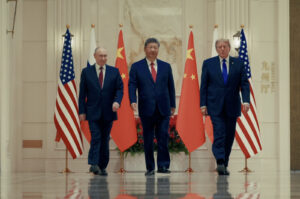
Putin described his recent talks with Trump at the summit in China as “serious collaborative work” and invited European representatives to Russia for further discussions.
“Through diplomatic channels, we have proposed that European representatives come to Moscow so that we can determine their position,” Putin told reporters. “After that, we will decide in what format to continue the dialogue with Ukraine.”
Ukraine’s response is another sign of interest in further talks. President Volodymyr Zelensky has stepped up calls for a meeting involving Ukraine, Russia, Europe and the U.S.
“We must do everything to make sure that the four-party meeting – Ukraine, Europe, America and Russia – happens as soon as possible,” Zelensky said, according to France 24. “We are ready to do this. Literally tomorrow.”
He added, “We have heard from our partners that they want to try to make it happen before Christmas. We hope it happens sooner.”
Some critics argue that negotiations could give Putin time to continue attacking Ukraine while driving a wedge between Europe and the U.S.
“The resumption of talks in Abu Dhabi has allowed the Kremlin to buy time to pursue two objectives in parallel,” writes the New Eurasian Strategies Centre. “The first is to weaken the Ukrainian economy by continuing its strikes on Ukraine’s energy infrastructure, while maintaining good relations with Donald Trump. The second is to deepen divisions both between the US and Europe and within the European Union itself.”
Maybe, but Russia could pursue those objectives without agreeing to negotiate.
Indeed, dividing the West while inflicting damage on Ukraine have been twin strategies of the war so far, according to a paper in the U.S. Army War College Quarterly.
Still, the Kremlin may have reasons to negotiate with Ukraine now.
Reports from the recent summit involving the U.S., China and Russia portrayed Putin as receiving less prominent treatment than Trump.
Independent Russian outlet Meduza reported that Chinese leader Xi Jinping greeted Trump at the airport but sent another official to greet Putin. Russia’s national anthem was not played when Putin entered the summit hall, and a Putin aide complained that Putin could not speak with Trump at a banquet because they were not seated together.
It would also be a mistake to assume Russia can finance the war indefinitely if global conditions change. A drop in oil prices could put further pressure on its budget.
Russia has enough financing to cover its budget deficit in 2027 and probably 2028, an analyst told the Associated Press. But doing so would require higher taxes and leave less money for other priorities.
That financial pressure could affect Moscow’s negotiating position over time, regardless of which party controls Congress.
“The room for maneuver is limited: an adverse shock such as a drop in global energy prices or an erosion of confidence in the financial system could quickly destabilize the fragile equilibrium,” said a report by the Kyiv School of Economics, cited by AP.
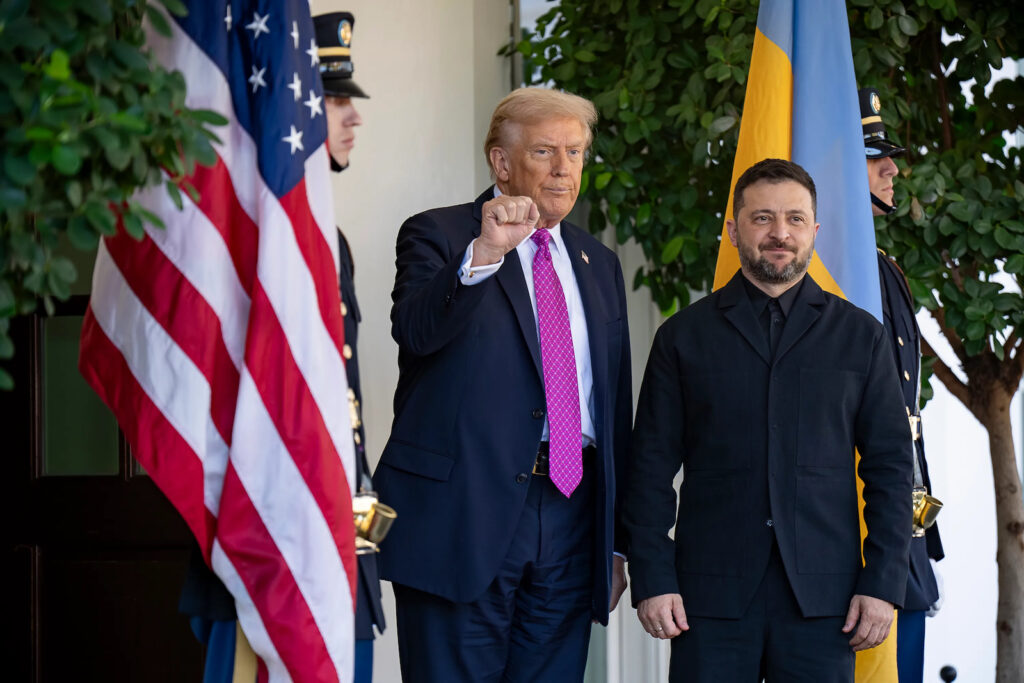
(President Donald Trump greets Ukrainian President Volodymyr Zelenskyy at the West Wing Lobby entrance of the White House, Friday, October 17, 2025. Official White House Photo by Juliana Luz)