Analysis: Trump, Rubio attend Chinese summit marked by signals, tone, not substance
President Donald Trump may have returned from his trilateral summit with Russia and China empty-handed, but that doesn’t mean the trip was unproductive.
For careful observers, the signals…
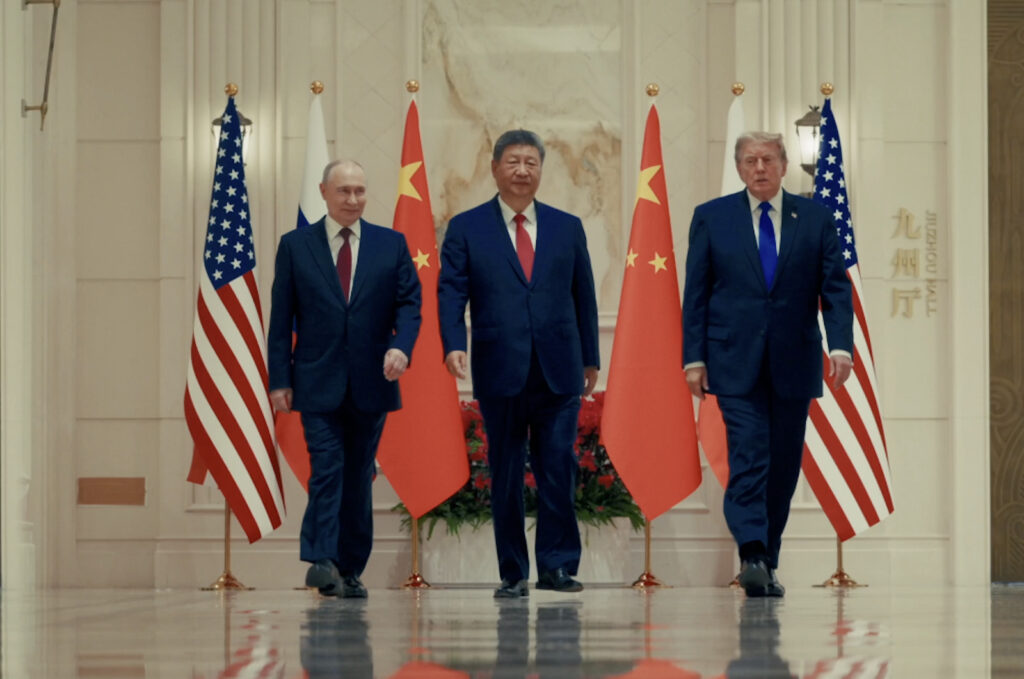
President Donald Trump may have returned from his trilateral summit with Russia and China empty-handed, but that doesn’t mean the trip was unproductive.
For careful observers, the signals sent at the summit may have been the most instructive part of the meetings.
According to the administration, the trip’s substantive benefits came before Trump’s summit with Chinese President Xi Jinping and Russian President Vladimir Putin in Shenzhen, China.
Before the meeting of the three leaders, Trump met with members of the Quad alliance – India, Australia, Japan and the U.S. – to strengthen regional commitments aimed at countering the Chinese Communist regime, as Heartland News previously reported.
Secretary of State Marco Rubio, who arranged the pre-summit meetings, characterized their outcome in economic terms that would benefit Americans.
“These are four very powerful economies that working together can create jobs and markets for American products in addition to being able to cooperate on a bunch of things,” Rubio told reporters.
(Read a transcript of Trump and Rubio’s remarks)
Rubio said the summit with Xi and Putin was more important as an exercise in diplomacy that “sets the tone” for future negotiations on trade and diplomatic engagement.
Signals of Russia’s diminished standing
For those looking for clues about the summit’s tone, there was plenty to see.
For Russia, the tone may have signaled a reduction in its power on the world stage.
Xi personally greeted Trump at the airport upon his arrival, while Putin was met by a Chinese Communist Party functionary.
“Chinese President Xi Jinping made it clear that Putin is not his or U.S. President Donald Trump’s equal: Xi did not personally greet him at the airport, as he did the American leader,” said Thomas E. Graham, a fellow at the Council on Foreign Relations.
The seating arrangements at the banquet may also have been designed to diminish Putin.
While Putin sat at the same table as Trump and Xi, contrary to some viral claims online, China’s First Lady Peng Liyuan sat between the Russian president and his American and Chinese counterparts, serving as a buffer.
Putin aide Yuri Ushakov complained that he was denied the opportunity to speak directly with Trump because of the seating arrangements, Meduza reported, describing the outlet as an independent Russian news organization.
The Russian news outlet said the snub continued when the Russian national anthem was omitted and Putin was dismissed ahead of a group photo with Xi, Trump, South Korean Prime Minister Lee Jae-myung and China’s first lady.
Japan receives a frosty welcome
China wasn’t finished playing bad host, according to media reports.
But in this case, the Chinese treatment of Japan may have signaled growing Japanese influence, as Japan takes a more prominent role in Indo-Pacific national security affairs.
Relations between China and Japan have grown tense over several issues, including trade and Chinese claims of sovereignty over Taiwan. Japanese Prime Minister Sanae Takaichi has said Taiwan’s freedom is a core national security issue for Japan.
Takaichi promised during her campaign for leadership that she would boost Japan’s foreign prestige by undertaking more diplomatic missions.
But her frosty reception in Shenzhen has left many in her country seething.
“There was no minimum level of diplomatic courtesy,” one senior official at the Japanese Ministry of Foreign Affairs told the Mainichi Shimbun about the Chinese reception. “It was truly rude.”
Like Putin, Takaichi was met by relatively low-level Chinese functionaries upon arrival.
Even getting off the plane in China was apparently problematic, with some suspecting the difficulty was another Chinese snub.
Multiple media reports noted that the mobile stairway used by the Japanese leader was left with a significant gap, making the first step off the plane dangerous.
Fuji TV in Japan released video it said showed ground crews deliberately adjusting the height of the stairs to make them more difficult to climb down.
A Japanese government spokesman implicitly acknowledged the incident by saying Japan “took appropriate measures to ensure safety,” according to Agence France-Presse.
“I wouldn’t be surprised to see her loyal supporters become upset by the way she was mocked and grow more resentful toward China,” Yu Uchiyama, a political science professor at the University of Tokyo, told AFP.
Trump emphasizes dialogue over disagreements
Trump’s tone was more forgiving. He said that approach was appropriate for countries such as Russia, China and the U.S., which together control 92% of the world’s nuclear weapons.
In his opening remarks at the summit, Trump said the three countries have a greater responsibility than to focus on their petty grievances.
“Too often, past leaders avoided talking to nations with whom they had disagreements,” Trump said. “No problems were ever solved under the old school: refusing to talk about it.”
Rubio later echoed the point, saying continued dialogue was the primary purpose of the conference.
“It sets the tone for everything else,” Rubio said. “The better these three leaders get along, the easier and more conducive the environment will be to actually agree to things that are concrete down the road, whether it’s with Russia, whether it’s with China, or together as three countries.”
(Image credit: Screenshot/X/White House)