With midterms looming, GOP’s Christian base shrinking as socialist insurgency roils Democratic Party
The devoted voter pool that Republicans are counting on to carry them through the midterms has been eroding for years and its future is uncertain, though the rise of radical progressives within…
The devoted voter pool that Republicans are counting on to carry them through the midterms has been eroding for years and its future is uncertain, though the rise of radical progressives within the Democratic Party may give the GOP an opening to mobilize other voting blocs.
Americans of faith comprise a substantial portion of the Republican coalition, and the GOP has secured sizeable Christian voter blocs in the near-term, including white evangelicals and white Catholics. However, the GOP will need to reckon with a narrowing base of religious voters to draw from in the coming years, as the share of white American Christians has beendeclining relative to the population.
Two prominent analysts of faith and politics explained to Heartlander News that Republicans have secured a voting bloc that Democrats continue to alienate. While one noted the GOP’s key plank of white American Christians is shrinking, the other said Democrats’ growing socialist problem could help the GOP attract voters beyond this declining religious base.
Ryan Burge, a leading data analyst on religion and politics and a professor of practice at the John C. Danforth Center at Washington University, told Heartlander News that the GOP’s “major problem” heading into the next decade is its shrinking pool of religious voters.
Explaining the layout of the religious voter landscape, Burge said, “[the GOP is] playing with house money already. You’re not going to lose the evangelical vote pretty much no matter what you do at this point. They’ve actually brought in the white Catholic vote too.”
“The problem with that base, though, is it’s eroding,” he continued. “You’ve got to win bigger percentages of those voters to actually win an election day. I think that’s the major problem facing the GOP – maybe not during the Trump terms, but in the next 10 years.”
American Protestant and Catholic numbers are down significantly since 2007, though both traditions have leveled off in recent years, according to the most recent religious landscape data collected by Pew Research.
Burge has noted that older generations are more religious, and once they taper off, “nearly every major American religious group is going to be in a load of trouble.”
Despite numerous recent reports on a Christian revival in America, Burge told Heartlander News that the data to support it is not very impressive. The American religious composition has remained largely unchanged over the past few years, and reports on revival focus on limited data interpreted in a specific way, according to Burge’s analysis.
Meanwhile, Burge said Democrats have been alienating Christian voters by focusing on LGBTQ-related social issues while largely ignoring Christians. He pointed to his own analysis of the 2020 Democratic primary field’s X posts, which found candidates mentioned Islam more often than Christianity.
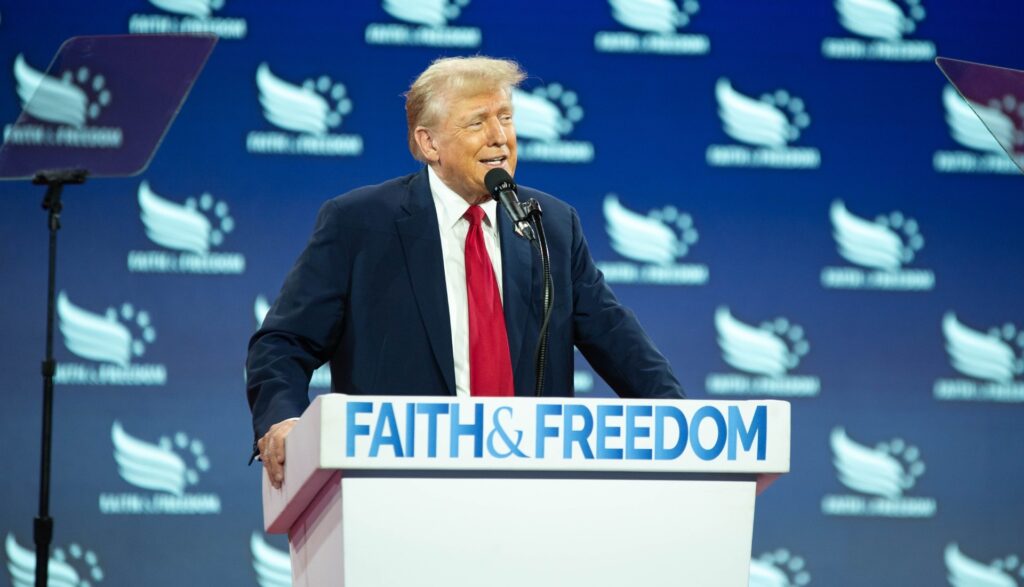
Ralph Reed, chairman of the Faith & Freedom Coalition and a longtime Republican strategist, told Heartlander News that he expects the threat of radical Democratic progressives will help motivate religious voters – and more – heading into the midterms. The messaging may resonate with swing voters and grassroots conservatives alike and could make a real difference given that voters who typically turn out for President Donald Trump in presidential elections often skip midterms, Reed said.
The faith coalition has become part of the “furniture” of the center right, Reed said, noting that despite the “Christian nationalist charges” coming from the left, Christians have “earned their place at the table.”
Reed predicts religious voters will remain “a critical part of the Republican governing coalition” under Trump and “any successor.”
He noted that this year’s Road to Majority conference in June, which mobilizes pro-faith, pro-family conservatives, drew its largest crowd yet of over 2,600 attendees.
At the conference, Trump pointed to the recent election of self-described socialist candidates in New York City – which took place that same month – as evidence of what he called “the most serious threat to our country since its existence.”
“They’re communists, they’re not social Democrats, [and] they want to completely destroy the traditional American way of life,” Trump said.
When asked about Trump’s messaging on radical progressives in the Democratic Party, Reed told Heartlander News that Democrats “walked into the punch” with the results of New York’s primaries.
“I don’t think this is your father’s Democratic Party,” Reed said. “These are socialists, in some cases communists, in some cases open anti-Semites, in some cases open supporters of terrorist proxies of Iran, like Hamas. And it’s deeply troubling.”
Reed added that any Democrat trying to assuage concerns that this is only happening in New York “is going to be in for a very big surprise” over the remaining primaries between now and the general election.
He pointed to former Maine Senate candidate Graham Platner – whom he described as “a very radical candidate who supports socialist policies and has a Nazi tattoo” – as evidence of a broader pattern.
Michigan’s Democratic Senate primary produced another progressive contender in Abdul El-Sayed, who has distanced himself from the Democratic Socialists of America (DSA) though the Washington Free Beacon first reported that Metro Detroit’s DSA chapter once referred to El-Sayed as a “longtime friend.”
Reed’s overall expectation for November is that it will be “a very competitive, very hard-fought, and I think probably a very close midterm election in both the House and the Senate.”