‘Jesus’ Law’: How Christians changed culture, defended unborn children through faithful conduct
Murdering unborn children has been a societal sin for millennia, and only Christianity’s moral principles and the work of Christians ended such practices.
That’s according to Samuel Elliott,…
Murdering unborn children has been a societal sin for millennia, and only Christianity’s moral principles and the work of Christians ended such practices.
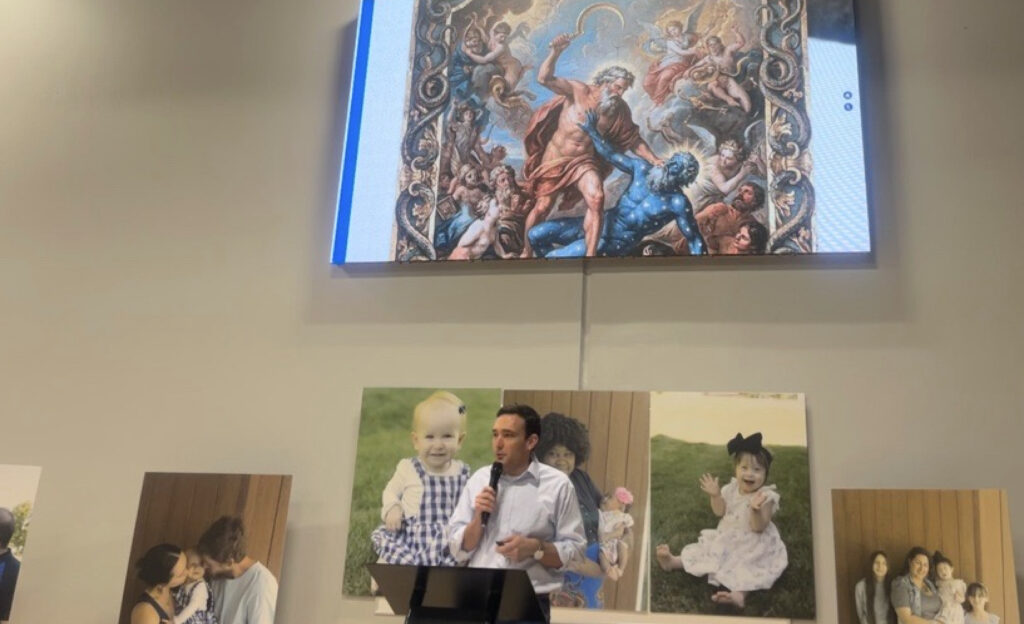
That’s according to Samuel Elliott, deputy solicitor general at the Office of the Florida Attorney General, who spoke to a gathering of local Missourians Thursday night, offering encouragement for Americans fighting against abortion today.
“If you think about what they did in ancient Rome, nobody was out there trying to win a Supreme Court battle in ancient Rome. They were just caring for people,” Elliott said, referencing early Christians. “They were just selling their extra land so that they could pay for an orphan to have a place at the orphanage. And that sort of moral example changed people’s hearts, brought people to Christ. And then once you have that, then the pro-life sort of just comes after that.”
Elliott offered a 60-minute fly-through history lesson on societies’ views of the unborn and abortion in his presentation, The Silent Thread, hosted by Parkville Women’s Clinic at Northland Christian School, where Elliott graduated in 2012.
The ancient Greeks’ and Romans’ view of the unborn
He recounted ancient Greek myths, later adopted in Roman society, that detailed gods eating their newborn children to prevent a future uprising. The myths frame the value system of these ancient societies and even impacted their laws. “Zeus’ law” – the idea of showing hospitality to strangers – derived from the fear that the god Zeus may be in disguise, coming to Earth to prey on human women, Elliott explained.
Ancient Greeks didn’t merely permit abortion and infanticide in their myths; they sought means to accomplish the murders in their society. Chemical abortion, a familiar topic in 21st century America, also existed in ancient Greece, Elliott explained.
Coinage from the city of Cyrene featured a rare herb, silphium, that was known to both prevent conception and dispose of an existing child in the womb, Elliott said. For procedural abortions, the ancient Greeks used a long, hockey-shaped stick to pry open a woman’s uterus, cut a baby into pieces, and scoop out the remains.
“Things, in some ways, haven’t really changed much in 2,500 years, except now that chemical abortions come in a box with an FDA [Food and Drug Administration] label on them, and surgical abortions are accomplished with vacuum aspirators instead of hooks and knives,” Elliott said.
The Romans adopted Greek myths and customs and justified abortions and infanticide for the same reasons commonly used today: to hide adultery, financial burden and lifestyle. Children were abandoned on the roadside, leaving their fate “up to the gods,” especially if the baby was sick, deformed or the “wrong sex,” Elliott said.
While baby girls were more frequently abandoned than baby boys, a 1988 excavation in Ashkelon, Israel, found the remains of 100 male infants under a Roman bathhouse. Archaeologists and historians suggest the bathhouse operated as a brothel, and the resulting conceived children were either discarded if a boy or, if a girl, kept and groomed as future merchandise.
The radical shift of Christianity
Elliott only highlighted ancient Greek and Roman societies but noted the practice of infanticide was universal among the known world, including child sacrifice. Only one culture was an exception: the Hebrews, descendants of Abraham.
Elliott referenced numerous Old Testament passages that elevated the life of the unborn as equal to a grown man and detailed the Creator’s design and purpose for each life. Even more shocking, the God of the Hebrews took human flesh as an infant and later, this Jesus of Nazareth, would preach the radical principle of loving one’s neighbors and enemies.
“You shall love the Lord your God with all your heart, with all your soul, with all your mind. This is the greatest and first commandment, and the second is like it: You shall love your neighbor as yourself,” Elliott said, quoting Matthew 22:37. “So, there it is, Jesus’ law, not Zeus’ law, Jesus’ law. After Christ’s death and resurrection, Christians put Jesus’ law into practice. This included speaking up for the inherent value of every human child.”
Christianity quickly conquered the ancient world, but not through war and conquest, instead through converts applying these morals, Elliott explained, citing sociologist Rodney Stark. Christians cared for the sick in times of plague while others fled; they sheltered abandoned children, and Basil of Caesarea opened the first orphanage in the fourth century. Eventually, Christianity became the religion of the Roman Empire, and with it, abortion and infanticide became illegal, Elliott said.
19th century America
But despite its outlawing, abortions were still practiced even in 19th century America. From roughly 1840 to 1878, Charles and Ann Lohman conducted more than 8,000 abortions across Boston, New York City and Philadelphia for an approximate sum of $600,000, or about $24 million in today’s economy, Elliott said.
Elliott examined the 1800s and the cultural landscape and views of the unborn during the passage of the 14th Amendment. Much of the legal debate surrounding abortion depends on the 14th Amendment, which states, “nor shall any State deprive any person of life, liberty, or property, without due process of law; nor deny to any person within its jurisdiction the equal protection of the laws.”
Pro-abortion arguments say the 14th Amendment’s definition of “person” does not include the unborn, but the pro-life stance argues it does. Elliott said cultural context helps determine how the 14th Amendment does in fact apply to unborn children.
“So, the idea is that you’re trying to figure out what the words of the statute meant to the people who actually enacted them,” Elliott explained. “That’s the question: who’s a person for purposes of the 14th Amendment, what we want to know is what did the people who ratified the 14th Amendment think that those words meant.”
Improved scientific technology in the 19th century revealed the development of a child in the womb from the earliest stages. Physician Horatio Robinson Storer built upon these discoveries to lead the Physicians’ Crusade Against Abortion. Storer also served as chair of a committee on criminal abortion for the American Medical Association and published a report in 1859 that defended the existence of fetal life from conception and condemned abortion as a crime “both against our Maker and society,” Elliott summarized.
From 1848 to 1868, 28 of the 37 states enacted laws against abortion at any stage of pregnancy, and nearly all of them referenced the unborn as either “a child or a person,” Elliott said. The 14th Amendment was passed “against this backdrop” in 1868.
“The idea that the people who ratified the 14th Amendment viewed preborn babies as sort of ‘non-persons, less than persons,’ is just completely inconsistent with the history of the pro-life movement in America,” Elliott said. “Preborn children have an inalienable right to life under our federal constitution and our state constitutions.”
Abortion in America today
But despite the legal protections, American society still rejects the fundamental reality of life in the womb and murders more than 1 million babies each year.
“Americans as people have utterly failed to protect the most vulnerable members of our society,” Elliott said.
In fact, after the Dobbs v. Jackson Women’s Health decision in 2022, which returned the abortion question to the states, abortions have increased both through states enshrining it in their constitutions and the increased use of mail-order chemical abortion pills, Elliott explained.
“So, Dobbs did not usher in a golden age for the sanctity of life, and in fact, by some metrics, the pro-life movement is worse off now than it was before Dobbs,” he said.
More states have passed laws protecting abortion than outlawing it, Elliott said. Missouri is one of them, but state voters have a unique opportunity to reconsider that law in the general election Nov. 3. Amendment 3 asks Missourians whether abortion should be illegal in all cases except rape and incest and whether sex-transition surgeries should be illegal for minors.
While Parkville Women’s Clinic emphasized the event was not a political endorsement, the clinic, as a pro-life organization, encouraged attendees to vote on the amendment in November. Elliott also encouraged the audience that, while the stakes are high and the cultural push for abortion seems bleak, faithful Christians changed Roman laws and practices by simply acting upon their morals.
“The biggest takeaway is just looking at it a different way and not fighting in the courts, but changing the culture,” Gena Kirkham of Parkville Women’s Clinic told Heartlander News after the event.
(Image credit: Michaela Estruth/Heartlander News)