Analysis: With 40 days to midterms, affordability and Trump seize the stump
With 40 days remaining before the U.S. midterm elections, Democrats and Republicans are locked in a battle over how to improve affordability for Americans.
Democrats are rolling out plans…
With 40 days remaining before the U.S. midterm elections, Democrats and Republicans are locked in a battle over how to improve affordability for Americans.
Democrats are rolling out plans reprising many of the policies under former Presidents Obama and Biden: raising the minimum wage, subsidies for Obamacare, green energy mandates and expansion of Medicare and Medicaid.
Republicans are proposing suspension of the gas tax while arguing many of the Trump administration policies, such as comprehensive tax cuts, have helped.
Both parties face unhappy voters, with congressional approval falling near all-time lows.
For Republicans, election history is also against them. Since 1934, the president’s party has lost an average of 27 U.S. House seats and three U.S. Senate seats in midterm elections.
With the GOP holding a four-seat lead in the U.S. House and a three-seat lead in the U.S. Senate, the odds look daunting.
Republicans must also overcome a war with Iran unpopular with voters, which has pushed oil prices up over $100 a barrel, raising American ire over the price at the pump.
“Gas prices matter because they’re one of the few economic indicators voters experience and see in real time,” veteran Republican strategist Chris Wilson told ABC News. “The price is literally staring them in the face several times a week. So I wouldn’t minimize the frustration we’re seeing, particularly among working- and middle-class voters.”
A substantial number of surveys show Democrats in the lead on congressional ballots.
“Voters say they prefer the Democrat to the Republican in their district by an average of 7 points in new polls (49%-42%),” reported Fox News.
However, Democrats come into the contest with blemishes of their own.
The party is in turmoil over the recent immigration of so many Democratic Socialists as candidates under the Democrat label, which threatens to alienate both Hispanic and black voters.
Who owns affordability?
Then there is the debate over affordability and how much of the issue Democrats own.
Affordability is largely unfinished business from the Biden administration, which saw inflation rates move higher than at any time since the 1970s and early 1980s wave of stagflation.
“Inflation roared back, shrinking the value of workers’ paychecks,” noted FactCheck.org about the Biden presidency. “Consumer prices rose 21.5%. Gasoline alone rose 31%. After adjusting for inflation, private-sector average weekly earnings shrank 4%.”
President Donald Trump addressed affordability extensively in his midterm convention speech in Dallas this month, arguing his tax cuts, which also eliminated taxes on tips and taxes on 88% of people receiving Social Security, were affordability measures.
Trump also promised a $5,000 dividend payment to all Americans, which could go a long way toward addressing voters’ affordability concerns.
He also called on Congress to pass his Great Healthcare Plan.
The plan would bring down drug prices and send subsidies directly to the insured so they could shop for insurance, rather than to the insurance companies.
In his speech, Trump said, “The insurance companies own the Democrats.”
Oil prices and Iran
In the meantime, the president seems determined to take the Iran war – which has caused oil prices to skyrocket – to a final resolution before he finishes his presidency.
“If we stand united,” the president told the United Nations General Assembly Tuesday, “we will soon see a world free of the last 51-year menace of Iranian terror and oil prices will come plummeting down even lower than they were at the start of the conflict, and they were very low; in the United States they were really low.”
He’s not completely insensitive to oil prices, but some in his party are demanding the Iran war end immediately. They also support emergency measures to bring down fuel prices.
“The war with Iran needs to end and end quickly,” said Republican U.S. Senate candidate Michael Rogers. “When it does, energy costs will plummet. But Michigan families can’t afford to wait for that to happen. We need to do something now.”
Rogers, who is locked in a tight race with Democrat Abdul El-Sayed for Michigan’s open Senate seat, proposed the suspension of gas taxes, in addition to embargoing exports of diesel fuel to help farmers.
Trump said he supports the gas tax suspension, which could save drivers up to 70 cents per gallon (or 17% over current prices), according to Rogers.
“I think the GOP is campaigning on affordability, but the economy is stumbling over oil prices and the war in Iran,” Tony Marsh, a conservative political consultant at Savanna Communications who worked on Winsome Sears’ lieutenant governor race in Virginia, told Heartlander News.
Differing approaches
The varying campaign approaches highlight a key difference between Democrats, their Democratic Socialist allies and the GOP.
Democrats are much more willing to adopt interventionist policies to manage the economy through tax credits, subsidies and price controls than Republicans, who favor putting money directly into the pockets of taxpayers.
The New Democratic Coalition, made up of Democratic members of Congress, argues for raising the minimum wage, expanding subsidies for Obamacare, expanding Medicare and Medicaid, providing more green energy subsidies, price controls on pharmaceuticals, tax credits for home purchases and federal laws that suspend local zoning, as part of its plan to restore affordability.
El-Sayed calls his affordability plan “Money in Your Pocket.”
To make life more affordable, he would have the federal government take over health care under Medicare-for-All, tax billionaire wealth, restrict construction of data centers, increase federal funding for education and import more foreign workers for farming.
None of the money in his “Money in Your Pocket” plan goes directly to Americans. It would all go to the government or a special interest first.
When asked by CNN moderator Kaitlan Collins whether he supported actual money in the pockets of Americans via Trump’s one-time dividend payment, El-Sayed was clear about his opinion on Trump.
“Look, he’s trying to bribe people, trying to literally bribe American voters,” he told the CNN host.
Critics say the Democrats do the same – just with more style and rhetoric.
“Their ‘industrial policy’ sounds good on paper, but that’s exactly the problem,” noted the progressive magazine The Nation last year, accusing Democrats of “political-economy cosplaying.”
The Trump factor
One of the few Republicans to go on the record about Trump messaging for the midterms admitted gas prices especially are hanging over the GOP.
But he noted Trump – and Trump alone – can turn out low-propensity voters among Republicans, which is important in a midterm race where the party in power historically is not expected to win.
“From a Republican perspective, hopefully the convention helped get some of those folks who haven’t turned out for the last two midterms to get them to turn out this time,” Wisconsin-based GOP strategist Mark Graul told Politico. “They’ve shown that they don’t care about the other stuff, right? These are folks who are incredibly loyal to Donald Trump, and they’ve been loyal to him for three straight presidential elections.”
Turnout will likely be the key. And history might be instructive, too.
In November 2022, with inflation raging at 7.1%, twice its current rate, and President Biden being statistically as unpopular as Trump is today, some were forecasting a Republican wave election.
But Democrats turned out youth voters in near-record numbers, blunting the GOP majority.
Unsurprisingly, Trump characterized himself as unique, asking voters to imagine he’s on the ballot during the midterms.
“When I’m running, we get tremendous numbers of votes and people coming out,” Trump said. “But when I’m not running, it’s a little different.”
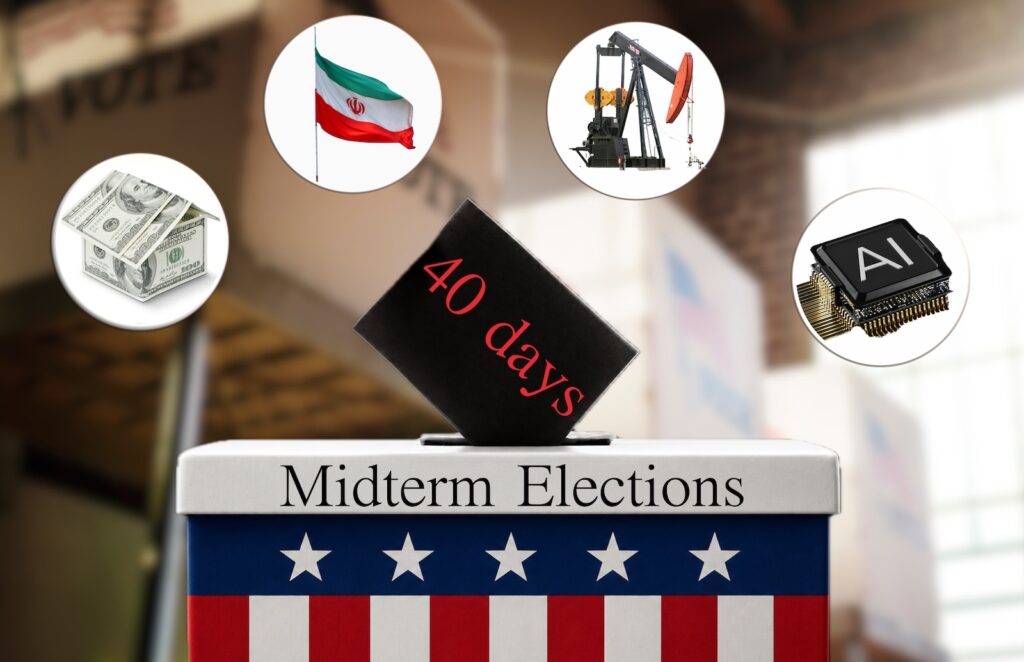
(Image credit: Created by Kaylee Obisesan/Heartlander News, using stock and public domain images)