Analysis: Democrats, Trump clash on AI policy, highlighting failure of progressive electric economy
Democrats have seized on uncertainty surrounding artificial intelligence (AI) to attack the Trump administration and potentially create a policy fracture among Republicans ahead of the midterm…
Democrats have seized on uncertainty surrounding artificial intelligence (AI) to attack the Trump administration and potentially create a policy fracture among Republicans ahead of the midterm elections.
Data shows, however, that liberals may be highlighting the failures of the top-down, centrally planned, electric-dominated economy they envisioned going back to Obama, in contrast to the rapid success the free market delivers in driving change.
In his first policy speech as part of the Trump administration, Vice President JD Vance argued that the administration’s AI policy was key to the reindustrialization of America.
“AI, I really believe, will facilitate and make people more productive,” Vance told a gathering of European leaders. “It is not going to replace human beings.”
Instead, Vance, a former tech venture capitalist, highlighted the productivity benefits AI will produce.
Democrats, on the other hand, have played on Americans’ fears of the technology.
“AI threatens to supercharge this divide: tech executives have warned that AI could lead to ‘a level of wealth concentration that will break society’ and create a ‘permanent underclass,’” U.S. Sen. Elizabeth Warren, D-Massachusetts warned this week.
Feeding on fears
Liberals have taken local, not-in-my-backyard objections surrounding electricity prices, water, zoning and transmission, noise, environmental concerns and jobs churn to amplify worries that AI will kill employment and one day kill humanity.
Experts inside AI and the administration are pushing back on the claims, saying they are exaggerated or downright false.
“There will be no AI jobpocalypse,” said Andrew Ng, who helped Google develop its AI and is an adjunct professor at Stanford University. “The story that AI will lead to massive unemployment is stoking unnecessary fear.”
In fact, Ng said AI will lead to job gains.
Insiders point to Connecticut-based Quantum Cyber, which just installed 80 3-D printers controlled by AI to manufacture drones it previously manufactured in limited quantities.
The upgrade has allowed the company to buy a 50,000-square-foot facility where it hopes to manufacture 100,000 military drones annually.
The company plans to add 80 jobs to the 35 it currently employs.
Democrats, on the other hand, are proposing regulations on AI that could leave communities and workers vulnerable.
Heartlander News previously reported that Loudoun County, Virginia, adjacent to Washington, D.C., has reduced property taxes significantly thanks to tax revenue created by data centers, making it one of the few places in the country where property owners are getting tax relief. Yet multiple municipalities are considering or have passed data center bans.
The fear is also impacting education.
New York Democratic Mayor Zohran Mamdani wants to prevent young students from even using AI, putting them at a considerable disadvantage when they enter the workforce.
“In an increasingly AI-driven economy, every worker will need baseline AI literacy skills to succeed, regardless of industry or occupation,” the U.S. Department of Labor noted earlier this year.
Chinese-fueled opposition?
The Information Technology & Innovation Foundation (ITIF) forecasted, after decades of American productivity stagnation, that the adoption of technologies such as AI and 3-D printing is key to increasing productivity and competing for jobs with China.
“This is particularly worrisome because China has significantly increased its production capacity in advanced industries and has already established leadership in many of them,” ITIF said.
Critics note that much of the apparent “grassroots” opposition to AI may have been manufactured by Beijing.
“AI panic is the new climate hysteria – and it’s handing the future to China,” wrote technologist Andrew I. Fillat and science scholar Henry I. Miller in the Washington Examiner.
Neville Roy Singham, the Shanghai-based American billionaire whom congressional investigators described this week as a central figure in a CCP-aligned influence network, has paid for 14 anti-AI campaigns through his Party for Socialism and Liberation, alleged the Bitcoin Policy Institute.
CBS News reports he’s currently under criminal investigation by a grand jury in the Southern District of New York for violations of the Foreign Agents Registration Act and for tax crimes.
For sure, legitimate practical concerns exist about AI.
But ironically, one of the most cited arguments may have just disappeared.
The battle over electricity
The U.S. House this week passed a bill requiring data centers to pay for their extra electrical generation needs instead of passing those costs along to ratepayers.
Many Americans have shared concerns about the impact of data centers on electricity prices and water supply, according to a new poll.
Ironically, this issue is important to liberals for data centers, but not for the electric economy Democrats have been pushing for two decades.
Democrat-controlled California, which has attempted to ban the sale of anything but electric vehicles (EVs) after 2035, previously estimated peak demand for data centers at 4.2-4.9 gigawatts by 2035.
By contrast, the state estimated peak demand for transportation electricity to be 3.5 gigawatts by 2035, lowering its 2024 estimate from more than 6 gigawatts by 2035 because the state has been unsuccessful in pushing adoption of electric-only vehicles.
Yet the state specifically says ratepayers are on the hook for the increase in transportation electricity as more EVs come online.
“Through the EV Infrastructure Rules, ratepayers cover the costs of service line extensions and electrical distribution infrastructure associated with EV charging,” notes the California Public Utilities Commission.
The contrast highlights the fundamental difference in approaches.
Democrats have relied on ratepayers, taxpayers and government mandates to build out their preferred electric economy, which thus far has disappointed even its supporters.
The Trump administration is betting private investment in AI will pay for the infrastructure needed to produce the productivity gains Vance says can reindustrialize America.
“I believe it will help us create and store new modes of power in the future, but right now, AI cannot take off unless the world builds the energy infrastructure to support it,” Vance said.
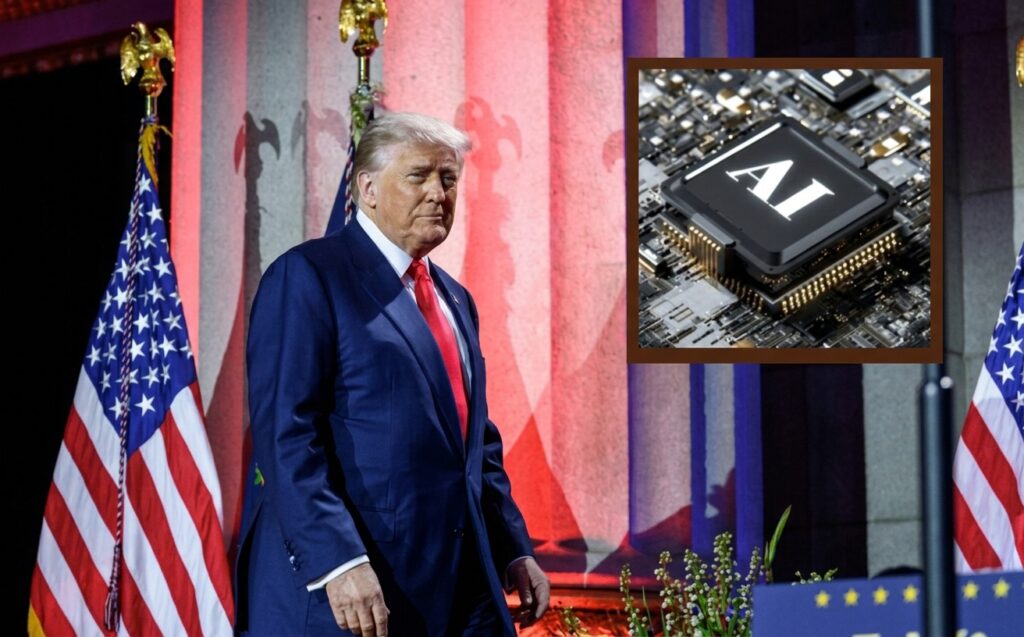
(Image credit: Trump attends AI summit; altered using Gemini AI)