Analysis: Direct Korean talks point to fraying U.S.-South Korea relations
South Korea is proposing direct military talks with North Korea, even as the U.S. has cooled toward engagement with the North, marking a potentially significant strain in the alliance.
The…
South Korea is proposing direct military talks with North Korea, even as the U.S. has cooled toward engagement with the North, marking a potentially significant strain in the alliance.
The election of Lee Jae-myung as South Korea’s president offers the Trump administration opportunities to press an ally to take more responsibility for its own defense, as previously reported by Heartlander News.
But critics now warn that the opportunity carries the danger that Lee is trying to move closer to China and North Korea diplomatically while disengaging from Washington.
“Our Ministry of National Defense officially proposes to North Korean authorities that South-North military talks be held,” South Korea’s deputy minister for defense policy said, according to the Associated Press (AP).
The talks would discuss the exact location of the ground military demarcation line between the South and the North, the restoration of military communication lines and measures to prevent accidental clashes in border areas, the AP said.
The proposal comes after a series of incidents, including border incursions by North Korea and a suspected mine explosion that the South says was caused by the North, injuring three South Korean soldiers.
Previously, U.S. President Donald Trump proposed direct talks with North Korea on nuclear weapons but has grown cold toward joint Korean talks after being rebuffed by the North.
At the same time, the U.S. began restricting the sharing of military intelligence with the South, especially on North Korea’s nuclear enrichment, according to widely published reports.
The restrictions may mark a wider rift.
U.S. Secretary of State Marco Rubio previously expressed concerns about intelligence sharing with South Korea’s ambassador to the U.S., Kang Kyung-wha. Kang later expressed frustration that she couldn’t reach senior members of the White House about the change, according to Korean media reports.
Lee has made the atmosphere more difficult by publicly commenting that his country was engaging in “pragmatic diplomacy that serves the national interest.”
South Korean conservatives have been rallying against the leftist Lee government, which they claim illegally deposed the previous government and is relying on Chinese cooperation to foster unification between South and North Korea.
Former President Yoon Suk Yeol, a conservative, was removed after he declared martial law, invoking powers given to him under the constitution, following 29 impeachment attempts targeting his government by Lee’s opposition party.
In addition to the general clampdown on social media, the Trump administration has also expressed concern about the prosecution of Son Hyun-bo, a South Korean pastor who was arrested for speaking out on behalf of Yoon.
More troubling is the criminal defamation case against former Trump administration official Morse Tan, who is being prosecuted in South Korea for critical comments he made in the U.S. against Lee at the Washington Press Club, Fox News reported.
Tan said the prosecution is purely political because he is an outspoken critic of the Lee regime’s “alleged appeasement policy” toward North Korea.
“People consider me to be leading a movement against the communizing of South Korea,” Tan said.
An attack on democracy?
Gordon G. Chang, a prominent anti-Chinese communist activist, said South Korea is on its way to becoming an authoritarian regime, citing its attempt to ban social media giant X.
“The Democratic Party of Korea is attacking Korea’s democracy,” Chang wrote on X. “It is, among other things, ending free expression.”
He warned, “China has totally infiltrated South Korea.”
The diplomatic and internal conflicts come as Lee is seeking to regain wartime operational control of the U.S. and South Korean militaries on the peninsula.
“To put it plainly, we should take back wartime operation control at an early time,” Lee told reporters, according to Reuters. “We are fully capable of it and discussions with the US are basically going well.”
But not everyone in South Korea is comfortable with the implications this would have for the U.S.-South Korea alliance.
Some in South Korea believe that Lee, by insisting on early control over U.S. and South Korean military forces in the country, is attempting to consolidate power by forcing U.S. troops to leave the country.
The opposition conservative People Power Party (PPP) has warned against turning over control of the military to Lee, citing U.S. opposition.
“When I recently visited the United States, I confirmed that many people in the US government, Congress and broader policy circles were concerned about the current state of South Korea-US relations,” South Korean Rep. Jang Dong-hyeok, a PPP member, said during a press conference with foreign correspondents, according to The Korea Herald.
Adding to concerns about democracy, the South Korean legislative assembly recently passed measures that would make it more difficult to investigate the president.
“The ultimate goal is to eliminate the president’s own trials,” Jang said.
Retired Gen. Robert Abrams, a former top U.S. commander in Korea, warned that imposing Korean control on the military has unforeseen risks.
“From my perspective and experience, I think there’s a lot of risk that hasn’t been properly been explained to everyone about hastening this and putting it on a timeline,” Abrams said.
The greatest risk, however, is to the alliance and Korea’s future as a democracy, said the opposition leadership.
“Many people are worried that the South Korea-U.S. alliance may collapse and that South Korea may be leaving the free world,” Jang added.
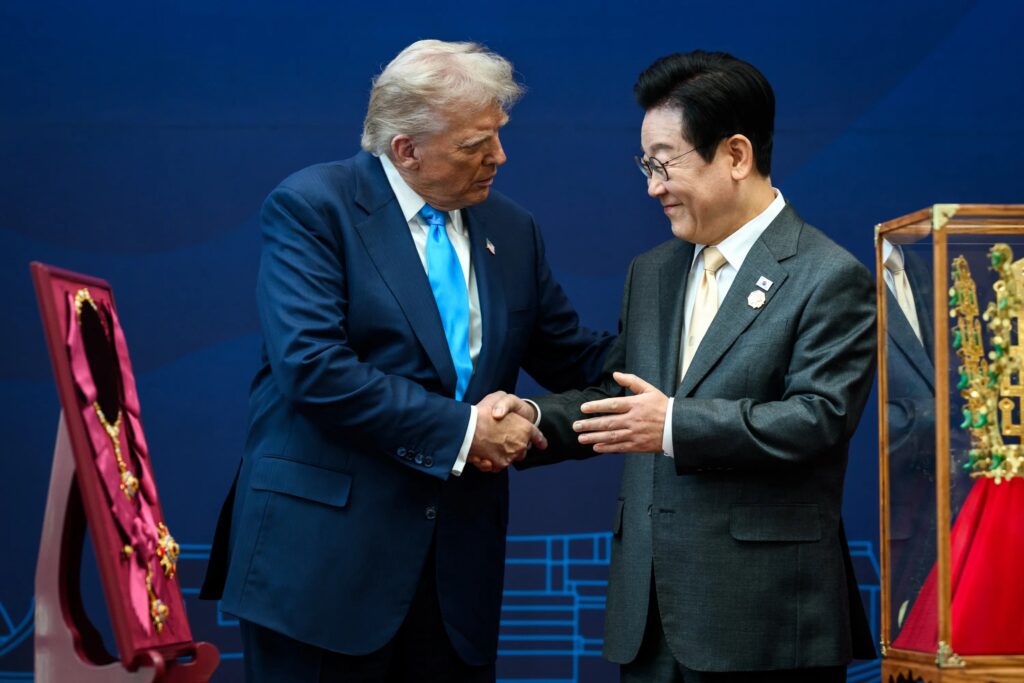
(Image credit: President Donald Trump and Korean President Lee Jae-myung)