Trump talks end of life, refuses to forgive enemies in 60 Minutes interview
President Trump told CBS columnist Ross Douthat in a 60 Minutes interview Friday that he hopes he goes to heaven when he dies but added that he cannot forgive his enemies.
“Well, I’m a…
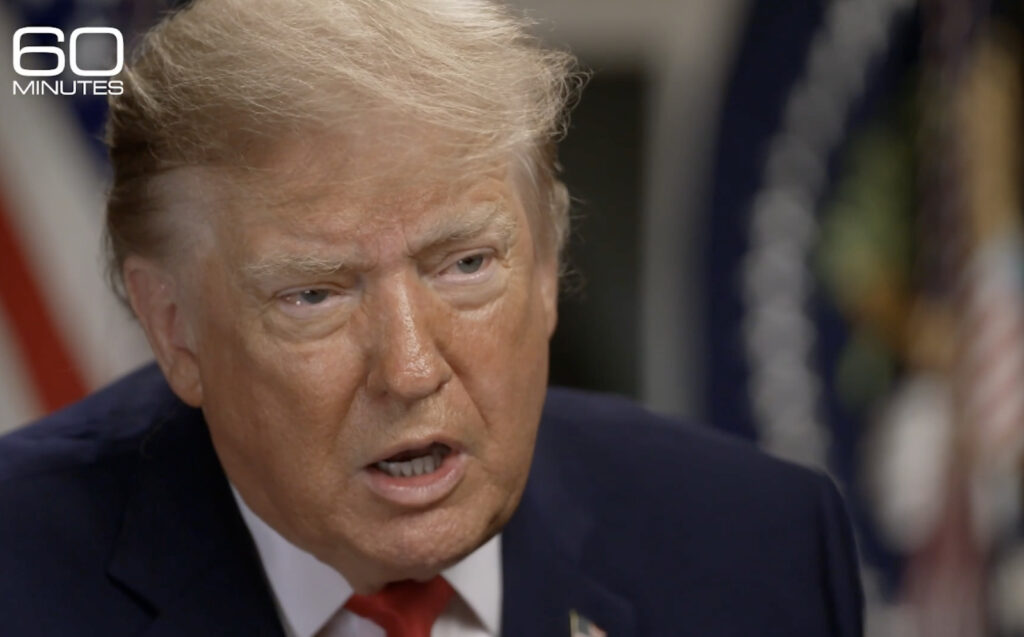
President Trump told CBS columnist Ross Douthat in a 60 Minutes interview Friday that he hopes he goes to heaven when he dies but added that he cannot forgive his enemies.
“Well, I’m a religious person, so in theory, I go to heaven,” Trump told Douthat in response to his question, “What do you think happens when you die?”
Douthat replied by asking Trump if he thinks he will go to heaven.
“I hope so. I don’t want to go to hell,” Trump said.
Douthat then turned to the topic of forgiveness, referencing Trump’s statements at the memorial service for Christian and political commentator Charlie Kirk, who was assassinated last September. At the memorial, Kirk’s wife, Erika, forgave her husband’s murderer in front of millions of people. Following her statements at the service, Trump said he hates his opponents and doesn’t want what’s best for them.
Douthat then asked Trump if he’d be able to “feel love and forgiveness for James Comey, Nancy Pelosi, anyone who you have expressed hate for over the years” if that’s all he needed “to do to enter paradise.”
“The answer is no,” Trump said, later adding, “I think they were very bad people, and I dislike – can use the word hate? – I do hate some of my enemies. I think they’ve been terrible.”
Trump joked, saying the question should be “easy,” but Douthat remarked twice that it was not an easy question, and yet the president’s blunt answer surprised him.
“Mr. President, you have had the most charmed and remarkable life of any American in my entire lifetime, and you are telling me that before the judgment throne of God, you couldn’t find it in your heart to forgive some of your enemies?” Douthat asked. “After all that’s been given to you?”
But Trump stood his ground and claimed:
“I mean, it’s such an easy answer. All I have to do is say yes,” he said. “I can’t. I again, I don’t, honestly. Can I be honest? I probably cannot do that now because I do hate some of my enemies, and I always will.”
Southern Baptist Theological Seminary President Albert Mohler discussed this exchange on his daily show, The Briefing, Monday morning. He praised Douthat for his boldness, calling it an “incredibly brave question” and a “revealing moment.”
Mohler also discussed Trump’s religious background, referencing the New York City church he attended, Marble Collegiate Church, and its “famous preacher,” the Rev. Norman Vincent Peale. Peale, often known for his book on “positive thinking,” claimed “prosperity as a sign of God’s blessing,” Mohler explained.
“So when I think about the influences in Donald Trump’s life, it does appear to me that that kind of prosperity theology, especially dressed up the way it was with Dr. Norman Vincent Peale, that probably had a lot of impact on him,” Mohler said.
Trump’s religious statements demonstrate a vague or even nonexistent “real acquaintance with the gospel of the Lord Jesus Christ,” Mohler said, adding that the president seems to self-evaluate on a general “cosmic scale of justice.”
Mohler called on his listeners and fellow Christians to pray for Trump, saying that the president is clearly surrounded by many genuine Christians but needs to truly hear the fundamentals of the gospel that offer grace, forgiveness and salvation through faith in the saving blood of Christ.
“I just want to remind Christians that when we’re thinking about this, we are not better people than the president of the United States because we can forgive our enemies,” Mohler said. “It is the right thing to do, but no one can do that without the grace of God. No one can do that without a work in our heart leading us to be able to forgive.”
Franklin Graham, president and CEO of the Billy Graham Evangelistic Association and Samaritan’s Purse, discussed the interview exchange on X, saying most people, like Trump, hope to enter heaven but must believe the good news of the Bible.
“But Heaven has borders. Heaven has unique and very strict entrance requirements,” Graham wrote. “To enter Heaven, the Bible tells us that you must acknowledge your sins, turn from them in repentance, and receive Jesus Christ by faith. That means, believe that Jesus Christ is God’s Son, that He paid the penalty for your sins by dying on a cross, was buried in a tomb, raised to life on the third day, and walked out of that tomb. He’s alive! If you put your trust in Jesus Christ, you will be in God’s presence for eternity. Religion can’t save you – only a relationship with the Savior, Jesus Christ, can save you.”
Mohler reminded his listeners that Trump’s hatred is “natural” for “the fallen, simple human man,” according to the Bible.
“Hatred is natural, and of course we understand that ultimately, theologically, the hatred is directed towards God,” Mohler explained. “But it is also very interesting that it is deeply human to keep score. And President Trump, I think he says basically all his life has known by his own judgment how to keep score, and he keeps score.”
But Mohler also emphasized Trump’s treatment of the questions, saying he did not discredit or scoff at the topic.
“I will say, interestingly enough, that President Trump didn’t treat the question as unimportant, and furthermore, his answers seem to be almost in a spirit of resignation. ‘Yeah, I could say I could do that, but I really can’t do that,’” Mohler said, paraphrasing Trump’s comments. “I just want to say to the president, no, you can’t do that, but the Holy Spirit of God can do that. But only when you have known the forgiveness of sins, and only on that basis do the sins of others against us take on an entirely new understanding. Those who have been forgiven much must forgive.”
(Image credit: Screenshot/X/60 Minutes)