EXCLUSIVE: Trump official says admin wants to unite the world in making permitting decisions through AI
Usha Turner, the head of the Environmental Protection Agency’s (EPA) Office of International and Tribal Affairs, told Heartlander News that the Trump administration wants to use artificial…
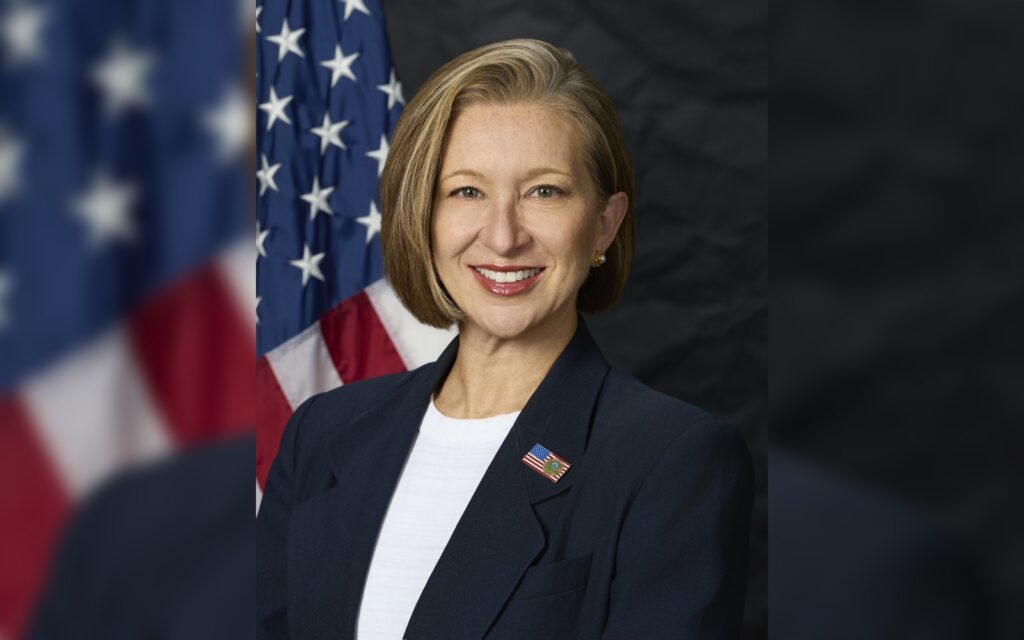
Usha Turner, the head of the Environmental Protection Agency’s (EPA) Office of International and Tribal Affairs, told Heartlander News that the Trump administration wants to use artificial intelligence (AI) to speed up permitting decisions.
“We need to move faster,” Turner said in an interview at the G20 Energy Abundance Ministerial Meeting in Houston on Wednesday. “We want to see AI utilized in our permitting decisions … We need to be able to figure out how to use AI to make strong decisions, so we’re not eliminating the human decision-making and objectivity that the human view needs to bring to a permitting decision, but how do we use AI to sort of churn through things and help us come to strong decisions and get there faster?”
Turner noted that her office serves as the EPA’s “lead diplomat, if you will” on international and tribal matters. She said the 20 largest economies in the world agree: regulators are getting “in the way” of the permitting speed needed for energy abundance and economic security.
The group includes China, Germany, Japan, India, Canada and Mexico, as well as the European Union. The African Union was added as a 21st member in 2023 but the name remains.
“Our supply chains have gotten ever more complex over the years,” Turner said, adding that every nation represented at the G20 meeting asked: “What are some of the things that we need to be looking at to make ourselves stronger?”
“Permitting reform was universally identified, which is amazing,” she said. “We think about permitting reform in the U.S. and it’s a big part of this administration’s focus, but to have it recognized and welcomed by the 20 largest economies in the world just sort of tells you” how urgent the pace of change must be in order to “underpin energy abundance [and] economic security.”
Turner added that “as the regulator community, we can get in the way – and that’s something that has been identified by all 20 members.”
When asked how tribal communities have responded to EPA’s recent deregulatory moves regarding the power sector, Turner said Navajo Nation President Buu Nygren had personally requested to attend the agency’s June 2025 unveiling of its move to repeal what critics dubbed the “Clean Power Plan 2.0.”
Turner said that Nygren was motivated to represent his community at the announcement because they want to maintain jobs at a coal-fired facility as they work to replace it with a gas-fired plant, a process that was hindered by the Biden-era EPA rule.
The Trump EPA finalized repealing most of the Biden administration’s greenhouse gas requirements for power plants this week in what the agency called the “largest power sector deregulatory action in U.S. history.” At the same time, the agency also proposed a separate rule to eliminate the remaining greenhouse gas regulations on the power sector.
The Trump administration has championed both deregulation and AI development, framing them as an economic boon and portraying the push to outpace China in the AI race as imperative. President Donald Trump has resisted pressure to support stringent regulations on AI, and wrote on Truth Social on Monday that there is a “sick conspiracy” against AI and data centers and “the only one that is happy about it is China.”
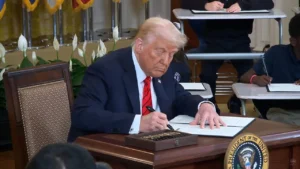
Trump, along with the world’s top tech leaders, signed the “ratepayer protection pledge” in March, which urges tech companies to provide their own power for AI. Some energy policy experts previously told Heartlander News that the pledge is a good start but questioned how it will be enforced moving forward.
Energy Secretary Chris Wright, when asked by Heartlander News at the G20 Meeting about tech companies bringing their own power to the grid, supported the pledge and framed data center growth as an affordability issue.
“If you look at the states in the United States, the states that have growing demand for electricity, whether it’s from data centers or onshoring manufacturing or growing populations – those are the states with the best price performance because they’re adding to their energy system,” Wright said.
(Image credit: Usha Turner, X/epaleezeldin)