Analysis: Trump’s strategy may aim at normalization in Korea, progress on Iran nukes
President Donald Trump scaled back joint exercises with South Korea just days before he noted with unusual certainty how many nuclear missiles North Korea possesses.
While many…
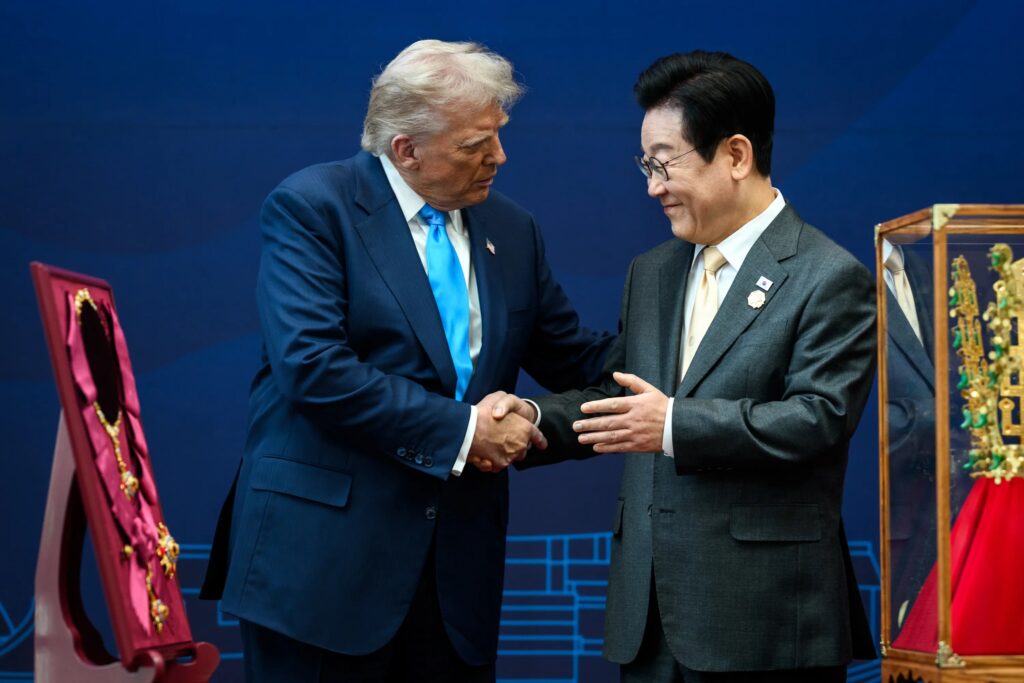
President Donald Trump scaled back joint exercises with South Korea just days before he noted with unusual certainty how many nuclear missiles North Korea possesses.
While many have characterized Trump’s moves on joint exercises simply as an attempt to punish South Korea for not cooperating with U.S. efforts to open the Strait of Hormuz, reporting shows Trump previously committed to reengage North Korea diplomatically.
The strategy may be to simultaneously work on normalization in Korea, as pushed by South Korea, while advancing the U.S. aim of preventing a nuclear-armed Iran.
The current South Korean government has been pursuing a strategy of normalization of its relationship with the North, seeking to go beyond the uneasy armistice negotiated in the 1950s.
“Let us put down our intentions to threaten each other and begin discussions to end the long-running war as the directly involved parties,” said South Korean President Lee Jae Myung, while celebrating in mid-August the 81st anniversary of the US-led liberation of Korea from Japan in 1945.
The two Korean countries have technically remained at war since the 1950-53 conflict.
During the G7 Summit in June, South Korean President Lee Jae Myung asked Trump to take the lead in restarting negotiations to reduce tensions on the Korean Peninsula, according to Reuters.
“President Trump expressed a strong determination to play a necessary role in advancing the Korean Peninsula issue,” said South Korea’s Yonhap state news agency, “and stated that he would consider ways to contribute to peace on the peninsula, adding that he would communicate closely with President Lee regarding this matter.”
While South Korea is likely to favor the denuclearization of the entire Korean Peninsula, Trump’s remarks, specifically noting how many nuclear weapons North Korea already possesses, could be a reminder that a nuclear-free Korea is now impossible.
At the same time, it may have been used to juxtapose South Korea’s commitment to the international community to look at nuclear non-proliferation in places such as Iran with as much favor.
“The fact that I get along with him, that’s a good thing,” Trump said of his relationship with the North’s Kim Jong Un, according to Fox News. “You can’t let Iran have a nuclear weapon. And I know Kim Jong Un very well, and he’s going to be fine as long as we have a smart president.”
Subsequently, Trump has floated an idea of a personal summit between himself and the North Korean leader, in line with their previous memorandum of understanding (MOU).
“Trump’s pivot toward engagement, however, may align with the MOU’s long-standing objectives, including the reduction of US-South Korea combined military exercises and broader deescalation measures,” said an analysis from the Institute for the Study of War.
While much of the coverage of North Korea’s response about a possible summit characterized the Kim family’s rhetoric as an outright rejection, Korea watchers are saying a meeting between Trump and Kim is possible.
Statements from Kim Yo Jong, the sister of the North Korean dictator who operates as a spokesperson for the country, didn’t say yes or no to engagement with Trump.
“As for the news from Washington that shortly ago, there was a communication between the leaders of [North Korea and] the U.S. I am not aware of it at all, and perhaps it may be the only thing I do not know as regards the foreign policy of our supreme leadership,” admitted Jong.
The ambiguity by the dictator’s sister may have left the summit door ajar.
“A steady stream of high-level North Korean statements and commentary indicates that Pyongyang will approach the United States within a wider strategic framework than it did during Trump’s first term,” said an analysis by 38 North.
That would make sense for a country that’s gone from having enough fissile material for nuclear weapons, to having close to or in excess of 60 nuclear bombs.
An analysis by the Center for Strategic and International Studies notes Kim has a lot to gain, even if just reminding the world that nuclear-armed North Korea is more consequential now.
Trump, on the other hand, can be simultaneously working towards pacification in Korea while advancing American interests in the Middle East by putting pressure on South Korea to help stop a nuclear-armed Iran.
Indeed, comments by South Korea in light of Trump’s criticism may make that scenario probable instead of possible.
“The government takes note of President Trump’s social media message,” the presidential office in Seoul said, stressing South Korea is “closely consulting with the U.S. on ways to make practical and military contributions” to peace with Iran.