Analysis: Trump’s Korean maneuver cancellation not a sign of US military strain
A look at the history of joint U.S.-South Korean military exercises should reassure critics who claim the Iran War is straining the resources of the American military.
President Donald Trump…
A look at the history of joint U.S.-South Korean military exercises should reassure critics who claim the Iran War is straining the resources of the American military.
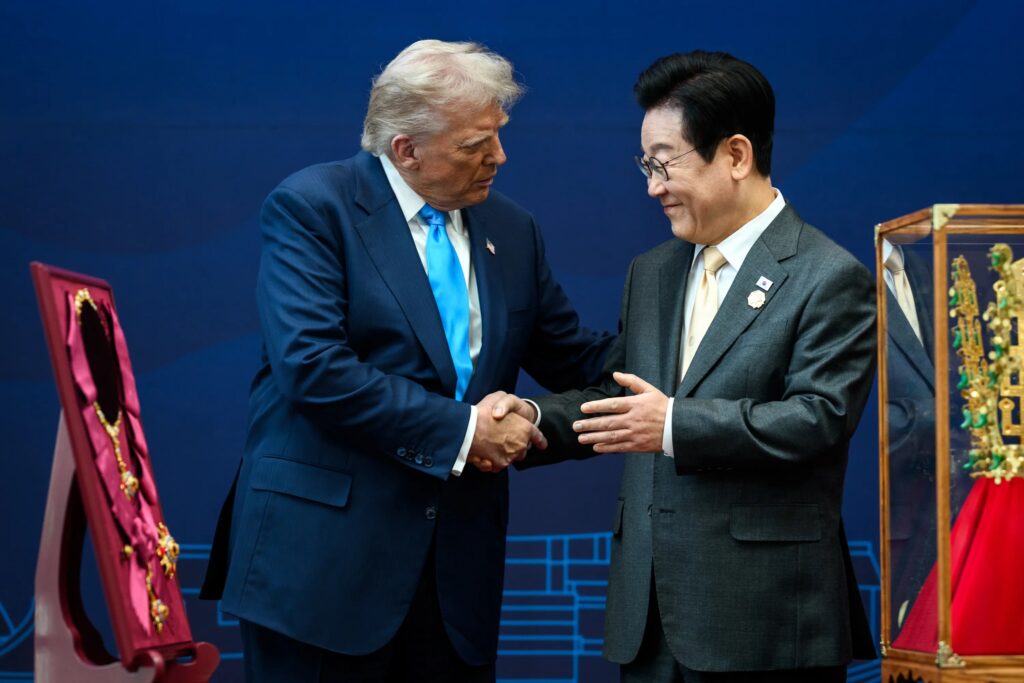
President Donald Trump announced that he was scaling back pending military exercises this year with South Korea because such exercises were “not only costly” but also “totally inappropriate and hostile” to North Korea, which he says, has been respectful while he’s been president.
A number of major media outlets, including CNN, have claimed the news of the scuttled war games “renews concerns U.S. forces are too stretched to support crucial Western allies or maintain deterrence against autocracies that threaten them” because of the conflict in Iran.
But the move is more likely a measure of diplomatic rather than military muscle.
In his post announcing the cancellation of the maneuvers, the U.S. president accused South Korea of not being supportive of his goals towards nuclear non-proliferation in Iran.
“I recently asked the President of South Korea if they would like to join us in the Denuclearization of the Islamic Republic of Iran, and they said, ‘No thanks!’” added Trump.
In 2018, Trump made a similar decision to cancel the Korean exercise dubbed Ulchi-Freedom Guardian and then terminated the annual exercise in 2019 as part of the diplomatic effort to engage North Korea.
On the face of it, the worries about an American military with too few resources to confront too many global threats is reasonable.
To address it, the administration has crafted a defense strategy that at least one analyst said puts “Europe fourth” among defense concerns, after the Western Hemisphere, the Indo-Pacific region and the Middle East.
That’s one reason why Trump has been anxious to deemphasize U.S. involvement in the war between Ukraine and Russia.
Trump has accused Europe of talking too much, and doing too little in their own defense.
“I think they’re weak,” Trump said of Europe’s political leaders.
And while much of the media has concentrated on the Iran conflict, known as Operation Epic Fury, as the impetus that depleted U.S. stockpiles of high-tech interceptor weapons such as the Patriot missiles, the missile supply has been under pressure because of the Ukraine war.
Heartlander News previously reported Ukraine has continuously complained about a shortage of Patriot missiles since the U.S. started providing the high-tech air defense technology in 2023.
Unlike the Afghan War from 2001 to 2021, and the second Gulf War from 2003 to 2011, where the major resource strain came from ground forces in those countries, the U.S. is fighting an air war with limited naval forces as it confronts Iran this year.
“Operation Epic Fury has objectively been a remarkable display of deep strike, naval control, and the rapid suppression of Iranian capabilities with airstrikes and sea-launched weapons,” observed the Modern War Institute. “It is no surprise that the public narrative defines it as an air and maritime campaign.”
But the Institute warned that naval power might not be enough. It might come down to ground troops.
And here’s where the problem is more apparent: the force realignment under Obama-Biden shrunk the number of ground troops, which have limited American response options across the globe more than any other constraint.
Writing for Brookings, Michael E. O’Hanlon sketched out scenarios in 2014 – including a Russian invasion of European borderlands, an attack on the Korean Peninsula, a Chinese war that would involve Japan or the Philippines, the Iranian threat of nuclear weapons, civil war in Nigeria and criminal networks operating in Central America – a combination of which that could limit U.S. options specifically because American ground forces are too small.
“All of the above strike me as, while improbable individually, far from unthinkable,” said O’Hanlon.
Twelve years later, while none of them have been ruled out as impossible, many of them, including the Iranian threat, the Nigerian Civil War, criminal gangs operating in central America, and importantly, a Russian invasion of Ukraine, have come to pass, simultaneously.
The major problem for U.S. commitments around the world today isn’t that the U.S. Navy is too small or the U.S. has too few high-tech interceptors.
The problem is U.S. ground forces have been made smaller since the mid-2000s.
O’Hanlon warned against counting on combined ground troops of just 450,000, noting it would be 10% below the Clinton era, and 20% below the Bush-Obama era.
The fiscal year 2026 budget notes that U.S. regular ground forces are currently at 454,000.
One persistent problem seems to have been solved.
The U.S. was dealing with a shortage caused by military recruiting difficulties.
Fox News reports that military recruitment has hit a 15-year high under Trump.
But still, the overall ground troop numbers have to be larger, experts say, if the U.S. wants to cover all of the potential hotspots, and that has nothing to do with the Iran War, or the Korean war games.
Eric Edelman, a George W. Bush-era under-secretary of defense for policy warned lawmakers in 2024 that the army was too small for the combined missions.
“We have to have an Army that’s sufficiently large that it can operate in all of these places simultaneously,” he said.