Analysis: Hormuz control presents ‘either-or’ options on regime change for Tehran
Commercial shipping continues to transit the Strait of Hormuz, according to a U.S. Central Command official, but whether the strait remains open could increase pressure for regime…
Commercial shipping continues to transit the Strait of Hormuz, according to a U.S. Central Command official, but whether the strait remains open could increase pressure for regime change in Iran.
“Traffic continues to flow through the Strait of Hormuz,” Capt. Tim Hawkins, a CENTCOM spokesman, told Al Jazeera.
But the U.S. Navy’s ability to keep the strait open indefinitely may prove difficult without Iranian cooperation, according to U.S. Navy records, insurance market data and President Donald Trump’s own statements.
Some analysts argue Iran’s willingness – or refusal – to allow free passage through the strait could reshape calculations in Washington and other capitals about whether regime change in Tehran has become a more desirable outcome.
Trump has repeatedly said regime change is acceptable, and even preferable, if it comes from the Iranian people rather than through U.S. military intervention.
Others argue it should become an explicit U.S. war aim.
“For me they need to accept regime change is the only way they can guarantee” the objectives Trump has outlined for the war, Sky News defense analyst Peter Jennings said.
More than one-quarter of the world’s seaborne oil trade and about one-fifth of global liquefied natural gas trade normally pass through the strait, according to the U.S. Energy Information Administration.
That gives the waterway an outsized effect on global energy markets, even though the United States is not dependent on oil shipped through the strait.
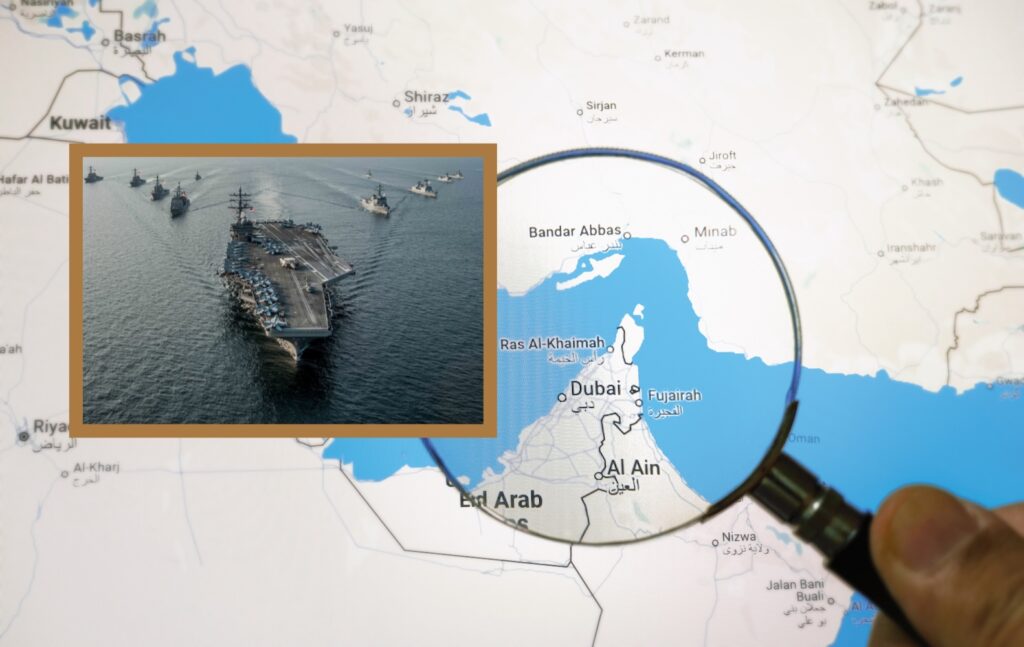
More than 20 U.S. warships, including two carrier strike groups and an amphibious ready group, are enforcing the reinstated blockade of Iran while allowing commercial traffic through the strait to non-Iranian destinations, according to The War Zone.
The renewed blockade covers Iran’s coastline while permitting neutral shipping to transit the strait, according to a U.S. notice to mariners.
“CENTCOM forces will enforce the blockade against vessels transiting to or from Iranian ports and coastal areas,” the notice said. “The U.S. military continues to support traffic flow through regional waters for all vessels not violating the blockade.”
Iran hopes to challenge access to the strait with naval mines, missiles, drones and swarm craft, according to Baird Maritime.
CENTCOM says five months of U.S. and Israeli strikes have degraded Iran’s missile and drone capabilities. But analysts note the greatest remaining threat is also the one least vulnerable to airstrikes: naval mines.
The threat of mines
Even if U.S. forces reopen the strait militarily, they cannot guarantee Iran has not laid additional mines.
Reuters reported Iran deployed roughly a dozen mines in the strait earlier in the conflict.
According to U.S. Navy records, even a single mine can effectively disrupt shipping.
During Operation Earnest Will, U.S. warships escorted reflagged Kuwaiti tankers through the Persian Gulf between July 1987 and September 1988.
When the USS Samuel B. Roberts struck an Iranian mine in April 1988, the blast tore open the frigate’s hull and nearly sank the ship.
The United States responded with Operation Praying Mantis, destroying Iranian naval vessels and military infrastructure.
But retaliation did not eliminate the remaining mines.
“The threat of mines in the area remains a concern immediately as well as further down the line, and mine-free routes need to be established,” Jakob Larsen, chief safety and security officer at BIMCO, the world’s largest shipping association, said following the recent ceasefire.
Larsen said maintaining safe shipping lanes ultimately requires cooperation from both the United States and Iran.
Even a single mine strike could drive insurance premiums high enough that commercial shipping companies stop using the strait, effectively closing it without a formal blockade.
The Irregular Warfare Initiative argues Iran has already demonstrated that insurance costs can become an asymmetric weapon.
“Insurance closed the strait before Iran’s Islamic Revolutionary Guard Corps navy did,” the organization said, referring to disruptions in commercial shipping earlier this year.
Trump’s demands that Iran guarantee free passage through the strait have often been paired with threats of military action.
“If Iran doesn’t FULLY OPEN, WITHOUT THREAT, the Strait of Hormuz, within 48 HOURS from this exact point in time, the United States of America will hit and obliterate their various POWER PLANTS, STARTING WITH THE BIGGEST ONE FIRST!” Trump wrote in March.
The ceasefire that allowed negotiations to continue ultimately broke down over Tehran’s demand to control passage through the strait rather than over its nuclear program, marking a significant shift from Iran’s prewar position.
The United States may be able to degrade Iran’s nuclear capabilities. Control of the Strait of Hormuz, however, presents a binary question: Either Iran retains the ability to determine who passes through the waterway or it does not.
Some analysts argue that reality could move regime change from an unacceptable option to one receiving greater consideration in Washington and other capitals.
Alexandru Hudisteanu, a former NATO maritime officer, told Al Jazeera that closing the Strait of Hormuz would increase the likelihood of regime change because more countries would have a direct interest in removing the threat.
“The status of Iran on the international stage will decrease consistently to the pariah state” if Iran insists on controlling the strait, he said.
Dr. John V. Bowlus, an energy geopolitics analyst, framed the choices even more starkly.
“Barring regime change in Iran or a durable diplomatic resolution to the closure of the Strait of Hormuz,” Bowlus said, “the West is now facing its most fundamental challenge to its energy security since the Arab-Israeli wars of the 1950s, ’60s, and ’70s.”