Virginia re-evaluates standing as U.S. ‘laboratory for education policy,’ outlines ongoing challenges in student outcomes
As the nation prepares for its 250th anniversary, the Old Dominion State serves as a microcosm of the present and future problems facing public education, according to a recent analysis.
“In…
As the nation prepares for its 250th anniversary, the Old Dominion State serves as a microcosm of the present and future problems facing public education, according to a recent analysis.
“In the 250 years since America declared its independence, changes in policy, instruction, and technology have continually reshaped Virginia’s public elementary, middle and high schools,” wrote Nathaniel Cline for the Virginia Mercury.
Those changes include standardized assessments, lower academic outcomes and “hyper-politicization of schools,” according to the article.
“When we look at education in Virginia today, we’re investing a record level of funding, (and) our outcomes are getting worse,” said Delegate Mike Cherry, R-Colonial Heights. “I think we as legislators need to look at what’s working, what’s not, and whether we are willing to admit what isn’t working and be willing to change those things.”
How standardized assessments became a ‘detriment to the learning environment’
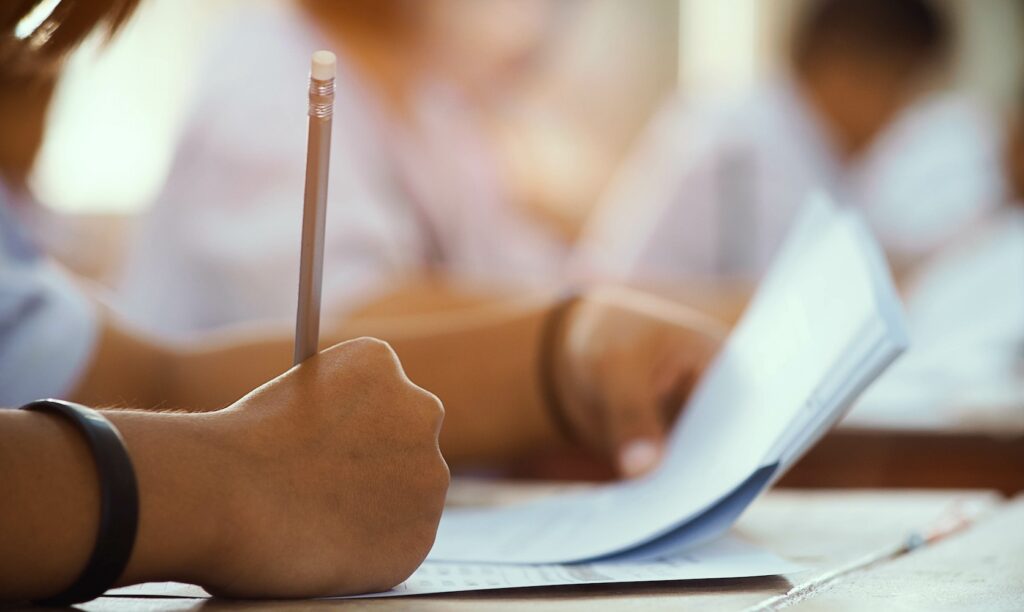
One of those areas involves student assessments, dating to 1995 in the state’s Standards of Learning (SOLs) to set baselines for academic achievement.
“The standards-based movement isn’t about standardizing education,” said Chris Jones, executive director for the advocacy group Virginia Association for Teaching, Learning and Leading (VATLL). “It’s about clear guardrails and high expectations for what students should learn.”
However, critics argue these assessments are overemphasizing rote knowledge instead of preparing students for life after high school.
“I think (SOLs) were well-intentioned,” Cherry said. “I think the actual outcome has been, on some levels, a detriment to the learning environment. It’s become, in essence, teaching the test, so that you make sure they pass the test, not necessarily teaching all of the skills necessary that go beyond the test.”
This perspective on standardized assessments isn’t limited to Virginia. Many former public-school teachers have also warned of the dangers in teaching to the test instead of teaching for the longer term.
“As an educator and a parent, I no longer believe success is something you can always measure in real time,” wrote Nicole Schildt in a commentary published by Business Insider. “Sometimes it shows up years later, in ways no test could predict.”
Schildt, a mother of six, taught public school for more than 10 years before she started homeschooling.
“I had to unlearn the idea that rigor requires constant measurement,” she admitted. “Progress unfolded unevenly, sometimes invisibly, and often in ways I couldn’t chart.”
Homeschooling her own children “challenged me to redefine success not as something to be proven, but as something to be lived,” Schildt explained.
“That lack of measurable proof forced me to sit with a harder question: Had I been mistaking structure for success?”
‘Trying to move away from the one size fits all’
Meanwhile, academic outcomes among public-school students plummeted after the COVID-19 pandemic, and their continued lack of proficiency in math and language arts continues making headlines nationwide.
“The problem is not that standards are too high on independent tests; it is that proficiency is shockingly low,” concluded Dave Trabert, chief executive officer of the Kansas Policy Institute, in a commentary published in December. “State education administrators want that harsh reality to disappear because looking good is more important than students being academically prepared for life after high school.”
Virginia, which Cline described as “a laboratory for education policy in the United States,” faces similar warnings over failing to prepare students for future careers.
“This is always going to be a moving target, because the skills that a young person needs to enter the workforce … is different in 1990 than it was in 2010, different in 2026 than it was in 2010,” said Delegate Tom Garrett, R-Buckingham. “So we should always be looking at those.”
Even public-school advocates such as Jones acknowledge the need for the current system to make changes.
“(Virginia) is trying to move away from the one size fits all,” Jones said, “and really thinking about each student one at a time, and how they’re entering into their learning experiences, and then taking that information to get to where those standards say that each student needs to be at the end of their 13 years.”
While technological advances continue to transform the instructional process, Garrett cautioned against overreliance on tools such as artificial intelligence.
“There’s a balancing act here… because you want to make sure that young people know how to send an email and maybe enter a good query into AI … you (also) want to make sure that they know how to interact comfortably in a social setting with other humans (and) that AI is not writing their paper for them,” he said.
‘How hyper-politicized public schools have become’
Another criticism discussed in the article focused on increasingly political conversations inside and outside classrooms – a bipartisan concern shared by the community as well as lawmakers, according to the article.
“Whether you be on the right or the left, there is a small frustration in recent years about how hyper-politicized public schools have become,” said House Education Committee Chair Sam Rasoul, D-Roanoke.
For Garrett, Virginia schools turned “‘too far into the social realm’ by addressing topics that should be up to parents to tackle with their children,” according to the article.
“I want schools to empower kids to be successful learners and critical thinkers, but some topics should remain with families,” he said.
One of the state’s most controversial districts, Fairfax County Public Schools, was flagged in a federal inquiry describing “significant antisemitic incidents” within schools.
Another district, Loudoun County Public Schools (LCPS), has drawn outrage over its policies allowing biological males to access women’s sports, bathrooms and locker rooms.
“For too long, the LCPS Administrative Office has not been held accountable for student outcomes and performance,” said Amy Riccardi on her campaign website for the school board. She defeated then-incumbent Arben Istrefi for the position in November.
“Current School Board members have rubber-stamped administrative decisions without any oversight for a $2B budget and continue to approve salary and budget increases despite the decrease in student enrollment. As your tax bill increases, student academic performance decreases.”
Meanwhile, options outside the public education system have been increasing in popularity, including Catholic schools and homeschooling.
“One thing that parents need to know is that homeschool kids are just like any other kids,” said Patricia Beahr, the Home Educators Association of Virginia (HEAV) director of government relations. “They play, they socialize, they make friends while learning in ways that best fit them.”
Furthermore, homeschooling can provide a strong foundation for life after high school, according to Beahr.
“Home education works (for parents), and it helps their children thrive. (The pandemic) changed their paradigm on what education is and what education can be.”
Even lawmakers such as Rasoul concede the mounting pressure for updates to the public-school system.
“In general, I believe that the way we have structured public education largely is built for the industrial age,” he said, “and is not structured and conducive to the way public education needs to be in moving forward.”