Trump-Ford feud ignites over wildfire smoke choking US cities
Ontario Premier Doug Ford is blaming American tariffs for out-of-control forest fires after President Donald Trump accused Canada of incompetent forest management and threatened new tariffs to cover…
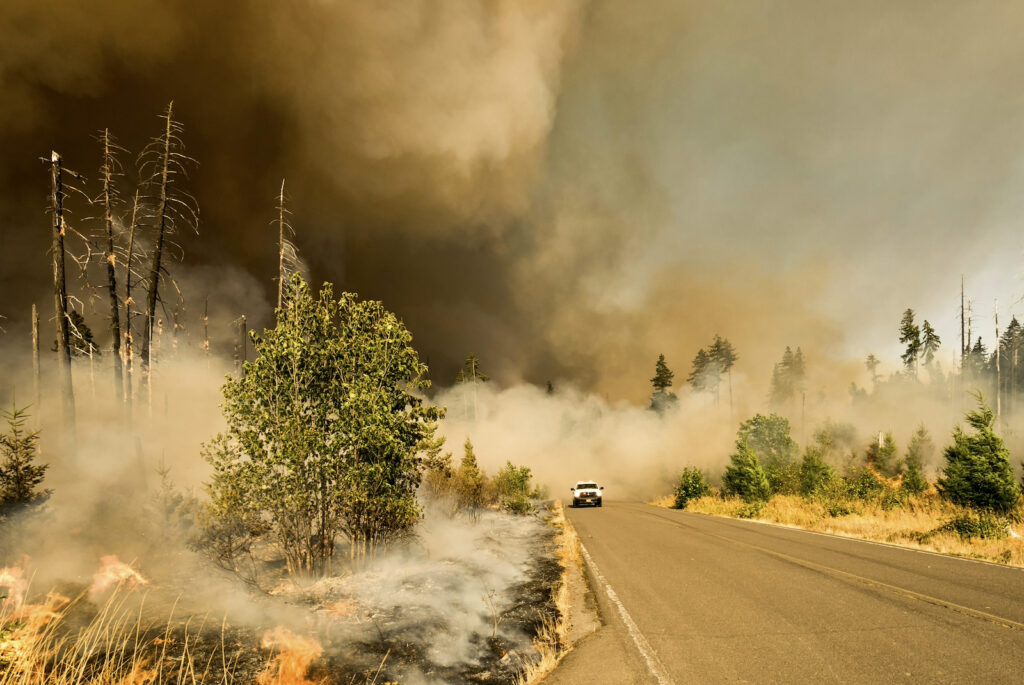
Ontario Premier Doug Ford is blaming American tariffs for out-of-control forest fires after President Donald Trump accused Canada of incompetent forest management and threatened new tariffs to cover the cost of smoke drifting into the U.S.
Administrator of the U.S. Environmental Protection Agency (EPA) Lee Zeldin said he is frustrated by Canadian inaction.
“There is a practice in Canada that when the fire starts burning, they monitor critical assets, they let the fire burn, as long as they feel like that fire is not going to risk those identified critical assets,” he said over the weekend.
The consequence is that Canada allows a lot to burn unchecked – and that has negative consequences for the health of U.S. residents, added Zeldin.
The American criticism comes as officials said 858 forest fires are burning across Canada, including 111 considered out of control, devastating nearly 6 million acres, reported Reuters.
Ford called comments from the U.S. administration “unacceptable” and “disgusting.”
“I got an idea for President Trump,” said Ford talking to reporters. “Why don’t you get rid of all the softwood lumber tariffs, because 30%, 33% of building – guess what? It comes from Canada. You want us to clear the forest. Well open up the gates.”
Trump pressed the issue on Sunday after speaking with Canadian Prime Minister Mark Carney at the World Cup final in New Jersey.
“I have a good relationship with Mark Carney, but we’ve got to stop the fires up there,” Trump told reporters.
Trump suggested that Canada could pay damages or the U.S. could increase tariffs to compensate for losses due to inadequate Canadian forest management.
“We are holding Canada responsible for the fact that they are not properly maintaining their Forests, and Brush therein,” said Trump via Truth Social. “The cost is incalculable! Canada has refused to engage in basic Forest Management and Debris Removal, knowing that such refusal will lead to exactly this result.”
Smoke from the hundreds of Canadian fires spread across the Midwest, Northeast and Mid-Atlantic U.S. last week, prompting health warnings in numerous states and recommendations that residents avoid outdoor activity.
Of major world cities, Detroit, which sits opposite Ontario, had the worst air quality in the world on Thursday.
A map of the air quality index (AQI) “as of around noon, showed Detroit with an air quality score of 724. Second was Toronto with a score of 271, followed by Minneapolis, Chicago and Kinshasa in the Republic of the Congo,” reported MLive.
Federal data showed dangerous levels of smoke across Minnesota, Michigan, northern Illinois, northern Ohio and into Ontario, with hazardous readings recorded in Minneapolis, Milwaukee and Toronto, said Reuters.
Ten states reported at least some locations registering “unhealthy” air quality, stretching from Minnesota south to Maryland, said the wire service.
Minneapolis closed municipal pools, nature camps, golf courses and outdoor programs. Concerts and fairs were also canceled in Minnesota.
Particle concentrations in parts of northeastern Minnesota reached as high as 1131.4 micrograms per cubic meter, nearly four times the hazardous threshold, reported CBS News.
An AQI of 50 and under is considered good quality air, while anything over 100 is considered unhealthy. AQIs of over 300 are considered hazardous.
The EPA designated at least 14 states and the District of Columbia with unhealthy AQIs, according to maps supplied by the EPA.
Carney said Canada deployed more than 5,300 firefighters to fight the wildfires.
“Nearly 300 aircraft are in the field – from waterbombers and helicopters to evacuation aircraft,” he wrote on X. “We are leveraging data, drones, new technology, and advanced thermal imaging to support real-time detection and mitigation efforts.”
Experts are divided over the extent to which commercial logging reduces the frequency and severity of wildfires.
But Republicans and many Democrats agree that forest management, including thinning forests, removing excess underbrush and conducting prescribed burns, the types of activities Trump mentioned on his social media post, is part of the solution.
But Ford’s contention that tariffs over one wildfire season prevented Canada from managing their forest, and consequently helped create the wildfires, goes against the evidence.
Terry Baker, CEO of the Society of American Foresters, said the conditions that produce large, severe wildfires are generally the product of years or decades, not something that develops over a single season or two.
“It’s the accumulation of fuel over time that really creates the space to have some of the large impactful fires that we’ve seen over the past few years,” said Baker.
(Image credit: Photo by Marcus Kauffman on Unsplash, altered)