‘Reinventing the ripoff’: AI surveillance pricing scams Americans, undermines economic fairness, Hawley says
American consumers pay radically different prices for the exact same product because AI companies are profiling individuals and spiking prices in outright “highway robbery” that undermines…
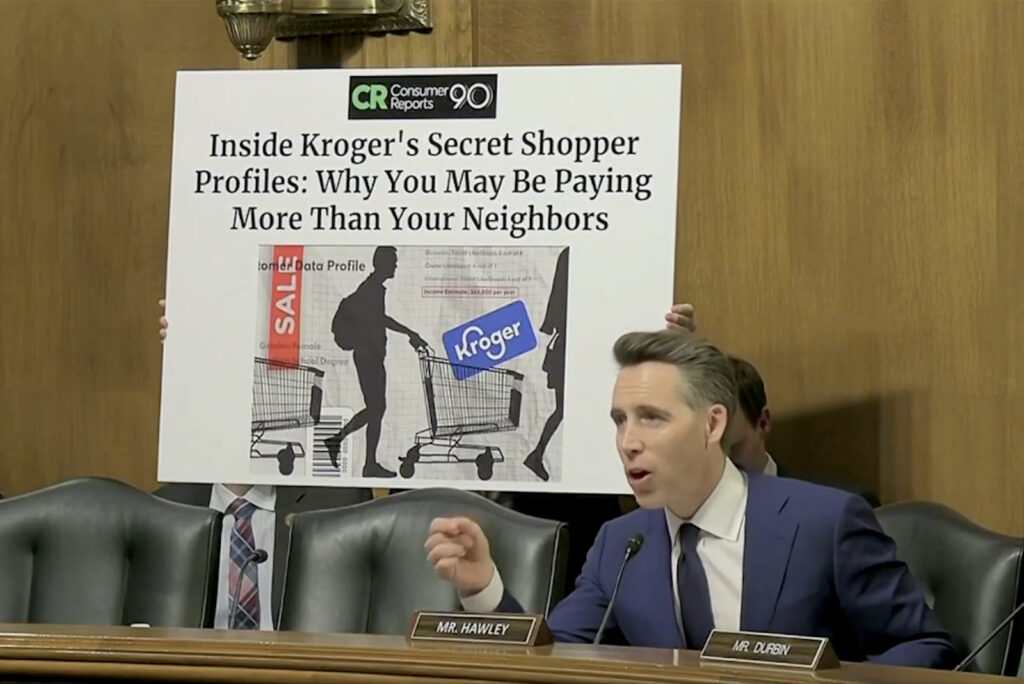
American consumers pay radically different prices for the exact same product because AI companies are profiling individuals and spiking prices in outright “highway robbery” that undermines “basic principles of fairness,” according to Sen. Josh Hawley, R-Missouri.
“We need to ban all of these corporations from using AI to set prices that rip you off,” Hawley told Heartlander News in an interview Wednesday. “I mean, that’s what they’re doing. They’re changing the price person by person.”
Hawley, who chairs the Judiciary Subcommittee on Crime and Counterterrorism, held a hearing on AI surveillance pricing Tuesday to discuss what he called “one of the biggest scams in American history”: the alliance of AI data surveillance, called dataveillance, and for-profit corporations.
“This [is a] marriage between the AI industry and these mega corporations, and they’re trying to pull it off against every American consumer,” Hawley said at the hearing. “AI surveillance pricing is the unholy trinity of everything Americans hate: spying on people, ripping them off, and taking away jobs.”
AI dataveillance: Tracking consumers’ online activity, location
During the hearing, the committee heard from five witnesses on the issue from both economic and technological perspectives. Groundwork Collaborative President and CEO Dr. Lindsay Owens explained how AI surveillance has “reinvented the ripoff.”
“Companies can now purchase, track, and analyze your personal data at a previously unimaginable scale and clip,” she said. “They catalog your location, your purchase history, and even your cursor movements to better predict exactly how much they can charge you. Even nominally beneficial programs like loyalty rewards can be used to harvest your information, turning customers into guinea pigs in sophisticated pricing experiments.”
The scam affects consumers across platforms, including grocery stores, online shopping, DoorDash and travel sites. Owens’ organization’s research found that Instacart offered different prices to consumers for the exact same items at the same time and location. Consumers often are unaware of the “ripoff” because they have no one to compare prices with at that moment, she explained.
This hijacking of prices costs the average American family an additional $1,200 annually, according to Hawley’s press release.
Additionally, Kroger’s loyalty program uses members’ data to estimate their annual income, Owens said. Robert Hedges, a digital fellow at the Massachusetts Institute of Technology, explained how AI companies profile consumers by collecting data on shopping history, web browsing history, location, device type and battery life, loyalty programs, clicks and card activity.
“These detailed profiles know or infer your behavior preferences, health conditions, relationship status, presence of children, countless other behavioral attributes,” Hedges said. “Your consumer profile can then be managed to produce signals about what a consumer might want.”
The economic twist
Within the AI industry and corporations, AI surveillance pricing is more commonly known by the euphemism “personalized pricing,” economist Z. John Zhang said. Zhang, the only witness defending the practice and a professor of marketing at The Wharton School at the University of Pennsylvania, said AI surveillance pricing is “not intrinsically sinister” in the economic realm, adding that it benefits “affordability” and “social welfare.”
“The basic reason why firms use personalized pricing is that consumers differ. Some are willing to pay more. Others are more price sensitive,” he said.
But the goal of AI surveillance pricing is to “estimate the highest price any given consumer is willing to pay at any given time,” according to Lee Hepner, senior legal counsel at the American Economic Liberties Project. He added that such practices undermine consumers’ expectation of “a fair and predictable price.”
“Surveillance pricing is good for corporate profits and bad for consumers,” Hepner said. “But this is not just about cost; it is about morality and power.”
Protections for consumers
AI companies and large corporations are scheming to maximize profits despite already being wildly profitable, Hawley said. Clear rules against online stalking, profiling and scamming must protect consumers from these schemes, Owens said.
“The answer can’t be to teach everyone how to beat the machine. We must set rules of the road so the machine plays fair,” she said. “Clear and transparent prices are essential for a functioning capitalist economy.”
Hawley agreed, saying Congress must protect consumers, especially those in the working class who are most likely to be harmed by AI surveillance pricing.
“And we need to give consumers and working people and families in this country rights against this kind of surveillance and exploitation,” he said. “If we don’t do that, the basic foundations, the moral foundations of our economy and of our country, will be devastatingly eroded.”
Hawley told Heartlander News AI surveillance pricing violates “basic principles of the rule of law” because consumers pay different prices for the same goods.
“We need to stand up and say we’re going to protect the American people,” Hawley said to conclude the hearing. “We’re going to give them rights. We’re going to preserve that basic moral foundation that makes our economy and our country more broadly work, and that we agree on together. So it makes us Americans. It’s done us pretty good for the last 250 years. I think maybe we ought to preserve it.”
(Image credit: Screenshot/C-Span)