‘No evidence to support these claims’: New report debunks allegation bans on transgender medicine for minors increase suicides
Contrary to threats that minors who are denied transgender medical interventions will commit suicide, a new study found no link between suicide rates and state policies banning the…
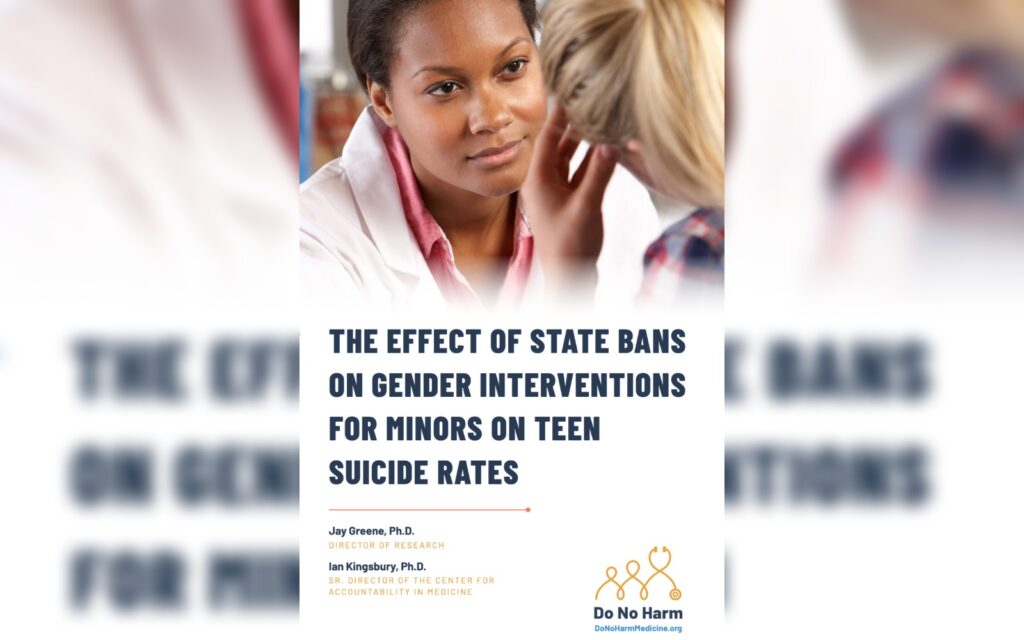
Contrary to threats that minors who are denied transgender medical interventions will commit suicide, a new study found no link between suicide rates and state policies banning the practice.
Do No Harm, a medical watchdog nonprofit, released a report Thursday that measured the rate of suicide in states with laws prohibiting transgender interventions on minors, using three separate models – two state-by-state and one national.
All three methods found a zero percent change in the rate of suicides among minors after such laws went into effect.
“Very bold claims have been made that state prohibitions on the use of surgeries, puberty blockers, or cross-sex hormones to treat minors with gender dysphoria would lead to a spike in suicides,” the study states.
“We have presented the results of three different types of analyses and find no evidence to support these claims. None of these analyses yields a result that is anywhere close to showing a statistically significant change in suicide rates resulting from state policy changes.”
Three research models conclude statistical zero change
Do No Harm relied on data from the Kaiser Family Foundation (KFF) and the Centers for Disease Control and Prevention (CDC) to calculate the change in suicide rates in the years following states’ enactment of bans on transgender interventions for minors. Two states passed such laws in 2022; 15 states in 2023; and six states in 2024.
The state-by-state method, known as the Difference-In-Difference model, compares the rate of suicide in a state with a ban on transgender interventions for minors to the rate of suicide in a state without a ban. The state without a ban serves as an indicator of what the rate would have been in the other state had the law not gone into effect, Senior Director of Do No Harm’s Center for Accountability in Medicine Ian Kingsbury told Heartlander News in an interview.
The second state method uses the same model with an adjustment to consider “changes on a rolling basis,” Kingsbury said.
These two studies both demonstrated that state laws against transgender interventions for minors had zero impact on the suicide rate among 15-19-year-olds, as categorized by the CDC.
The third research model considered the national rate of suicide among minors and the number of reported transgender youth in each state. Do No Harm compared the rate of suicide among 13-17-year-olds with 18-24-year-olds, who are not affected by the laws, and found a zero percent difference, even accounting for seasonal and other changes.
The study is the first of its kind regarding transgender interventions to consider suicide as an actual outcome instead of a self-reported consideration or common Google search, Kingsbury explained.
“Medical practice and policy must be grounded in evidence, not emotionally manipulative talking points,” Do No Harm Director of Research Jay Greene said in a statement provided to Heartlander News. “That principle is all the more critical when it’s a matter of children’s health and well-being.”
The history of transgender medical claims and ‘data’
Because of the drastic results of transgender interventions, LGBTQ advocates in various fields of politics, science and medicine have claimed for years that minors would take their lives if they don’t receive so-called transgender care, Kingsbury explained.
“When it comes to providing children with access to sex-changing interventions, these are irreversible and powerful medical procedures that really do a lot of biological harm,” he said. “So the only way to justify doing that is by claiming or asserting that the counterfactual is somehow even worse. And that’s what happened.
“The activists claim that if we don’t allow children access to these types of procedures, by which I mean puberty blockers, cross-sex hormones, in rarer cases surgeries, that if kids don’t have access to them, that they may end their lives.”
Do No Harm’s most recent report also analyzes the various studies making such claims and found the data is inconsistent and biased.
“The ‘research’ that has been done on this topic is just profoundly unreliable,” Kingsbury said.
The first study in 2011 from the Netherlands proposed the “Dutch protocol” – the theory that puberty suppressers and cross-sex hormones improve psychological function and reduce mental health struggles. But the research relied on self-reporting and did not isolate the potential causes, as patients receiving transgender drugs were also simultaneously receiving psychological treatments. This study, however, became the global reference point for other medical action and research on the transgender issue.
Other studies in the U.S. that claimed to tie bans on transgender medicine to an increase in suicide failed to appropriately define and isolate the term suicide. Instead, such studies relied on Google searches of words relating to suicide or self-reporting by individuals recalling their mental state before and after transgender intervention – introducing a clear bias in the data, Kingsbury explained.
Whistleblower Jamie Reed, who uncovered the deception in transgender medicine in a 2023 article, explained that patient self-reporting is unreliable and often “a manifestation of social contagion.”
In 2024, the Trevor Project, an LGBTQ advocacy organization with a suicide hotline, reported suicides among transgender minors increased 72% after the passage of “anti-trans” laws, according to Do No Harm’s report. But this statistic relied on self-reports primarily from Idaho, where the two laws had not even gone into effect at the time of the research, which also coincided with the COVID-19 pandemic, bringing a national increase in suicides among youth.
Yet, most major medical groups have stuck to the lie that children will take their lives if they do not receive sex-altering drugs and claim that anyone who hinders access to these interventions will “have blood on their hands,” according to the report.
The World Professional Association for Transgender Health (WPATH) designates transgender interventions “as medically necessary” to alleviate gender dysphoria and psychological struggles, including suicide risk, in its Standards of Care Version 8. The American Medical Association and American Psychological Association both claim so-called gender-affirming care saves lives and restrictions inflict harm or even death.
Rest of world backtracks on transgender interventions
Meanwhile, European countries, including the United Kingdom, Sweden and Finland, have all distanced themselves from so-called transgender medical care, with many implementing laws against such interventions for minors. The famous Cass Review, a study released in England in 2024, recommended increasing psychological care for minors and restricting the prescription of puberty blockers.
“Most of the developed world has pulled back on it, either cutting it off completely or restricting access to highly unusual cases or clinical trials,” Kingsbury said.
Additionally, most Americans oppose the T of LGBTQ ideology, with only 38% of Americans saying it is morally acceptable to change one’s gender and nearly 70% of Americans saying transgender athletes should play on teams according to their biological sex.
But the Trevor Project and other ideologically aligned organizations such as the Human Rights Campaign stick to their narrative. In August, the Centers for Medicare & Medicaid Services announced a potential ban on coverage for transgender medical interventions on minors beginning in October. In response to the announcement, the Trevor Project said the order is “a restriction on doctor-prescribed healthcare” and cited its own flawed data.
“The Trevor Project’s research shows that access to this care is associated with significantly lower rates of depression and suicide risk among transgender and nonbinary young people who receive it,” the org wrote in its statement.
The Trevor Project did not reply to Heartlander News’ request for comment regarding Do No Harm’s released report. Kingsbury said such ideological orgs will not change their narrative, but Americans should know what the data says.
“We could publish the most methodologically sound, compelling study of all time, and they would still insist that we have the facts wrong. But our job is not to convince the Trevor Project or the Human Rights Campaign,” he said. “We know where they stand on this issue. The objective is to help the public and clinicians and lawmakers understand that they have not been telling the truth about this.”