Illegal immigrant wave overwhelms Spanish enclave in North Africa, prompts EU pushback, warnings of ‘weaponized’ migration
A Spanish enclave in North Africa is still reeling after an estimated 70,000 illegal immigrants crossed into Ceuta, Spain, from Morocco over the weekend.
Spanish Prime Minister Pedro…
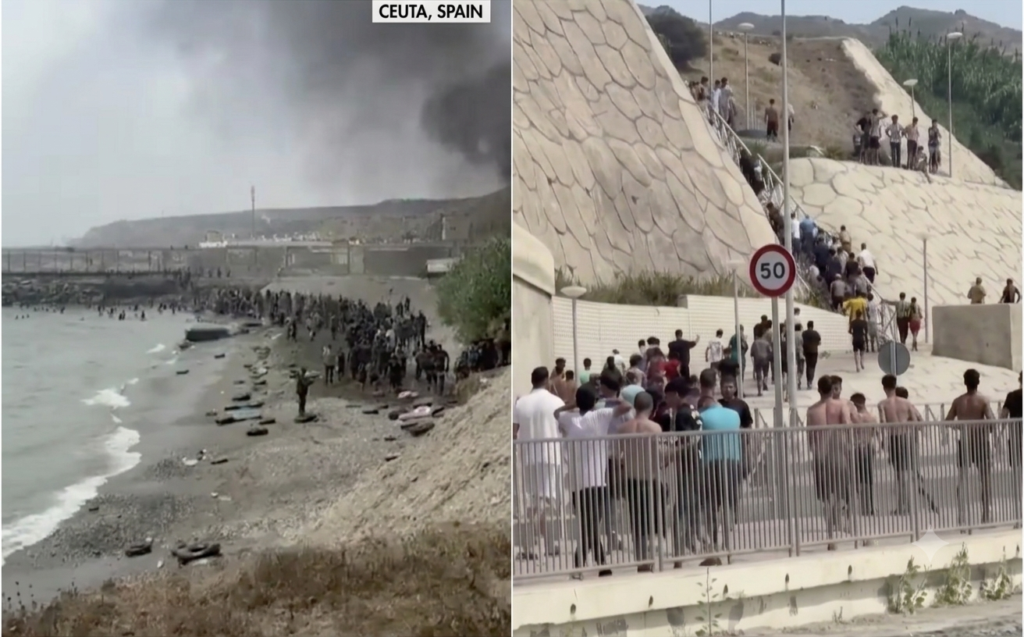
A Spanish enclave in North Africa is still reeling after an estimated 70,000 illegal immigrants crossed into Ceuta, Spain, from Morocco over the weekend.
Spanish Prime Minister Pedro Sánchez is claiming the mass migration was due to misinformation spread by human traffickers about a Spanish Supreme Court ruling, CNN reported. But critics point to Spain’s left-wing immigration policies and the increasing willingness of countries to use illegal immigration as a weapon.
President Donald Trump warned Americans that if Democrats return to power in the midterms, the U.S. could see a similar crisis within three years if Biden-era illegal immigration policies are restored.
“You know, I saw Spain yesterday, and I watched the catastrophe that took place,” Trump told reporters at Friday’s Cabinet meeting. “It looks like an invasion of a country by hundreds of thousands of people.”
The Spanish Supreme Court ruling on July 8 carved out an exception to immediate deportation for those who arrive by sea.
“If you’re trying to swim to Europe from Africa,” The Atlantic wrote, “there may be no better destination than Ceuta, a speck of Spanish territory in North Africa, surrounded by Morocco on its western edge and the Mediterranean elsewhere.”
Videos over the weekend showed tens of thousands of military-aged men arriving on the beach in Ceuta, leaving large amounts of refuse in the water and on the sand. Others overwhelmed the land border, climbing fences or surging through gaps in the border wall.
Spanish military arrived in Cueta to return many of the migrants and enforce order, but the death toll stands at 83, with about 3,000 illegal immigrants still on the Spanish side, including 862 minors who cannot be deported, Reuters reported.
Prior warning and EU reaction
Spanish politicians say they did not anticipate the crisis because Morocco did not warn them. But Spanish intelligence warned the government before the crisis that a large-scale border rush by Moroccans into Ceuta could happen at any moment, Spain’s Cadena SER reported.
“These people would not have entered Spain if the Ministry of the Interior had taken measures to prevent it,” a Spanish intelligence source told the newspaper.
One reason authorities did not act more decisively was because Sánchez, a progressive from the Spanish Socialist Workers’ Party, has prioritized good relations with Morocco over border security, critics told Politico.
Reaction among European Union members was one of outrage across the political spectrum.
The European Union is vulnerable because the Schengen Area, which includes 29 European countries, allows passport-free travel similar to travel between U.S. states.
Twenty-two European leaders wrote to European Commission President Ursula von der Leyen ahead of an emergency European Union meeting addressing the Spanish immigration crisis.
“We cannot allow uncontrolled mass crossings, the instrumentalisation of migration or other hybrid threats to create the perception that illegal entry into the European Union is possible,” they wrote.
The crisis has been complicated by Spain’s April immigration amnesty for up to 1.2 million illegal immigrants.
The letter argued the amnesty helped encourage the Ceuta crisis.
Italian Prime Minister Giorgia Meloni announced a suspension of Schengen benefits for Spain.
“The Government has decided to temporarily suspend the free movement regime provided for by Schengen in maritime and air connections with Spain, reintroducing border controls,” Meloni wrote on X.
She also offered Italian assistance to Spain in restoring border security.
In Germany, Alternative for Germany leader Alice Weidel said that despite reports Spain has escorted most of the illegal immigrants back across the border, chaos remains in Ceuta.
“Asylum centers are overcrowded, migrants are trying to break into homes and attack residents, thousands are marching through the streets chanting ‘Allahu Akbar,’” Weidel wrote on social media while reposting videos she said were from the scene.
‘Weaponization of migration’
In February, Matthew Boyse, a senior fellow at the Hudson Institute, warned Congress that immigration tensions between Morocco and Spain were part of the “weaponization of migration,” which he said has become a regular foreign and national security strategy.
He said the U.S. needed to be more willing to speak out against the weaponization of immigration, both to secure American borders and to help secure European borders.
“Morocco has been using migrants to change Spanish policy, and it has succeeded,” Boyse told Congress.
He noted a smaller but similar border incursion in 2021 involving 8,000 illegal immigrants from Morocco that forced a change in Spanish policy toward Moroccan control of Western Sahara.
The Barcelona Centre for International Affairs predicted at the time that the Spanish concessions created “dependency” whenever Morocco decided to open the border.
“Europe gifted them this ability,” British journalist William Nattrass, who is based in Prague, wrote about the latest wave of illegal immigration. “Whatever conclusions it draws from the Ceuta crisis, [Europe] must now learn to stand up for itself.”
(Image credit: Screenshots/YouTube/France 24 English)