Fossil’s last meal challenges 245-million-year claim, could indicate flood burial
The fossil of an alleged pre-dinosaur marine reptile, found in southern China, is offering scientists a nearly perfect picture of its simple digestive tract, with the scales of a sushi dinner…
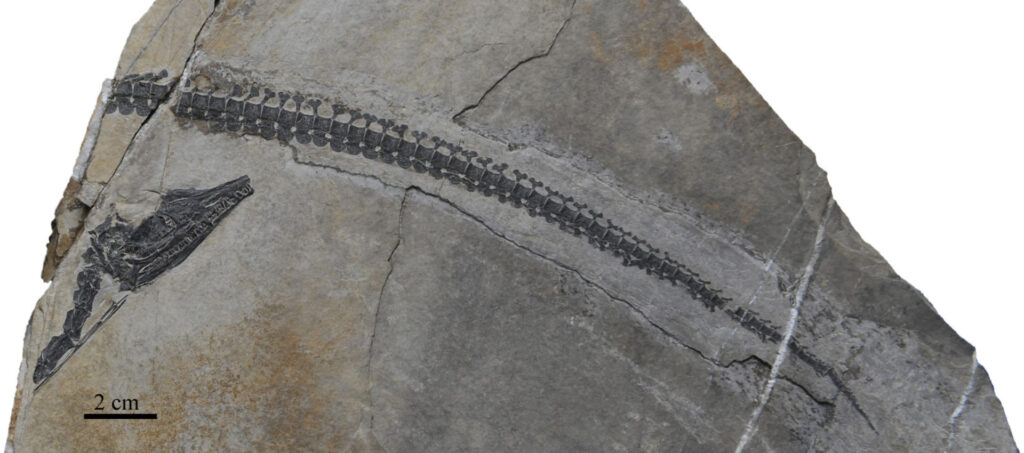
The fossil of an alleged pre-dinosaur marine reptile, found in southern China, is offering scientists a nearly perfect picture of its simple digestive tract, with the scales of a sushi dinner still preserved inside.
Mainstream scientists estimate the fossil is about 245 million years old, falling within the Triassic Period, according to evolutionary dating. Evolutionary scientists estimate dinosaurs first appeared around 230 million years ago, Reuters reports.
But leading creation scientist and trained geologist Dr. Andrew Snelling reads the evidence differently, telling Heartlander News the fossil and its burial are suggestive of a flood of biblical proportions.
The roughly two-foot long (60 cm) fossil was discovered several years ago in Yunnan Province of southern China, a region common for the discovery of well-preserved fossils.
The Yunnan Province is a popular fossil site because of the multiple sedimentary layers in the region that are necessary for fossil preservation, explained Snelling, who works for the organization Answers in Genesis. The presence of marine fossils on the continent is significant because “it means the ocean waters rose and swept over the continent,” he added.
Upon discovery, the marine reptile’s stomach, liver and intestines were nearly perfectly preserved, providing an inside glimpse of its internal anatomy, which scientists reported was relatively simple.
“To our knowledge, this represents the oldest well-preserved digestive tract of any reptile,” said paleontologist Stephan Spiekman of the State Museum of Natural History Stuttgart and the University of Hohenheim in Germany, one of the authors of the study, published July 29.
Evolutionary bridge or aquatic design?
The fossilized creature, an Austronaga minuta, is believed to be a relative of the archosaurs lineage that includes modern day crocodiles and some birds, according to Reuters. But Geologist for Answers in Genesis Dr. Andrew Snelling disagreed with this conclusion, saying that evolutionary scientists infer this date based on their underlying acceptance of evolution.
“We cannot observe what it supposedly evolved from or supposedly evolved into,” Snelling told Heartlander News in an email. “Its supposed evolution is only inferred by those scientists who already believe in evolution.”
The authors of the study, published in the journal Science Advances, said the creature bridged a gap in the development between a terrestrial and a marine reptile. They noted the aquatic lizard’s paddle-like forelimbs and loosening pelvis that allowed it to navigate its water home.
Snelling said this claim is not a proven fact but rather an assumption based on the authors’ “preconceived evolutionary inference.”
“Terrestrial reptiles have legs and feet, whereas aquatic reptiles have flippers,” he said. “They have never found an in-between fossilized reptile with half-feet, half-flippers because any such creature could not have walked very well or swam very well so would not survive! Any claim is merely their evolutionary story based on their belief that evolution must have occurred.”
The sea creature’s stomach did not portray the same supposed evolutionary development, marking a pre-adaptation interior, scientists said. The swimmer’s single chamber stomach contrasts with the double chamber seen in birds and crocodiles.
“The neat thing is that so much of the internal organs are preserved and it is possible to see the different parts of the gut,” study author Dr Nick Fraser at National Museums Scotland told IFLScience.
Study authors did not discuss whether the fossil could have been much younger, instead saying much more evolutionary development had to happen before modern day crocodiles.
“It tells us that the double-chambered stomach likely did not evolve at the beginning of stem-archosaur evolution, but a later stage, closer to the origin of birds and crocs,” Spiekman said.
Snelling was unconcerned with the alleged “unevolved” internal structure, saying it was again a matter of evolutionary expectation, not evidence.
“Any claim or assessment that internal development is either behind or not yet adapted is only based on their evolutionary expectations and not on any reality,” he said. “This fossil is simply that of a unique aquatic reptile that was well-designed and well-adapted for its aquatic lifestyle.”
Sushi dinner preserved
Inside the stomach, small fish scales, from one of the marine lizard’s final meals, were preserved. Even more surprising to scientists was the tint of red color of the liver, indicating the preservation of hemoglobin, an iron-rich protein in red blood cells.
“Its positioning posterior to the stomach is no surprise. The most surprising thing to me was the preservational aspect – the fact that residues of hemoglobin, with elevated iron contents, could still be distinguished in a fossil that is 245 million years old,” Spiekman said.
Snelling explained that the creature could not be millions of years old because of the preserved dinner, which would require a relatively recent, rapid burial. The soft tissues of the creature and its meal could not survive for millions of years, he added.
“All we observe is a delicately preserved fossil creature, which required rapid burial in life position, meaning it was buried alive whole all-at-once which required a lot of sediment dumped on it so it didn’t rot or get eaten by scavengers,” Snelling said. “That required catastrophic flood conditions.”
Even the study’s authors conceded a similar point, saying the sea lizard was buried in “life position,” Snelling explained, adding that they do not elaborate likely because they want to avoid the biblical Flood explanation.
Additionally, the evidence of hemoglobin, which Snelling specified is a logical inference and not a fact, dates the fossil to be only a few thousand years old, he said. These iron cells can only survive a few thousand years and cause decay upon oxidization, Snelling explained. He concluded the fossil was “buried in the recent biblical global Flood cataclysm only about 4,350 years ago.”
“The location of this aquatic fossil buried alive on the continent so beautifully preserved can only be explained by the biblical global Flood when the ocean waters rose to sweep over the continents dumping humongous amounts of sediments in layers across them,” he said.
Image credit: Wang et al., doi: 10.19615/j.cnki.2096-9899.231013.