China censors Tibet flooding, reports minimal casualties, orgs say
Amid deadly outburst flooding in Tibet and Nepal, several Tibetan organizations are questioning Chinese state media’s claims that less than 20 people have died in Tibet, alleging censorship and…

Amid deadly outburst flooding in Tibet and Nepal, several Tibetan organizations are questioning Chinese state media’s claims that less than 20 people have died in Tibet, alleging censorship and deliberate underreporting.
Official state media reports 16 deaths in Tibet, or the Xizang Autonomous Region, along with a total of more than 900 casualties since the Wednesday event, which would place most of the deaths in Nepal.
“The Chinese government portrays it like it’s only happening in Nepal and there’s nothing across the border. For any type of crisis, the way China handles it is that there is no crisis. The party is in control,” Tencho Gyatso, president of the International Campaign for Tibet (ICT), told The Guardian.
Beijing annexed Tibet in the 1950s, bringing the Buddhist region under the rule of the Chinese Communist Party. China has labeled the region’s “spiritual leader,” the Dalai Lama, a separatist, but Tibetans claim the communist government violates human rights, according to the BBC.
As global headlines reported hundreds dead after floodwaters swept through the key Nepal-Tibet border crossing on the morning of Aug. 26, China’s state broadcaster opened Thursday’s brief by announcing the launch of a new book by President Xi Jinping, according to the BBC.
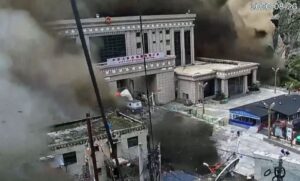
The Chinese Communist Party (CCP) immediately removed images and “firsthand documentation” of the glacier-induced flooding of Gyirong Port, according to ICT, an organization that advocates for democracy and human rights in Tibet. Instead of reporting a death count in Tibet or the extent of the destruction, Chinese media is highlighting Xi Jinping’s rescue and relief efforts, ICT says.
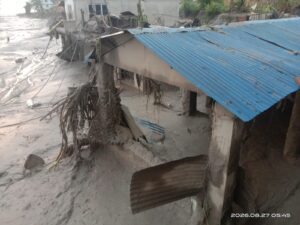
But, like Nepal, areas around Gyirong Port in Tibet are completely devastated, with entire shops, restaurants and homes swept away, ICT reports. Additionally, Chinese media has not interviewed survivors and had reported only three deaths as of Saturday, ICT Executive Director Ryan Fioresi told the BBC. Many Tibetans also “self-censor” out of fear because Chinese authorities often detain, interrogate or imprison individuals for publishing restricted content, he said.
Officials in Tibet announced Sunday that they had penalized at least 10 people for promoting “false disaster information” but did not specify the penalties, according to The Guardian. As of Monday, Chinese authorities had reported 16 people dead and 546 people missing, according to The Guardian.
China is also censoring alleged reports of warnings from scientists regarding the area’s geological conditions dating back more than a year, The Epoch Times reported. In July 2025, a glacial lake outburst flood destroyed the Friendship Bridge along the China-Nepal border – the same area now devastated by recent floods of the same kind.
Chinese scientists warned that more glacial lake outburst floods could hit the same area in a study released that same month by the State Key Laboratory of Geohazard Prevention and Geoenvironment Protection at Chengdu University of Technology. The scientists identified 55 glacial lakes and warned that rising regional temperatures had accelerated glacier melt and runoff, according to The Epoch Times. They recommended stronger flood warning systems and an analysis of the risk of flooding for all 55 lakes.
But China has built an “entire port complex right on top of a riverbed” in this naturally unstable environment, The Epoch Times reports. Gyirong Port represents nearly 30% of all China-Nepal trade – approximately $590 million, The Epoch Times reports.
Lin Ting-hui, former deputy secretary-general of the Taiwan Society of International Law, told The Epoch Times that China’s intervention in such a location “defies nature,” noting the region’s river trade dates back roughly to the seventh century.
“In all those centuries, the area had never suffered a disaster on this scale. However, in recent years, flooding began recurring,” Lin said. “The CCP’s atheism has led it to believe man can conquer nature. But people must instead respect nature, or nature will strike back.”