Birth rates plunge as public schools face long-term enrollment decline
U.S. births have dropped dramatically over the last two decades, a trend affecting public school enrollment in most states.
The decline is more pronounced in blue, Democrat-led states…

U.S. births have dropped dramatically over the last two decades, a trend affecting public school enrollment in most states.
The decline is more pronounced in blue, Democrat-led states than in red, Republican-led states, and many of the states with the steepest birth-rate declines lack school choice programs.
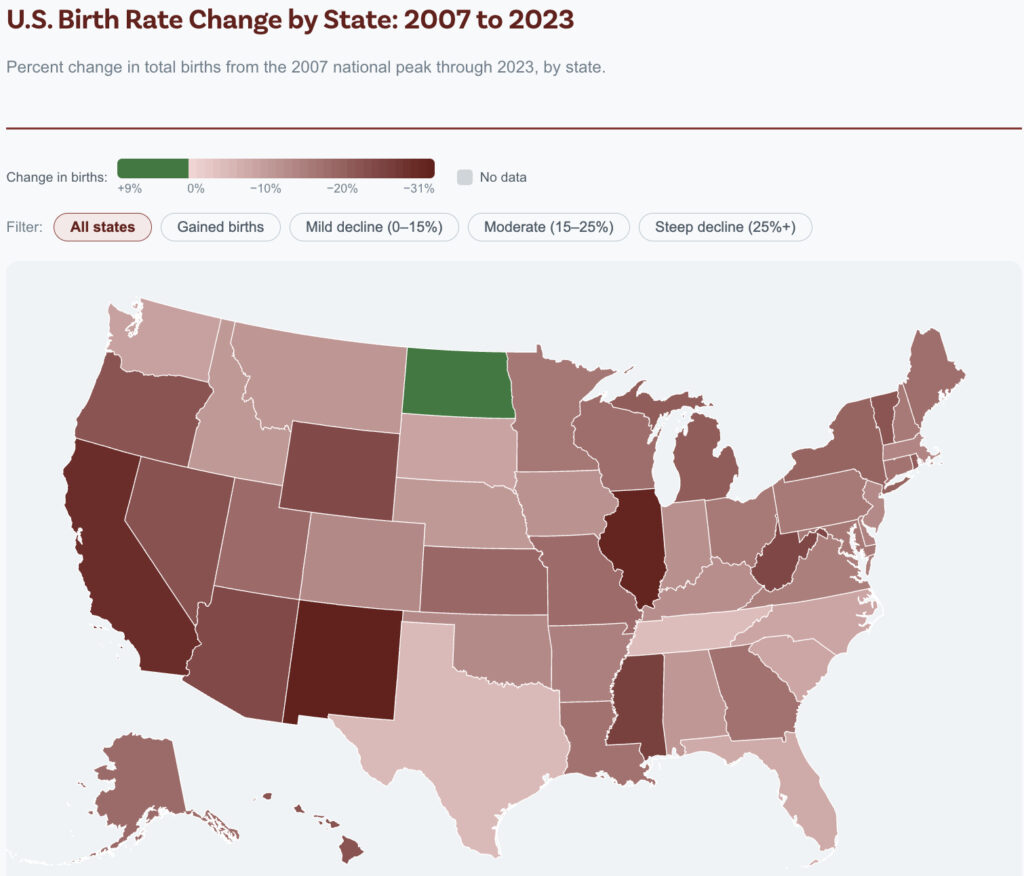
Research from ExcelinEd, which was founded by former Florida Gov. Jeb Bush, found 21 states experienced moderate-to-severe declines in birth rates between 2007 and 2023, with drops of 15% or more.
Illinois and New Mexico had the largest decreases, each at 31%. Nationally, births fell 17%. By contrast, Texas and Tennessee saw birth rates decline less than 5%, and North Dakota was the only state to post an increase, up 9.1%.
“Simply put, there are fewer school-aged children than there were a generation ago,” the report says. “And in many parts of the country, particularly in urban centers, rising housing costs have made it difficult for young families to stay put, leading to outward migration into suburban and rural communities.”
Blue states down more than red states
The results also show a political correlation. Republican-led states were more likely to see stable or increasing birth rates, while Democrat-led states were more likely to experience larger declines.
Among the 14 states with birth-rate declines of 20% or more, nine are blue, three are red and two have divided government.
Among the 14 states with the smallest declines or increases, 12 are red, one is blue and one has divided government. Nine of those 14 states have school choice programs.
Missouri’s birth rate declined 18.1% and Kansas’ fell 18.9%, placing both near the middle of the pack. Missouri has broad school choice, while Kansas does not.
Enrollment declines are taking a toll on public school districts, many of which are closing schools and consolidating operations.
Yet research from the American Enterprise Institute shows schools have added more nonteaching staff in recent years even as the number of teachers has remained relatively flat.
The National Center for Education Statistics projected just 13 states – all Republican-led – would gain public school students between 2021 and 2031. Of those states, 10 have school choice.
Although some state governments guarantee funding to school districts even when enrollment drops, such “ghost” funding is expensive, ExcelinEd says.
Instead, the report recommends districts make multiyear plans based on enrollment projections, eliminate inefficiencies to reduce costs and collaborate with neighboring districts.
It also recommends giving districts flexibility to make performance-based layoffs to retain talented teachers while allowing them to hire more part-time staff and maximize the roles of their best teachers.
Those recommendations, including delaying employment commitments until funding is secured, would challenge policies favored by teachers’ unions, which support guaranteed step increases and pay raises for their members.
The report also recommends states repurpose underused buildings, rethink student transportation and focus funding on student success rather than enrollment alone.
That could include selecting proven reading programs and rewarding districts for successful student outcomes.
Amid the shifting environment, “the consequences of inaction are growing.”
“The data is clear, the trend lines are steady,” the report concludes. “Declining enrollment isn’t a temporary dip. It’s a structural shift. Yet far too many school systems are clinging to outdated assumptions and unsustainable models.”
States and school districts that make strategic decisions now may avoid crisis-driven cuts later.
“That means embracing hard truths, engaging communities honestly and designing policies that reflect the future, not the past,” ExcelinEd says.