Arkansas fights to protect Ten Commandments monument on capitol grounds
The state of Arkansas is appealing a district court decision which ruled a monument of the Ten Commandments on state capitol grounds violates the First…
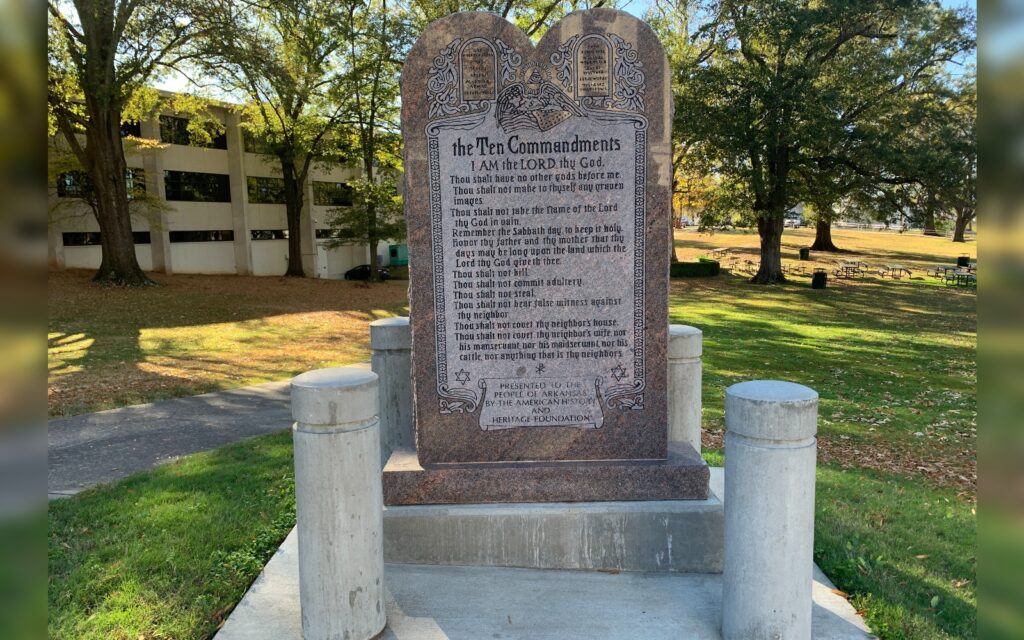
The state of Arkansas is appealing a district court decision which ruled a monument of the Ten Commandments on state capitol grounds violates the First Amendment and must be removed.
Arkansas Attorney General Tim Griffin asked the U.S. Court of Appeals for the Eighth Circuit in an appellate brief filed Thursday to reverse the lower court’s ruling, arguing that it ignored Supreme Court precedent and misapplied the First Amendment.
“Creating a monument that simultaneously recognizes the Ten Commandments’ importance to our legal tradition, like placing ‘In God We Trust’ inscriptions on coinage, is ‘rationally related’ to Arkansas’s interest,” the brief argues.
The case considers Arkansas’ 2015 Display Act – legislation that expresses the state’s intent to erect a monument of the Ten Commandments, according to Arkansas law, which requires such legislation for any display on government grounds.
The Display Act argues the Ten Commandments were “an important component of the moral foundation” for “many founders of this nation,” and are “a foundation of the laws and legal systems of the United States,” according to the brief. The law said the display would “‘help’ Arkansans understand that ‘moral foundation,’ without ‘favor[ing] any particular religion or denomination over others,’” the brief explained.
“The Ten Commandments are an important part of the foundation of the laws and legal system of the United States,” First Liberty Institute Senior Counsel Roger Byron, who is representing defendants in the case, told Heartlander News in an interview. “And as a symbol of law, the Ten Commandments have both religious and secular significance in this country, due to the historical importance of the Ten Commandments to the nation’s founding and to the American legal system.”
The monument was first erected in 2017, but a vandal destroyed it with a truck less than 24 hours later, according to First Liberty Institute’s press release. The display was re-erected in 2018, but shortly afterwards, several secular groups, including The Satanic Temple, Freedom from Religion Foundation and the Arkansas Society of Freethinkers, filed a lawsuit against state officials, according to the press release.
Despite the historical precedent of numerous biblical or religious displays across the country, these organizations claimed this Ten Commandments monument violated the First Amendment, citing the perceived religious nature of one of the donors: the American History and Heritage Foundation, according to the brief.
But displays of the Ten Commandments in and around several national public buildings, such as at the Supreme Court, “‘serve secular purposes,’” despite the “‘religious associations,’” according to the brief.
Additionally, the plaintiffs argued the Display Act violated the First Amendment’s Establishment Clause, which forbids Congress from making a law “respecting the establishment of religion.” The district court agreed but relied on the Lemon Test – a U.S. Supreme Court precedent that SCOTUS abandoned in 2022. Byron explained that the district court saw the dismissal of Lemon as “simply a suggestion,” adding that the court did not apply Lemon properly and the Display Act would still be constitutional even under Lemon.
To determine whether an act is legal under the Establishment Clause, courts follow the “history and tradition test,” Byron explained. This test considers what history and traditions were in place during the time of the Founders and what religious establishments they were trying to prevent.
“In this country, the Ten Commandments have been recognized by literally all three branches of our government,” Byron told Heartlander News. “It was part of our history and tradition, and as part of the foundation of the American legal system. The displays of the Ten Commandments are all over our nation’s capital. They’re in the capitols of many of the individual states, and this is just one more one more monument to fit within that history and tradition.”
Image credit: Wikipedia