Analysis: Chicago’s violence interruption industry faces questions after homicides tick up
At least 21 people were shot, three fatally, and three others were stabbed in Chicago over the long Fourth of July weekend, shining a spotlight on Chicago’s violence interruption (CVI)…
At least 21 people were shot, three fatally, and three others were stabbed in Chicago over the long Fourth of July weekend, shining a spotlight on Chicago’s violence interruption (CVI) industry.
Two Chicago police officers were wounded Friday during a South Side traffic stop, kicking off the holiday known in the city for its violence.
A suspect has subsequently been charged in the case.
The weekend violence included a West Side mass shooting early Sunday where six people between the ages of 17 and 20 were wounded, reported local Fox 32.
Police also said a 17-year-old girl was critically wounded in a separate shooting in the same area about 10 minutes earlier.
The bloodshed drew a sharp response from Ald. Raymond Lopez, a Democrat from Chicago’s violence-affected 15th Ward and one of Mayor Brandon Johnson’s most outspoken public-safety critics.
“One open gym for 75 youth didn’t do the trick,” Lopez said on social media above a report on the West Side shooting.
The comment was a jab at Johnson’s prevention-first approach to violent crime, which relies heavily on youth programming, community organizations and violence-interruption groups that critics claim have been ineffectual.
Rejecting federal help
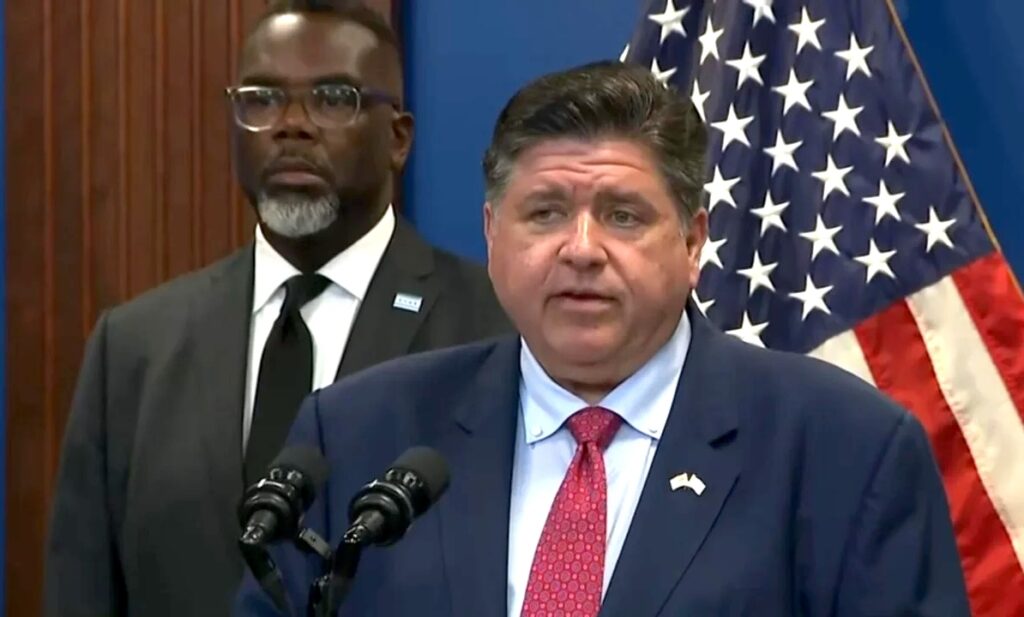
It also came as Johnson and Illinois Gov. JB Pritzker continue to reject President Donald Trump’s repeated offers of federal help to reduce crime in Chicago, as Cook County reports homicides in the first half of the year are up 5% from 2025.
After a violent June weekend in which 39 people were shot and six died, Trump posted on Truth Social that Pritzker should call him, saying he could fix Chicago “FAST and Permanently,” noted local ABC News 7.
Pritzker dismissed the offer, saying he did not believe Trump knows “how to protect us in the state of Illinois.”
Johnson said Trump had “done nothing to protect cities.”
The scale of the violence problem Johnson and Pritzker have on their hands can be measured by mainstream media fact-checkers.
As Trump took aim at Chicago violence via social media, Newsweek reported for once that they thought the president was understating the problem.
“A review of City of Chicago records by Newsweek found a substantially higher toll” than the president was claiming, reported the news magazine.
Meanwhile, Illinois and Chicago-area governments continue to pour money into community violence prevention, which often centers on alleged former gang members who develop information from police but brag that they don’t share any information with police.
The Illinois Department of Human Services’ Office of Firearm Violence Prevention reported in fiscal year 2024 that it distributed nearly $150 million in Reimagine Public Safety Act (RPSA) funding through 299 grant awards to 156 grantees.
The same report said Illinois invested another $123.3 million in non-RPSA youth development and community violence response programs.
Federal records reviewed by The Lion show the Biden administration ramped up federal aid in Chicago to such programs under his administration.
In 2021, federal aid totaled $26.7 million after taking out victims assistance programs. By 2024, that total had mushroomed to nearly $110 million.
Awards directly labeled for community violence intervention, youth violence prevention, school violence prevention or gun/firearm-related violence initiatives totaled roughly $34 million, including more than $21 million specifically tied to CVI or youth violence-prevention programs.
Those awards peaked in 2024 and fell sharply in 2025, with no 2026 awards appearing in the reviewed file.
CVI is promoted by supporters as a public-health alternative to traditional policing.
The model depends on outreach workers with neighborhood credibility, often including people with criminal histories or gang backgrounds, to mediate disputes before they become shootings.
That history is part of the model, but some question whether that’s at odds with the purpose of the programs.
In a recent WTTW report, Vaughn Bryant, executive director of Metropolitan Peace Initiatives, described the relationship between CVI groups and police as intentionally one-sided.
“We have sort of a one-way communication line,” Bryant said. “So we get information from the police, but we don’t give information to the police because that would ruin the credibility and the trust that we have with folks.”
Metropolitan Peace Initiatives later clarified the arrangement by saying CVI groups have a “delicate, one-way line of communication with CPD,” while helping respond to violent incidents without damaging their standing in the community.
The WTTW segment also showed how Chicago’s anti-violence infrastructure overlaps with the city’s broader progressive political world.
Chicago Teachers Union members can be seen working alongside CVI volunteers handing out materials prior to the Fourth of July weekend.
The arrangements raise basic accountability questions: If taxpayers are funding groups as public-safety partners, is the public getting safer, or are street gangs gaining another layer of protection from law enforcement?
Or is CVI simply a get-out-the-vote operation run by progressives and funded by government?
“CVI is being pushed by many who don’t want to use it as an addition to law enforcement,” Ald. Silvana Tabares of the Southwest Side’s 23rd Ward said recently. “They want to use it as an alternative to law-enforcement.”
Tabares said police sources have told her cops sometimes arrest interrupters for crimes and that interrupters also interfere in investigations.
Last year, Kellen McMiller, 35, who worked as a CVI violence interrupter, was arrested and charged with murder in connection with a smash-and-grab robbery of a high-end Chicago store, just days after posing with Gov. Pritzker in his role as a “peacekeeper,” reported the local NBC News affiliate.
“It’s folks like these that we need more of doing the hard work of community violence prevention, not troops on the ground to undermine efforts fighting crime,” Pritzker said of McMiller during the photo-op.
Tabares, however, said the record is clear that these programs can be a front for criminal activity and personal enrichment.
“I have heard from top supervisors and front-line beat cops and they all say that this violence interrupter program is a fraud, is a scam,” she said. “Individuals or organizations that are using taxpayer money for personal gain, we need to hold them accountable.”