Analysis: After years of impending recession talk in the media, 61% of Americans believe it
A new poll by Harris indicates 61% of U.S. voters believe the nation is enduring a recession.
However, the data, including consumer spending numbers, wage numbers, unemployment, comments by…
A new poll by Harris indicates 61% of U.S. voters believe the nation is enduring a recession.
However, the data, including consumer spending numbers, wage numbers, unemployment, comments by liberal Federal Reserve bankers, economists and the raw GDP prints, show the U.S. is nowhere near a recession.
“We’re experiencing record divergence between the vibes and the hard data,” said Austan Goolsbee, president of the Federal Reserve Bank of Chicago, as previously reported by Heartlander News.
Goolsbee served as the chairman of former President Barack Obama’s Council of Economic Advisers until 2011.
Some have questioned whether the constant downbeat economic message from the Democrats could be responsible for declining consumer confidence.
Commentator Rod D. Martin observed that former President Bill Clinton perfected the art of assassinating consumer confidence in his 1992 presidential campaign against then-President George H.W. Bush.
“In reality, the economy grew 3.5 percent in 1992, above the post-World War II average,” wrote Martin. “It didn’t matter.”
Bush lost on the economy.
Martin argues Democrats are again responsible for the dour mood of Americans economically in 2026.
In fact, the Federal Reserve made a special study of the 1992 economy and presidential election and at least partially agreed with Martin.
The study concluded that the media amplified negative messages broadcast by the Democrats throughout 1992, reinforcing negative attitudes about the economy.
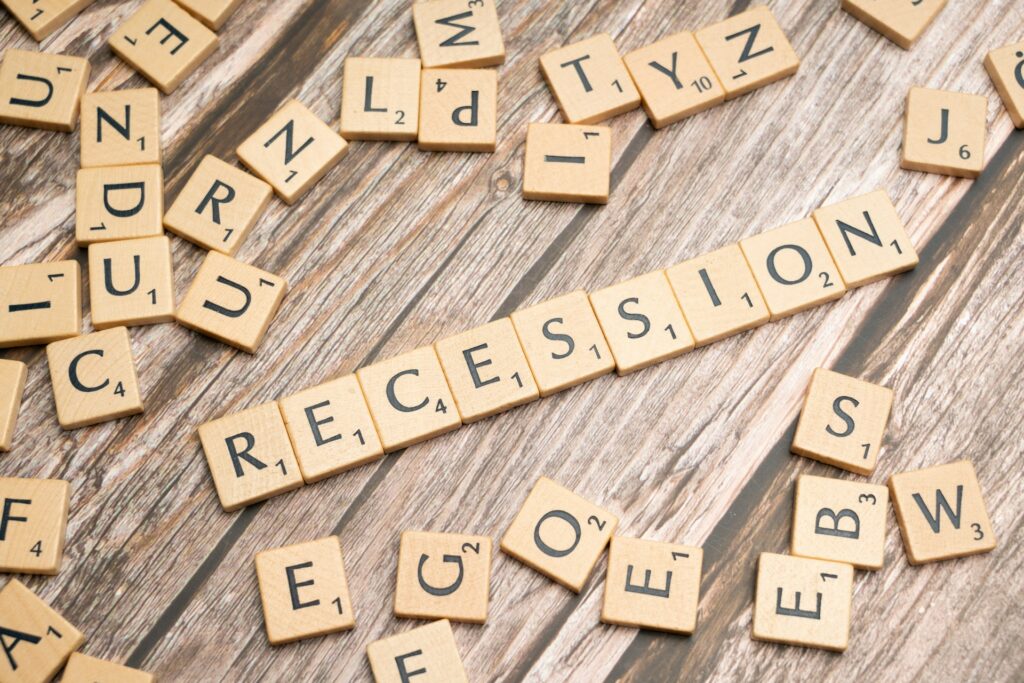
Specifically, researchers found the overuse of the word “recession” by the media (called the “R-word” in the study) helped wrongly inform people’s idea of what was going on with the economy, even as the economy was recovering.
The study tracked various words negatively associated with the economy, such as “recession,” into an index.
“Although the actual downturn during the early 1990s was relatively mild, the R-word index is much higher during this period than during the recessions in the 1980s and late 1970’s,” researchers concluded.
Heartlander News repeated the experiment for the second Trump term by using Google Trends internet keyword searches combined with government data.
This time the keyword searches included “inflation” as well as “recession.”
The result clearly shows the words recession and inflation have not reflected the underlying economic data, resulting in the bad “vibes” noted by Goolsbee. [CHARTS GRAPHICS PRODUCED BY AI]
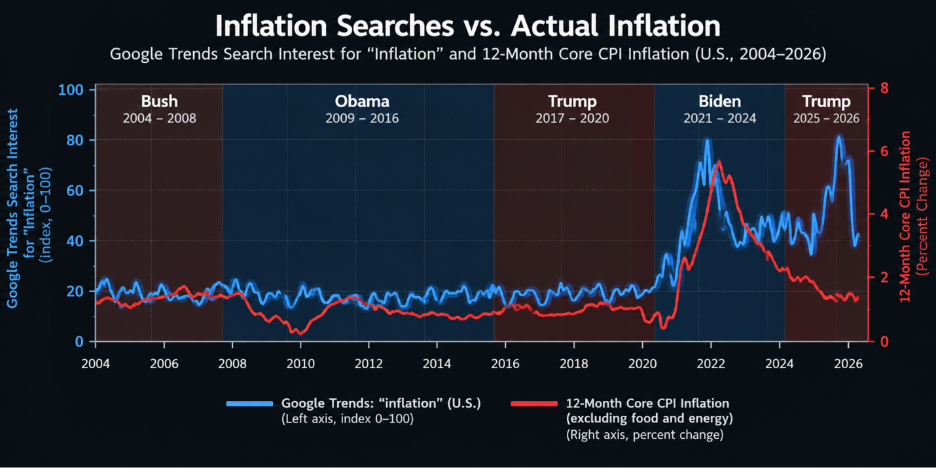
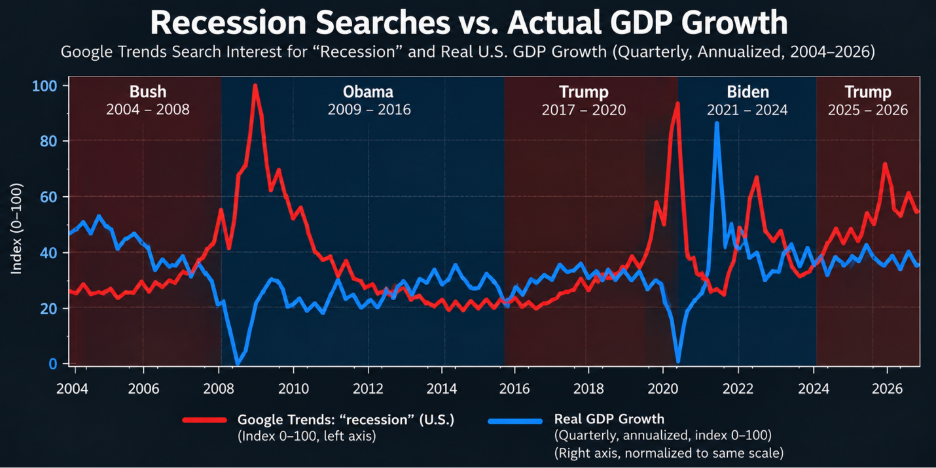
The disconnect between economic reality and public perception was created by a steady drumbeat of dire economic predictions that have been divorced from the real economic numbers.
Exactly two years ago, the Associated Press (AP) reported that 16 Nobel Prize economists signed a letter warning about Trump’s tariff scheme, even before he was elected president.
“Nonpartisan researchers,” the AP quoted the letter, “predict that if Donald Trump successfully enacts his agenda, it will increase inflation.”
But that was just the beginning.
“People who would never even think about recession now suddenly have to consider it,” said Mohamed El-Erian, chief economic adviser at Allianz, in April 2025 shortly after Trump was inaugurated. “It’s been an incredible transformation in the last four weeks.”
ABC News’ George Stephanopoulos, a Clinton communications alumnus for both the campaign in 1992 and later the White House, gave one of the most outrageous examples the same month.
He specifically asked Obama’s former Secretary of the Treasury Larry Summers to predict the hard numbers of “higher inflation, lower growth going forward” after a year of Trump.
“I think it’s almost inevitable,” said Summers. “This is the biggest self-inflicted wound we’ve put on our economy in history. We are increasing inflation because the prices are higher because of the tariffs.”
Summers said the S&P 500 would almost certainly make the $5 trillion in market losses permanent, while consumers could lose $30 trillion.
Mathematically, it’s the same thing as claiming people are going to lose a gazillion bazillion.
The whole economy produces $30 trillion annually.
When Summers made his prediction in April 2025, the S&P 500 started the month at 5,671.
By Oct. 14, 2026, it had climbed to 7,719, a gain of 36%.
Using an approximate S&P 500 market capitalization of $49 trillion at an April 1, 2025, starting point, the gain in the S&P 500 has been $17.69 trillion.
And GDP along with consumer spending has grown, despite Summers’ predictions.
Ultraliberal Mark Zandi of Moody’s Analytics, one of the world’s most influential credit-rating and financial research institutions, compared Trump’s economy to the Great Depression in April 2025 and said unemployment would reach “north of 7%.”
By August, he said the “economy is on the precipice of recession” and said the Federal Reserve had limited “rescue” options.
And the predictions of gloom, as shown by the charts, have never really stopped.
Today, nobody with any real authority is talking about a recession seriously.
As Heartlander News reported, some concern about inflation remains because of gas prices, but increasingly analysts describe optimism about the economy overall, and an expectation that inflation will reset to 2% once oil prices get over the effects of the Iran war.
“Americans in the middle are getting ahead,” noted Martin’s X post. “Fewer Americans are living in poverty. Yet we’re supposed to accept that this is national ruin?”
Well, it certainly ruined a few economic forecasts.
And those forecasts unfortunately ruined the mood of the American consumer, even if they’ve been wrong.
(Image credit: Photo by Markus Winkler on Unsplash)