America’s greatest danger has been post-9/11: We’re now doing to ourselves what the terrorists could not
The only thing more cataclysmic to America than the 9/11 attacks has been the stunning erosion of patriotism and kinship we’ve seen in the quarter-century since the mournful…
The only thing more cataclysmic to America than the 9/11 attacks has been the stunning erosion of patriotism and kinship we’ve seen in the quarter-century since the mournful cleanup.
While foreign flags fly proudly in street protests, the American flag has made some feel “triggered and unsafe.”
Meanwhile, the New York mayor’s actions and associations rightly turn the stomachs of 9/11 families and undoubtedly millions of others, as he and other elected officials pal around with radicals who excrete on the memory and say we deserved 9/11.
“Some people did something,” is how Rep. Ilhan Omar, D-Minnesota, remembered the attacks.
There for a while, hating on America was shockingly in vogue:
- Disgraced NFL quarterback Colin Kaepernick still has a loyal following, and a lucrative book deal for an upcoming “memoir and manifesto,” after taking a knee to disrespect the country during its national anthem. Sickeningly and disgracefully, he named it after part of that very anthem: The Perilous Fight.
- “I hate Americans. I hate America,” singer Ariana Grande was caught saying.
- “No one is illegal on stolen land,” singer Billie Eilish told a dwindling Grammy audience just this year.
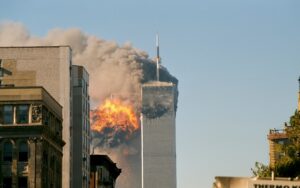
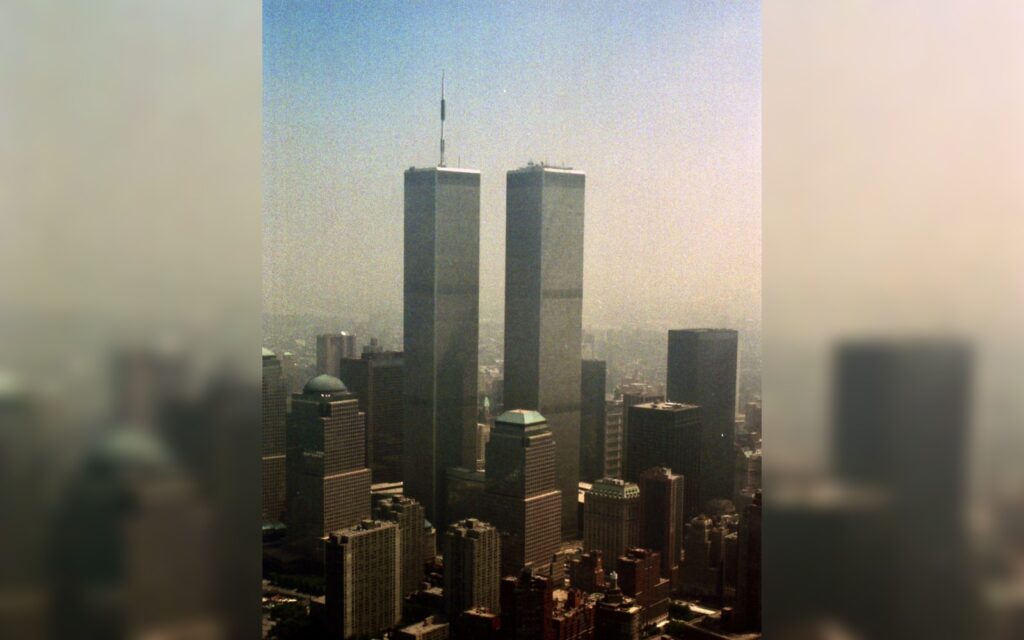
The terrorists of 9/11 brought down New York’s Twin Towers, along with four airliners packed with innocents. But only we stand capable of flying planes into our most fundamental beliefs, traditions and institutions.
And boy, have we.
But how? Why?
From a confluence of noxious factors, really.
Teaching 9/11, American exceptionalism
For one thing, while the media rarely dust off the horrifying video of that day, it’s highly likely schools are doing a much better job indoctrinating our children in America’s supposed continued racism – and trans ideology – than informing them of 9/11.
And consider: Nearly a third of Americans living today hadn’t been born back then.
Moreover, a tsunami of illegal immigrants lured in by Democrat politicians has reshaped the landscape with tens and tens of millions of un-assimilated residents who, however industrious or well-meaning, aren’t inculcated into American culture, governance and tradition. And their hearts are not likely to carry the scars of 9/11 that the rest of us do.
Nor are schools adequately teaching even native-born kids the ins and outs of citizenship and our amazing American experiment in self-rule. Indeed, in his 2016 book If You Can Keep It: The Forgotten Promise of American Liberty, Eric Metaxas wrote that “Most of us don’t understand the idea of self-government enough to be properly astonished by it.”
That’s only become truer since the Biden open-border disaster and the glacial civic disengagement we’ve seen since the 1960s.
How did we get here?
When asked where today’s indigenous anti-Americanism comes from, Google AI says of education alone:
Academic shifts: Many universities no longer teach traditional American history and Western traditions as core subjects.
Focus on Flaws: Curricula often highlight national shortcomings rather than foundational achievements.
Generational Divide: Younger college graduates report lower national pride and higher favorability toward alternative economic systems like socialism compared to older generations.
At the same time, Robert Putnam’s landmark book Bowling Alone chronicles Americans’ pulling away from social and civic clubs, religious institutions and even bowling leagues. Smartphones have only accelerated such social isolation, which has crept into society across six decades.
Nor does it help that one political party, while lurching ever leftward, has endlessly demonized half the country as “a basket of deplorables” – while successive Democrat administrations have used the instruments of state to spy on and even frame their opponents as traitors. (For more, read Lee Smith’s The Plot Against the President.)
The lie that Donald Trump was a Russian asset – created out of whole cloth by the Hillary Clinton campaign and Democratic National Committee, and given completely counterfeit credibility by the outgoing Obama administration and its bad-seed Mueller “investigation” – also ripped American society apart like nothing since the Civil War.
Whatever happened to reverence?
Abutting a crumpling of American religiosity – it sunk 17 points in the decade ending last year – has been a nearly complete collapse in reverence. For anything. For God; for life itself (ShoutYourAbortion.com admits to promoting “normalizing abortion and elevating safe paths to access, regardless of legality”); or for death (one woman – a certified nursing assistant, no less – just posted a video mocking Charlie Kirk’s assassination on its one-year anniversary).
Trust in legacy institutions also is near record lows, Gallup reports.
All along, the word “irreverent” has somehow become a compliment, particularly in entertainment, and the term “Boy Scout” has somehow become a pejorative.
How to change course
What might change all this was presented in a photo that appeared on my social media feed a few years ago: A young football fan, not much more than a toddler, photographed behind the bleachers at a youth game after he’d visited a concession stand. He had stopped in his tracks and put his popcorn bags on the ground to honor the national anthem.
I repeat: behind the bleachers. Not even most adults do that.
It’s a reminder not only of what reverence looks like, but how it’s handed down to succeeding generations: not through DNA, but through teaching. Someone taught that boy to revere his country.
Reverence – for God, family, country – must be taught, both urgently and graphically.
That means, in this day and age, with images such as that little boy standing at attention. Today’s young are increasingly visual learners.
“The learnings of the modern generation aren’t in the textbooks that they read in class,” explains professional training website KnowledgeHut.com. “Rather, they come from visual stimulation such as movies or videos, where words are said in context, or in a catchy tune that you can’t get out of your head. … Studies state the fact that visual learning helps students retrieve more than 85% of what they experience …”
Reverence also needs to be talked and written about. As Paul Woodruff notes in his book Reverence: Renewing a Forgotten Virtue, “We have the word ‘reverence’ in our language, but we scarcely know how to use it. Right now it has no place in secular discussions of ethics or political theory.”
That has to change, in order for the eternal light of reverence to stay lit – and perhaps for our very survival as a nation or a civilization.
Terrorists couldn’t do this
On Sept. 11, 2001, I was tasked with writing not one but two newspaper editorials – one for a special afternoon edition and another for the following morning – about the attacks that were still under way. The work helped me get through the day.
That night, however, like many Americans, I took my family to church, and I could hardly hold back the tears.
In the weeks and months that followed, like many of us, I had a constant churn in the pit of my stomach – as we recoiled from the attacks and braced for more. Then there was the anthrax terror.
But in all of those terrible moments on and after Sept. 11, I never once thought America was in danger of ending.
I can’t say that today.
(Image credit: Photo by Tomas Martinez on Unsplash)