Army plans to detonate nearly five tons of unstable explosive in Iowa
The U.S. Army plans to detonate nearly five tons of degraded lead azide at the Iowa Army Ammunition Plant in Middletown, Iowa, on Wednesday, Nov. 25.
The controlled detonation, rescheduled…

The U.S. Army plans to detonate nearly five tons of degraded lead azide at the Iowa Army Ammunition Plant in Middletown, Iowa, on Wednesday, Nov. 25.
The controlled detonation, rescheduled to allow for better weather and additional safety measures, is planned for approximately 9 a.m. The Army says it will announce a more precise time after assessing conditions. Middletown is 57 miles north of the Missouri border.
Why is the Army detonating it?
Lead azide is a sensitive explosive formerly used in ammunition. During a routine inspection in March, the Army found that material stored in 68 drums had partially crystallized, making it increasingly vulnerable to friction, shock and cold temperatures.
The stockpile was moved to Iowa around 2009, Bureau of Alcohol, Tobacco, Firearms and Explosives Director Robert Cekada said at a Tuesday news conference. President Donald Trump blamed the Obama administration for improperly storing it, though the Army has not attributed the material’s deterioration to that administration.
The lead azide had been stored in a water-and-ethanol solution, but some of the liquid evaporated, allowing the explosive to crystallize, officials said. The Army concluded that opening or moving the drums could trigger an accidental explosion. It also evaluated other disposal methods before deciding to detonate the material in place.
“It’s not a matter of if, it’s a matter of when,” Cekada said, noting that removing a drum lid could set off the material. “There is no other option but to proceed with a controlled detonation.”
Who could be affected?
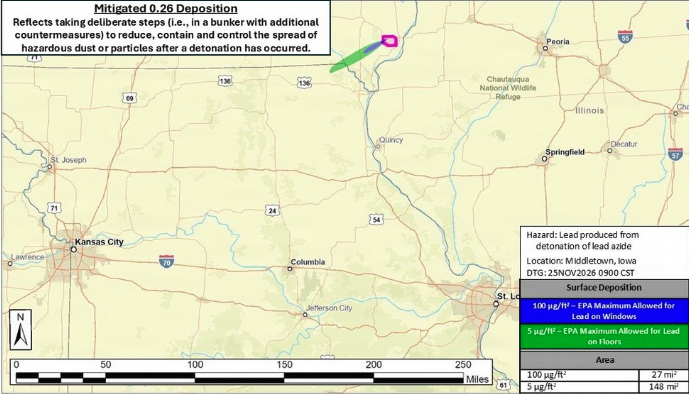
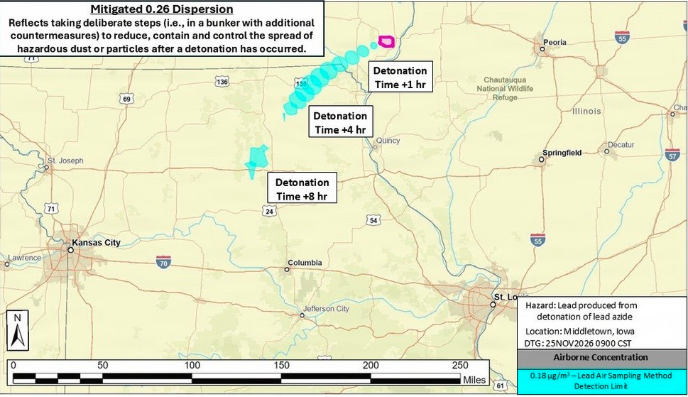
The Army is urging residents of Middletown and other areas within a five-mile zone extending southwest of the plant to relocate before the detonation. Residents outside that zone are advised to stay indoors during the potential exposure period, close windows and doors, and prevent ventilation systems from drawing in outside air. The affected areas may change with the weather; residents should consult the Army’s latest advisory and maps.
Federal officials say they will provide transportation, lodging, food and other supplies to people who need help relocating. Lodging is available through Nov. 27, with additional flexibility for those who need it.
Nearby residents may hear a loud blast, feel ground vibrations and see a dust plume. An earlier Army release described concrete, earth-covered magazines, sand-filled barriers and water measures intended to reduce the spread of lead. The Army’s updated plan includes additional barriers and other measures to contain particles.
“I really want to take a moment to praise the leadership of President Trump and also his chief of staff Stephen Miller,” Federal Emergency Management Agency Administrator Cameron Hamilton said at the Tuesday news conference. “They have made it very, very clear that we are to spare no expense to ensure that Americans are kept safe.”
Even with those precautions, officials expect some lead-containing particles to enter the air and settle on surfaces. The Army says it will test air, soil and water after the detonation and tell residents when it is safe to return.
Illinois is not expected to be affected, according to the Illinois Environmental Protection Agency. Missouri Gov. Mike Kehoe said state officials are prepared to respond if lead-containing dust reaches Missouri.
“We have a lot of work to do after this detonation as well. A lot of work. … The work doesn’t end after the detonation, our responsibility continues to move on,” said Sean Kaufman, principal deputy assistant secretary for preparedness and response at the U.S. Department of Health and Human Services.
(Photo credit: Unsplash, Edgar Serrano)