Analysis: Ukraine’s armed robots could break stalemate with Russia over time
When tanks first appeared in World War I in 1916, they achieved local breakthroughs but failed to deliver decisive victories because the Allies needed time to refine tactics.
A recent…

When tanks first appeared in World War I in 1916, they achieved local breakthroughs but failed to deliver decisive victories because the Allies needed time to refine tactics.
A recent Ukrainian operation may represent a similar turning point in modern warfare.
Operation Vivaldi, a counteroffensive targeting Russia’s main operational effort this year, delivered Ukraine a local victory featuring advanced electronic warfare, drones and armed robots.
And if given enough time and resources, it may have demonstrated how Ukraine can finally defeat Russia while validating new tactics in modern war.
The developments come as European leaders have agreed, at least in principle, to finally negotiate with Russia over ending the war, the BBC reported, indicating that time may not be on Ukraine’s side.
Ukraine’s army used sophisticated techniques to blind Russian drones while attacking with robots armed with machine guns and, in one instance, a repurposed drone to deliver robots to the battlefield, Reuters reported.
“[The battle] demonstrated how Ukraine might achieve an operational-level breakthrough on the contemporary battlefield,” wrote Robert G. Rose, the chief research officer at West Point’s Modern War Institute.
Rose noted that the new tactics and cheap technology allow Ukraine to do something that it was previously able to do only intermittently and episodically: strike deep behind Russia’s lines.
The deep strikes may allow Ukraine to stop fighting a battle of attrition, which favors Russia by virtue of its larger numbers of people and resources.
One expert interviewed by Reuters called the operation a “significant defeat” for Russia but noted that its value was only “local in its impact.”
The developments demonstrate that robot soldiers are increasingly a part of any modern army’s arsenal, but it would be a mistake to believe that the capability is unique to Ukraine.
Rose added a caveat that Russia “adapts, learns, and mobilizes additional resources” just as Ukraine does.
He called on Ukraine’s defense industry to maximize production and eliminate corruption to allow the production of enough new combined-arms technologies “required for an operational breakthrough.”
Still, the local impact of the Ukrainian operation isn’t to be underestimated.
Russia’s main military goal for 2026 was to capture the region targeted by Operation Vivaldi, known as the Fortress Belt, in order for Russia to secure the high-population cities and break into Western Ukraine, which would help restore mobility to the Russian army.
Russia has been counting on grinding down Ukraine through sheer numbers after failing to secure a quick victory.
But the Ukrainian high-tech offensive could change the calculation.
“The Ukrainian counteroffensive known as Operation Vivaldi in the Lyman direction has completely disrupted this Russian plan by inflicting an operational defeat on the northern Russian pincer,” wrote the Institute for the Study of War (ISW).
The Ukrainian victory “fundamentally unhinged the Russian campaign” in the region for 2026, ISW said.
But the Reuters report acknowledged that the results favoring Ukraine may have been “amplified by Kyiv through a sleek media campaign around a rare piece of good news” for the tiny nation that has been standing up to the Russian Bear for nearly five years.
West Point’s Rose also acknowledges that the benefits from the counteroffensive may be at least as valuable for domestic and international public relations as they are strategically, noting that the country now relies on the draft to fill 90% of its manpower needs.
“Ukraine must provide a clear theory of victory to mobilize the support of its international partners,” he wrote. “Ukraine needs a narrative that explains to foreign donors what support to prioritize and how their support will contribute to victory.”
European willingness to negotiate may have been stoked by the growing realization that the costs of the war are increasingly difficult to justify – an argument made consistently by U.S. President Donald Trump, who has called on Europe to pay a larger share of the war’s costs.
Trump has also complained that even as the U.S. has imposed significant financial sanctions on the former Soviet Union, Europe has continued to freely buy energy from Russia.
“Europe has sadly spent more money buying Russian oil and gas than they have spent on defending Ukraine by far,” said Trump in March 2025.
An investigation by Germany’s Der Spiegel published Thursday details that since 2022, Europe has spent roughly as much money buying energy from Russia as it has committed to Ukraine in military aid.
The magazine estimated that Europe sent $254 billion worth of aid to Ukraine versus $255 billion worth of energy purchases from Russia.
“Europe is paying as much for [Russian President Vladimir] Putin’s energy industry as it is for the resistance against him,” said one former member of the European Parliament from Germany.
Making the numbers more damning, about $90 billion in total aid from Europe has come in just the last 21 months, after Trump told European nations to pay a higher share for the war.
The question now is whether the U.S. and Europe will continue to allow Ukraine to be the laboratory fostering the tactics required for these new technologies to be decisive against Russia.
War, as Trump has pointed out frequently, is costly not just in money but in real human lives.
Just as French Gen. Philippe Pétain in World War I rejected the wholesale slaughter of trench warfare, experts have compared that war’s “thousands of kilometres of trenches, dugouts and foxholes” to the current stalemate between Russia and Ukraine, the Globe and Mail reported.
As an alternative, Pétain opted for a strategy that waited for an old ally and a new technology to save lives and create a breakthrough.
“I shall wait for the Americans and the tanks,” he said.
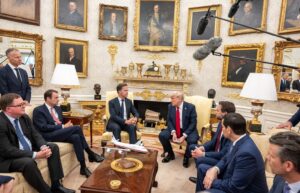
(Image credit: Screenshot/YouTube/Reuters)