‘Destroying the dignity of human life’: Four states ask voters to consider abortion in midterms
Four ballot initiatives, split evenly between red and blue states, ask voters to either legalize, constitutionally protect or restrict abortion in their states.
The ballot initiatives are…

Four ballot initiatives, split evenly between red and blue states, ask voters to either legalize, constitutionally protect or restrict abortion in their states.
The ballot initiatives are “exactly what the Dobbs decision was intended to do,” Pacific Justice Institute Legislative Counsel Andrea Hitefield told Heartlander News, referencing the 2022 Supreme Court decision that overturned the national legalization of abortion under Roe v. Wade.
Hitefield explained that many Christians and pro-life Americans celebrated the Dobbs decision too early, assuming the victory was won. But the Supreme Court’s decision simply moved abortion from a federal matter to the states.
“It returned the decision of abortion back to the states, and these states are putting that decision on the ballot and asking the people in the state: ‘How do you feel about abortion? Do we want to make this a right forever and put it in the Constitution, or do we just run some state level bills?’”
Nearly half of Americans (49%) believe abortion should be illegal in all or most circumstances, while 48% say it should be legal in all or most circumstances, according to a June Gallup poll.
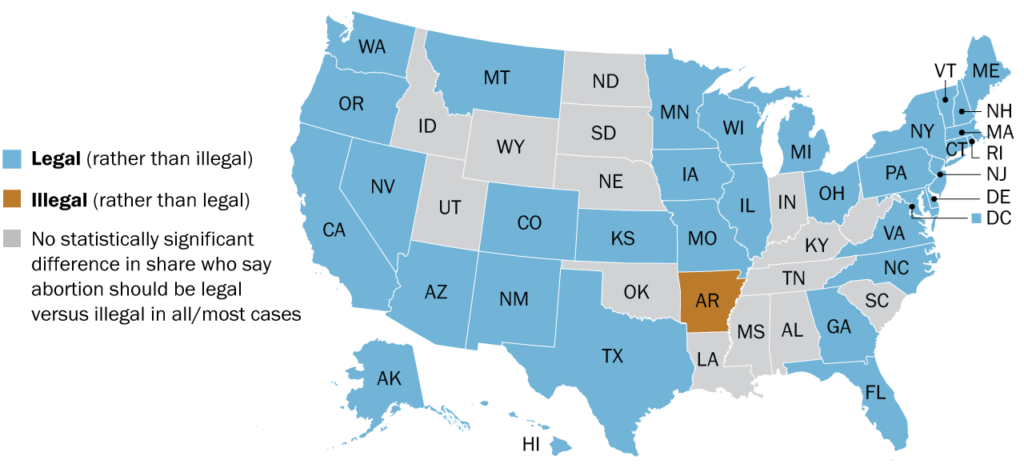
At the state level, most people in 34 states say abortion should be legal in all or most cases, and opinions are nearly tied in 15 states, according to a March Pew Research poll. Arkansas is the only state where a clear majority of residents (57%) say abortion should be illegal.
Idaho
Idaho, one of 13 states with an abortion ban, is asking voters to consider a statutory amendment that would legalize abortion up to fetal viability – around 24 weeks of gestation – and even later in circumstances involving the “health or life of the mother.”
Fetal viability is generally recognized to be around 24 weeks of gestation, but no legal definition sets that number, Hitefield explained, calling the term “squishy.”
“The problem with viability is that it changes,” she said. “So, it is a scientific statement. It is a scientific definition more than legal or legislative. And because it’s scientific, it will change with time.”
Viability means a baby can survive outside the womb. But with scientific advancements, that age shifts, Hitefield explained, adding that the standard of viability in 1973 under the Roe decision was 30 weeks.
She also explained that viability can depend on access to quality medical care, referencing rural states that may not have neonatal hospitals nearby. A viable baby still needs extensive medical care. If that assistance is not close, Hitefield theorized, could a doctor deem the pregnancy unviable and perform an abortion? She noted the lack of clarity in abortion law that does not exist in other areas of law.
“Murder is still murder. That hasn’t changed over the past 100 years, so it’s [fetal viability] just a squishy one,” she said. “It makes me uncomfortable when I see it in a bill because it can be loose.”
Currently, Idaho bans abortion at all stages except to save the life of the mother. But Proposition 1, the “Reproductive Freedom and Privacy Act,” would legalize abortion under language such as:
“. . .the government can not interfere with the following personal decisions about reproductive healthcare” including, “abortion, childbirth care, contraception, fertility treatment, miscarriage care and prenatal, pregnancy, and postpartum care.”
Idaho Chooses Life CEO David Ripley previously told Heartlander News the measure would violate nearly “every pro-life law the Legislature has enacted over the last 30 to 40 years.” As a statutory amendment, however, the proposition would not change Idaho’s Constitution, and the state Legislature could amend or repeal it if passed, according to Multistate Insider.
Missouri
Missouri is the other red state considering abortion this election. Missouri Amendment 3, “Prohibit Abortion and Gender Transition Procedures for Minors,” asks voters to reconsider the 2024 amendment that changed Missouri’s Constitution to legalize abortion until viability. The 2024 measure passed with 51.6% of the vote, according to Ballotpedia, and included heavy spending from out-of-state groups, something that is continuing this cycle.
Kate Sickles, the statewide Amendment 3 coordinator for Freedom Principle Missouri, explained that outside groups spent more than $31.4 million on the pro-abortion initiative in 2024 and “deceived people” about its provisions.
“They were putting out commercials saying that women were in hospital parking lots dying from lack of miscarriage and lack of ectopic pregnancy care, and people believed that,” she told Heartlander News. “And it was also very confusing.”
Pro-life groups spent just $1.3 million opposing the 2024 amendment.
Before that amendment passed, the Show-Me State had a total abortion ban, including in cases of rape and incest. This year’s Amendment 3 would still permit abortion in those cases. A February St. Louis University YouGov poll found that more than 75% of Missourians support abortion after rape or incest, Sickles noted.
Amendment 3 would ban abortions at any stage except in cases of “medical emergency, fetal anomaly, rape, or incest, and permit abortions in cases of rape or incest no later than 12 weeks of gestation,” according to the ballot language. It would also prohibit sex-rejecting surgeries and procedures for minors, including puberty blockers and cross-sex hormones, except for cases “unrelated to the purpose of a gender transition.”
Missouri’s SAFE Act currently prohibits these procedures, but protections against puberty blockers and hormonal drugs are set to expire next August, Sickles explained.
“So, we’re fighting to get most of the abortions out. We’re fighting to get the women’s health and safety back and we’re fighting to get a permanent ban on transgendering of children into our constitution,” she said. “So those are the three – I call it the three legs of the stool – that we’re trying to do, and all three of those we believe are in line with what Missouri voters believe. That this is our values.”
Pro-abortion groups are significantly outspending the pro-life side, with more than $25 million spent against the amendment compared with less than $7 million supporting it, according to ABC 17 News. More than 95% of the pro-abortion money comes from out of state, compared with more than 85% of in-state financial support for the amendment, Sickles added.
“So, we are fighting this battle against well-funded special interest groups outside of the state of Missouri that are trying to bring this language into our constitution,” she said.
The matter will be decided Tuesday, Nov. 3.
Nevada
In Nevada, voters are considering an abortion amendment for the second time, under a state policy requiring constitutional amendments to pass in two consecutive elections. Question 6, the “Right to Abortion Initiative,” would amend Nevada’s Constitution to legalize abortion up to fetal viability or whenever “medically indicated to ‘protect the life or health of the pregnant patient.’”
“The Constitution of the state carries much more weight than the statute. So having these issues on your voter ballot, having them ratified in the constitution, is a much bigger issue than having a bill pass through the legislation,” Hitefield explained.
Voters passed Question 6 in 2024 64.4% to 35.6%. If passed again, the measure may require an undisclosed sum of taxpayer funds because the amendment to the Constitution would make current abortion laws unconstitutional and require additional legal changes, as previously reported.
Nevadans for Reproductive Freedom launched a $1 million ad campaign in September to support Question 6, adding to the more than $800,000 raised in support of the amendment as of July. Cumulative sums raised against Question 6 had not reached $12,000 by late July, according to The Nevada Independent.
Virginia
Virginians are considering Question 1, the “Right to Reproductive Freedom,” which would constitutionally permit abortion through the second trimester and into the third if “the fetus/baby is not viable or a physician determines an abortion is necessary to protect the life, mental health, or physical health of the mother.”
Virginia law currently permits abortion through 24 weeks of pregnancy. But the constitutional amendment would extend legality to 28 weeks of gestation – the beginning of the third trimester – and perhaps further under the specified circumstances.
Hitefield dissected Question 1’s vague language, demonstrating the extreme scope of abortions the amendment could enable.
“This sentence to me was written vaguely in order to sweep very broad,” she said. “This sweeps way too broad and can catch any, basically any abortion under this.”
The text requires only one physician and does not specify how the physician determines that “an abortion is necessary,” Hitefield said, asking whether the determination is based on medical knowledge, a test or simply the physician’s opinion.
The definition of “protect” is also unclear, she said.
“Protect to what end? To protect the life is very different than to save the life,” she said.
The broad term “mental health” opens the door to late-term abortions, Hitefield noted, referencing a 2022 statement from the American Psychiatric Association that defended abortion as a mental health imperative or treatment. But every pregnant woman experiences fluctuating hormones – both hers and her baby’s – that often induce “flooding emotions,” Hitefield explained.
“Because if I’m eight months pregnant, my boyfriend breaks up with me, and now I say I can’t handle taking care of a kid, I’m going to commit suicide or something,” Sickles explained, noting that many states have also changed viability to mean the baby must survive outside the womb without medical assistance.
“They can easily get a late-term abortion – dismemberment, partial birth abortion.”
The broad meaning of “mental health” could bring constitutional challenges, Hitefield said, referencing constitutional and legal protections for “ordinary people” to understand the meaning of a statute or law.
“Legally, a bill can’t be vague,” she said.
Abortion on a national scale
In 2024, of the 11 abortion measures passed by states, Arizona, Colorado, Maryland, Missouri, Montana, New York and Nevada expanded abortion access. Three states, Florida, Nebraska and South Dakota, rejected abortion amendments, while Nebraskans passed a pro-life protection against abortion after the first trimester, approximately 12 weeks of pregnancy.
In 2022 and 2023, California, Michigan, Vermont and Ohio passed pro-abortion measures, while Kansas, Kentucky and Montana rejected pro-life proposals.
Only 15% of Republicans, compared with 75% of Democrats, say abortion should be legal in all or most cases. Among independents, 48% favor legality, according to Gallup’s poll. Nearly three-fourths (73%) of conservative Republicans say abortion should be illegal, while 93% of liberal Democrats say it should be legal, according to Pew. More than half (53%) of moderate Republicans and 77% of moderate Democrats support legalizing abortion.
A small majority of Americans (53%) identify as pro-choice – 56% of women and 48% of men – and only 41% say abortion is morally wrong, according to Gallup.
“I think we as a society, as a culture, the current zeitgeist that we are in America, is destroying the dignity of human life,” Hitefield said, encouraging voters even in states without abortion on the ballot to pay attention. “I think we see that at the end of life with medical aid in dying. And then we have, at birth, abortion slowly encroaching dignity, and then we have the transgender slowly encroaching on the dignity of the human life and what it means to be human in the middle. So, I see these all as sides of the same coin that we are leaning in this way that is destroying the dignity, the value of the human.”