More students with disabilities enroll in school choice programs than in traditional public schools, report finds
Children with disabilities are just as likely, if not more likely, to attend private schools as public schools, according to new research countering a decades-long objection to school…
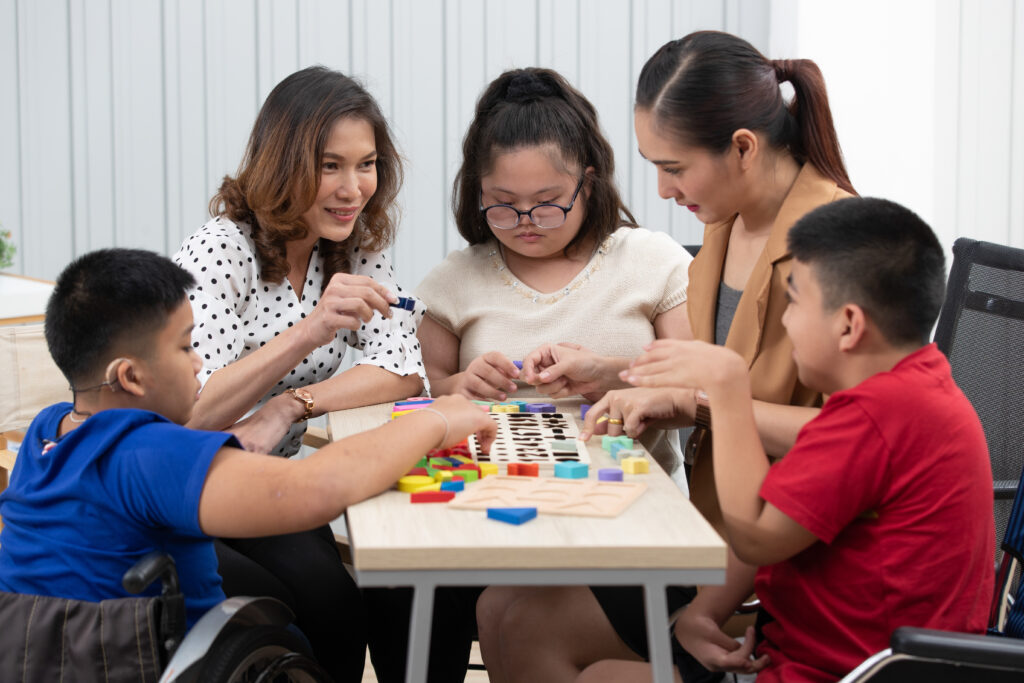
Children with disabilities are just as likely, if not more likely, to attend private schools as public schools, according to new research countering a decades-long objection to school choice.
The report, released by the American Enterprise Institute and conducted by several EdChoice analysts, estimated that 15.5% to 17.2% of students in private school choice programs have disabilities, compared with 15% of students in public schools.
The data contradicts the belief that private school choice programs exclude students with disabilities, said EdChoice Senior Research Analyst John Kristof.
“This seems to counter the narrative that students with disabilities are going to be left behind in these private school choice programs because not only are there a bunch of programs specifically targeted to them that wind up being fairly sizable in number, but even, in more broad-based school choice programs, quite a number of them participate,” Kristof told Heartlander News in an interview.
For years, school choice opponents have claimed that increased access to private education would lead to a higher concentration of students with disabilities in public schools.
“That hasn’t happened,” the study states. “Students with disabilities are served in choice programs at a rate higher than that in the public school sector.”
The Individuals with Disabilities Education Act (IDEA), passed as the Education for All Handicapped Children Act in 1975, aimed to “ensure that all students with disabilities have access to schooling,” according to the report. But because private schools don’t fall under federal governance, many school choice opponents assume that private schools underserve students with disabilities because they don’t adhere to IDEA, Kristof explained.
“There’s an assumption that ‘well, if there’s not that governance, then the kids aren’t going to be helped in the private school system,’” he said.
The American Civil Liberties Union argues that school choice will “further segregate and impoverish the education of students with disabilities.” The National Education Association, the nation’s largest teachers’ union, claims that “vouchers continue to discriminate against students with disabilities, strip away students’ human and civil rights and exacerbate racial segregation.”
But Kristof and the report said those fears are unfounded.
Why parents are choosing private education
The study details two motivations for parents: Public education often “pushes” them to search elsewhere, while private education often “pulls” parents in through specific, adaptable special-needs programs.
“Parents of students with disabilities appear to be drawn to private school choice programs to exercise the parental influence over education,” the report states.
Kristof explained that parents of children with disabilities often choose private education either out of frustration with the public school system or because of better, parent-involved programs in smaller schools.
“The way IDEA works is you, as a parent, you kind of deal with what your school district gives you, and it can take, not always, but it can take a lot of fighting if that’s not working to get something else,” he said.
Approximately 1.5 million K-12 students enroll in private education through choice programs, including tax-credit scholarships and education savings accounts (ESAs), meaning more than 250,000 children with disabilities receive assistance and educational opportunities through school choice, according to the report.
Many private schools serve students with special needs, and some exist specifically for that purpose.
“I’m not saying every single non-public school option is going to be better than every single public school option,” Kristof clarified. “That’s not what I’m saying at all. But what I do know is that there are a lot of non-public school options out there with some specialized knowledge in how to deal with the adaptations needed for something like autism, for something like dyslexia, for all kinds of disabilities that are out there, and where those options exist, and where school choice makes the finances work out a little bit better, there can be a pull toward that.”
Of the three models for funding private education, ESA programs “appear to be more attractive” to parents of children with disabilities because of their flexibility, the report notes. This flexibility allows parents to direct or influence their children’s education, including the specific programs they use and the extent to which they participate in peer interactions and classroom learning.
School choice opponents’ claims refuted
Even after the data, some opponents of private education claim that the higher percentage of students with disabilities in private schools must reflect children with less significant challenges, while children with more profound conditions remain in public education, Kristof noted.
“I think their implication, though they don’t say it out loud, is ‘okay, well, the “easier” kids with disabilities will go to the private schools because that’s cheap. . . so it doesn’t like really count, and still like the highest, the most difficult to adapt to disabilities remain in the public schools,’” he said.
But Kristof researched Arizona’s school choice policies, which categorize the total percentage of students with disabilities by specified conditions. He found that more than 50% of students with disabilities in ESA programs report having autism – one of the most expensive disabilities to accommodate in schools, according to the state.
Studies show that students with disabilities spend more than 80% of their day with peers without disabilities and perform better on English and mathematics assessments after greater classroom inclusion, defined as more than 80% of daily instructional time, according to EdChoice. These numbers also counter the claim that students with disabilities will not receive the same educational or inclusion time emphasized by IDEA and other federal laws.
Another common argument among school choice opponents is that special-needs education requires significant funding, making the quality of education and opportunities vary from school to school. But the national average per-student spending on students with disabilities in traditional public schools (TPS) is $13,127, according to EdChoice.
Various state school choice scholarships also help families cover these costs. Florida’s Family Empowerment Scholarship for Students with Unique Abilities assists more than 75% of all students with disabilities in school choice programs, according to the report. Kristof explained that this is likely due to how long the program has existed – the scholarships launched in 2014 – and the size of the state.
“The momentum in expanding choice is bringing on board lots of families who are seeing the results they’ve long hoped to see,” EdChoice’s article concludes.