Educating in ethnic heritage, language in Israel: The historical origins of Arameans from B.C. to today
A small remnant of one of the first peoples to follow Christ is reclaiming its heritage and identity, rooted in the northern region of Israel, despite the prominence of Arabic education and…
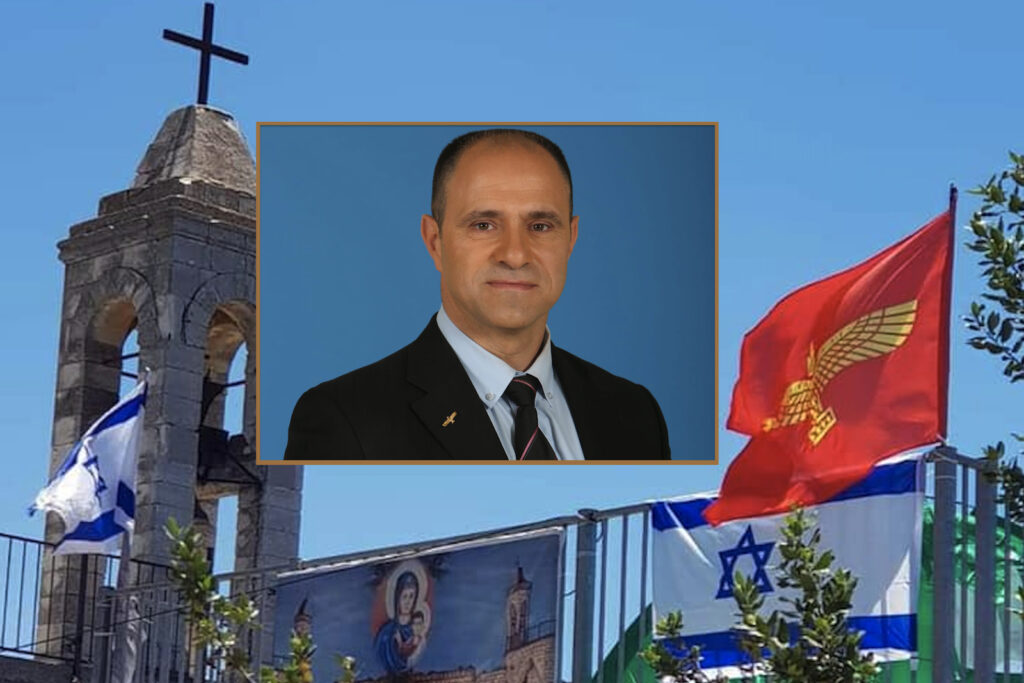
A small remnant of one of the first peoples to follow Christ is reclaiming its heritage and identity, rooted in the northern region of Israel, despite the prominence of Arabic education and political tensions in the land.
“We are helping our people to reconnect back to the roots, to the Aramaic roots, to the Aramaic identity, to know their language, to connect to their forefathers, and it takes time,” Israeli Christian Aramaic Association founder Shadi Khalloul told Heartlander News in an interview.
The Israeli Christian Aramaic Association works to preserve “ancient Christian heritage in the land of its birth,” with a primary focus on Aramaic identity, heritage and language, and on “rebuilding the first Christian Aramaic community and town in the Galilee of northern Israel,” according to its website.
The website’s logo combines the historic national Aramean flag, which depicts an eagle representing liberty and strength, Khalloul explained. The eagle’s heart is the cross of Christ, and the two symbols on the wings depict Mount Lebanon (right) and a tower (left), representing the Arameans as guardians of both the Christian faith and Aramaic heritage, he said.
A key way to preserve Aramaic culture is through education, Khalloul said.
“We consider education as a cornerstone for saving our Aramaic language and identity from dying and revitalizing it at one point,” he said. “Until today, Christians in Israel’s Ministry of Education are learning under Arab curriculum, which means Islamic history, Arab language without studying their own history and Aramaic language. . . This leads to weakness of Christians here, disconnection from our roots and losing our future existence.”
Arabs frame anyone who culturally resists Arabic education as a “betrayer” and a “collaborator” with Jews and Zionists, Khalloul explained.
“Either you are with them against the Jews and Israel, or you are a collaborator and betrayer,” he said, adding that the Islamic state imposes Arabism or an Arab identity on students in the classroom.
But Arameans are not of Arab heritage and must learn their own culture and history, he said, explaining that without this education, the Aramaic people are like “a tree cut from its roots – it will die.”
“No, we are not Arabs, we are Arameans,” Khalloul said. “Now we need to educate people and tell them more because even our people that were learning only in Arab schools and Arab curriculum, they didn’t know anything about their identity. Even Christianity, they didn’t know about.”
Ancient history of the Arameans
The Arameans date to 2,000 years before Christ and are often called Syrians in the Old Testament. They are a Semitic people, descended from Aram, the son of Shem and grandson of Noah, who occupied the region called Aram – the land of Mesopotamia, directly northeast of Israel and extending to the Euphrates River. The land came to include the biblical cities of Damascus and Antioch in the New Testament.
“The Arameans are all Christian population that are originated from here, from the land of Israel, from the Levant,” Khalloul said, specifying that the Levant includes the lands of Israel, Lebanon, Syria and Iraq.
Their language, Aramaic, became the “lingua franca,” or common intercultural language, and was widespread throughout the Middle East around the eighth century B.C., Khalloul explained. Even the Persian and Assyrian empires adopted Aramaic, spreading the tongue from Egypt to Afghanistan, he said.
Because of its widespread use, Aramaic was the vernacular language of Jews during the time of Jesus – Jesus Himself spoke it – and Arameans were among the first followers of Christ. The Church of Antioch, founded by the apostle Peter, was later called the Syriac Maronite Church or the Syriac Orthodox Church of Antioch. Both still exist today.
With the spread of Christianity, evangelists often shared the Gospel in the common Aramaic tongue, and archaeological inscriptions suggest the language even reached China.
But most people are unaware that Aramaic is still spoken today.
“This language is alive 4,000 years. It is continuous 2,000 years before Jesus. And 2,000 years after Jesus, as now, it’s still spoken,” Khalloul said.
The Aramean people dispersed during numerous wars and periods of persecution after the rise of Islam in the seventh century A.D., Khalloul explained, adding that the majority of the population in Israel at that time was Christian. The communities in Israel faced a choice: convert to Islam or pay jizya, a tax imposed on non-Muslims.
“These Muslims, Arabs who came from Arabia, Saudi Arabia of today, with their forces, armies,” Khalloul said. “They forced on us either submission to Islam or stay a Christian or Jew and pay jizya – means tax protection for not harming you or your family or raping your women or taking your daughter or your children, and selling them.”
Many converted to Islam and began speaking Arabic, losing their Jewish or Aramean identity, he explained, adding that “the only ones who stayed and decided to fight back for their existence and defend their lands were the Aramaic Syriac Maronite people in Lebanon.”
These resisters, now called Maronites, fought Islamic forces until 1305 A.D., when, Khalloul said, the Ottoman Empire besieged the land and cut off all economic trade and food. Those who did not perish fled to Europe and America, causing a great diaspora among the Arameans, with only a handful remaining in the Levant.
Preserving Aramaic language, identity
After the establishment of Israel as a state in 1948, Jews, Christians and some Arameans returned to their homeland.
Khalloul, however, had his eyes fixed on the American dream. He served as the first Christian paratrooper officer in the Israel Defense Forces from 1993 to 1997 and moved to America to pursue an undergraduate education at the University of Nevada, Las Vegas.
He took a Bible class to fulfill his English literature requirement. During a lecture on Mark 5:41, when Jesus raises the centurion’s daughter, saying “Talitha cumi,” the professor noted that the phrase is written in Aramaic. He explained that this was the common language Jesus spoke but that it had since died.
“Instructor, sorry, the language didn’t die. We still exist,” Khalloul objected. “We still pray in this language. We still speak this language in daily life.”
The next week, Khalloul presented the history of the Aramean people to his class and taught them the Lord’s Prayer in “Jesus’ language,” which his church – the Syriac Maronite Church of Antioch – still recites.
Khalloul’s professor and classmates encouraged him to return to Israel, advocate for his people and preserve their language.
“I am here trying to build my American dream, and now these guys are pushing me back to Israel,” he said. “They want me to help my community and I am running away from my community. So they are pushing me back home to build Aramaic dream. It’s Aramaic. It becomes Aramaic dream now, not American dream.”
Since his return to Israel, Khalloul has been educating his community and advocating for official recognition of the Aramean people. He lobbied the Israeli government and finally achieved recognition for Arameans as a distinct ethno-religious group in 2014, when Interior Minister Gideon Sa’ar approved “Aramean” as a nationality on Israeli identification cards.
“I convinced him to recognize our Aramaic identity, not only to not register us as Arabs, but as Aramaic people, because we are not Arabs, we are Arameans,” he said.
He is now working to convince his community members to register as Arameans, which he said is a slow process.
“And hopefully, within time, people will register by themselves back to Aramaic identity, and it’s a process. It’s not easy,” he said.
Khalloul is educating his community about its heritage through speaking engagements, summer camps and educational curricula. He received an official permit from the state to teach Aramaic in elementary schools, despite opposition from the Arab population in Israel. He also won a case before the Israeli Supreme Court to secure cultural education for Aramaic children, including language instruction and free transportation, he said.
He is also hoping to build the next “Christian Aramaic town,” with a corresponding school in the Galilee region near Haifa, where 18,000 Christians reside. He said he “already has the green light” from Prime Minister Benjamin Netanyahu. Israel’s Christian population is approximately 182,000, and Arameans make up about 120,000 of that total, he said.
He said he hopes these efforts help “build bridges” between Christians and Jews by providing Christians with Aramaic history and heritage that tie them to the land.
“And by connecting back to the Aramaic roots, they will be able to integrate better within the state of Israel as equal citizens and not feeling that they are part of a conflict that’s called an Arab conflict against Jews and that we have nothing to do with it as Christians,” he said.
(Image credit: Screenshots/Israeli Christian Aramaic Association)