U.S. Airman shot down over Iran credits prayer and God’s protection for survival: ‘modern-day miracle’
A U.S. Air Force officer is opening up about the harrowing ordeal in April that unfolded after he was shot down inside Iran, crediting God’s protection for his survival and calling his rescue an…
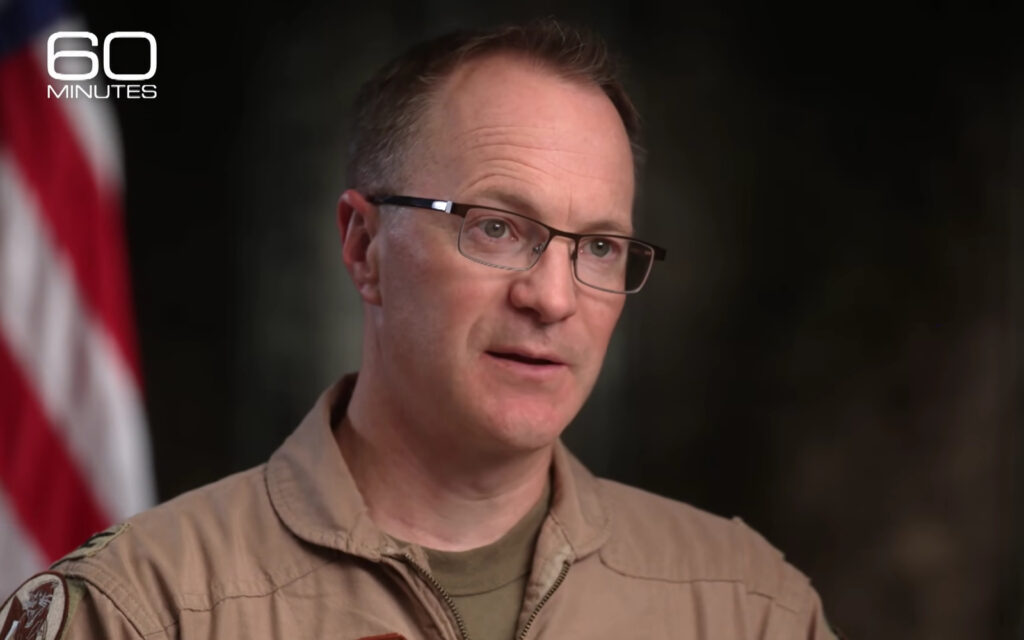
A U.S. Air Force officer is opening up about the harrowing ordeal in April that unfolded after he was shot down inside Iran, crediting God’s protection for his survival and calling his rescue an example of America’s commitment to “leave no man behind.”
The officer, identified publicly only by his call sign, DUDE 44 Bravo, was one of two crew members aboard an F-15E that was struck by an Iranian missile April 2 in the early weeks of the conflict – forcing both men to eject over hostile territory.
Their ejection set off a dramatic U.S. rescue operation.
Bravo recounted his story during an interview with CBS’ 60 Minutes, describing the moments from the missile strike until his eventual rescue. 60 Minutes agreed to use only his call sign due to security threats from Iran.
“That day was just another day in the war for us, until the moment where we got hit by an Iranian weapon,” he said.
The missile’s impact, he said, was like “getting hit by a freight train.”
“[We] found ourselves floating over the heart of Iran,” Bravo said, crediting his crewmate, Alpha, for ejecting them.
The two men may have survived the strike, but they were far from safe.
Bravo’s troubles began almost immediately when he realized his parachute – his lifeline for those few brief moments – was not fully deployed.
“My parachute was damaged in the initial attack,” he said. “At one point, when I looked up and saw no parachute, that was the … most terrifying thing I’ve ever seen. So I paused right then, and I prayed, ‘Lord, Your will be done. But if I’m getting through this, I need help.’”
Bravo was free falling with a compromised parachute over enemy territory, unsure whether he would survive or where he would land. He also was about five miles from his crewmate.
“I wasn’t focused on the speed at which I was falling. I was instead focused on trying to correct the problems that were in front of me, and doing anything I could to unfurl or pull pieces of the parachute loose,” he said.
It is estimated he hit the ground at speeds between 70 and 100 mph.
Somehow, he lived to tell about it.
“A modern-day miracle,” he said, describing his survival. “I believe that it’s a testament to God’s provision in my life to bring me through that moment in a way that didn’t prevent injuries, but prevented any catastrophic injuries that would have affected my ability to survive.”
The impact left him with a broken back, arm and shoulder, along with a sprained ankle and cuts across his head and face. Incredibly, though, he was still able to move.
“Iran is the size of Alaska, and in the heart of Iran, where we were, there are high desert valleys, but also amazing craggly cliffs, and so I find myself in one of those valleys with cliffs on either side.”
It was nighttime.
Bravo pushed through the pain and began climbing a 7,000-foot ridgeline, determined not to be captured and paraded on Iranian TV. That motivation drove him. (U.S. military officials later said Iranian forces got to within a few hundred yards.)
Help was on the way, but it didn’t arrive immediately. In the daytime, hours after the two men ejected over Iran, a U.S. mission involving 21 aircraft rescued Alpha during a daring raid – but was unable to find Bravo.
It would take direct communication from Bravo to let rescuers know he was still alive. He sent a brief message confirming he had survived and was moving, though injured. He also made clear the faith that had sustained him.
“I sent ‘God is good’ as a recognition of all that He had brought me through,” Bravo told 60 Minutes.
U.S. military officials delayed the mission to extract Bravo another 24 hours, meaning he would have to survive on his own, in the cold, with little food or water. During that time, the CIA launched a deception campaign to trick Iran. The U.S. also bombed Iran’s nearby Revolutionary Guard.
Finally, the rescue operation to retrieve Bravo involved about 90 people on the ground – and several hundred in the air.
U.S. military personnel reached Bravo roughly 50 hours after he had been hit, but the mission was not over. That’s because the rescue aircraft landed on a desert airstrip, but the landing gear became stuck in the sand. Another Air Force unit was brought in to help free the aircraft.
“This is not a story about what I went through,” Bravo said. “Instead, it’s a story of the teamwork, of the training, of the faith, of the decisions and leadership to do something that will live in history, as an example of what America is willing to do in order to uphold our promise and leave no man behind.”
(Image credit: Screenshot/CBS 60 Minutes)