Analysis: Democratic Fed governor admits economy is roaring under Trump, and he hates it
Democratic Federal Reserve Gov. Michael S. Barr said Tuesday the economy is gaining momentum with resilient consumers, strong business investment and a capital-spending boom driven by artificial…
Democratic Federal Reserve Gov. Michael S. Barr said Tuesday the economy is gaining momentum with resilient consumers, strong business investment and a capital-spending boom driven by artificial intelligence.
He then admitted the Fed is moving to kill the growth even as core inflation is at its lowest level since before the Biden affordability crisis struck.
“With economic growth strong and the labor market solid, we need to address risks to achieving our inflation target in a timely fashion,” said Barr, the man who helped lead Fed policy to nearly double-digit inflation in 2022 under Biden.
Barr and others at the Fed want inflation at 2%.
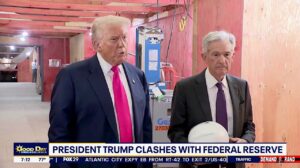
But critics, including President Donald Trump, argue political disagreements, not economics, are really driving interest rate policies.
Barr, who served as assistant secretary of the Treasury for financial institutions under President Barack Obama and was appointed to the Fed by President Joe Biden, made his comments at the Detroit Economic Club.
Economy gains momentum, data shows
Data has been accumulating that despite the Fed’s reported hostility to Trump, the economy is beginning to regain much of the momentum it had prior to the war in Iran.
The real-time estimate of gross domestic product (GDP) from the Atlanta Federal Reserve puts third-quarter GDP at 5%, which would mark the best quarterly economic growth since the COVID-19 pandemic recovery.
Despite stories of consumers being constrained by inflation, consumer spending today accounts for 2.84 points of the growth, or 57% of GDP, at the high end of normal.
Unemployment is also slowly trending downward, not helped by a Fed that has been signaling higher interest rates to fight inflation since the beginning of the Trump administration.
In fact, outside of oil prices impacted by the Iran war, core inflation has continued on a downward trend under Trump.
Earlier this month, the Census Bureau reported the U.S. recorded the highest real median household income in history.
“In 2025, median household income was $87,460, an increase of 2.6 percent from the 2024 estimate of $85,210,” said the Census report.
At the same time, the Census Bureau announced poverty levels have fallen to historic lows.
“In 2025, the official poverty rate fell 0.5 percentage points to 10.2 percent,” said the report.
That’s down from nearly 22% in 1959, and well off the 15% poverty rate the U.S. reported under Obama.
Still, the labor market has not been as hot as the rest of the economy – likely the result of the Fed’s position on interest rates, which saw real rates move persistently higher.
Interest rates hit consumers, jobs
Higher interest rates tend to increase unemployment and slow job creation while increasing credit costs.
In fact, the increase in the cost of credit is much higher than the increase in the cost of oil over the period from 2021-26. Credit-card interest rates are up 35% and auto loan rates are up 48%, versus West Texas Intermediate crude prices, which are up just 28% over the same period.
“Expect auto loan and credit card rates to jump first – with payments climbing by a few dollars on average – adding strain to households already holding a record $18.8 trillion in debt,” said The Week after the latest rate hike.
The Week predicted the Fed will continue to raise interest rates this year.
Trump can’t control oil prices, but the Fed can certainly control interest rates.
That’s why Trump would like to see lower rates to help consumers with affordability concerns and job creation.
Fed confused by job market
But the Fed has argued the job market on the one hand is too cold, yet on the other hand it’s too hot.
“Zero net job creation in the private sector” and a U.S. economy “dealing with very, very low, nonexistent really, growth in the labor force,” former Fed Chair Jerome Powell claimed to reporters last year. “Which, of course, we’ve never had in our history.”
It’s an odd comment for a Fed chair to make when he’s arguing for higher interest rates, which would hit employment first.
And in fact, it’s at odds with what his compatriot Barr told the audience in Detroit.
“Job creation has averaged around 80,000 a month this year,” Barr said, “close to reasonable estimates of its breakeven pace, and the unemployment rate of 4.1% is close to many estimates of maximum sustainable employment.”
But Barr, too, is guilty of trimming his sails to justify another rate hike.
In fact, a look at unemployment rates shows the U.S. economy had significant periods of unemployment near 3.5% without inflation, as Powell himself noted when Biden was president.
Barr argued lower net immigration means the U.S. should add fewer jobs to justify a tepid monthly job gain of 80,000 while he simultaneously argues for higher interest rates.
“On the labor supply side, lower net immigration has reduced the number of new jobs needed to keep pace with growth in the labor force,” he said.
Fed finds new inflation threat in AI
And now, others in the Fed are floating a new theory this week on why rates must go higher: AI-fueled shocks might be feeding future inflation.
“In particular, the inflationary impact of the AI-related demand shock is increasingly salient, and I now expect somewhat larger and longer-lasting effects from energy prices on inflation,” said John C. Williams, president of the Federal Reserve Bank of New York, who then admitted he sees no “evidence of these spilling over into broader and more persistent inflation.”
Still, he wants to raise interest rates.
Williams titled his comments, “Unwavering Dedication.”
And that really gets to the crux of the argument between Trump and the government’s central bankers.
Whether it’s immigration, tariffs or the AI shock, the Fed seems unwavering when it comes to inventing reasons why it will raise rates before the midterms, when it meets Oct. 27-28.
“The board is very hostile,” said Trump this month as the Fed raised rates 25 basis points. “They’re very political. They’re doing the wrong thing. They’re a bunch of politicians.”
And they are unwavering.