Analysis: At Trump summit, Xi hopes to horse-trade while preparing China for hardship
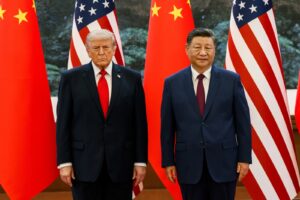
As President Donald Trump hosts Chinese Communist Party Secretary Xi Jinping for a state visit Wednesday through Friday, the U.S. faces a fundamentally different China than it did 15 years…
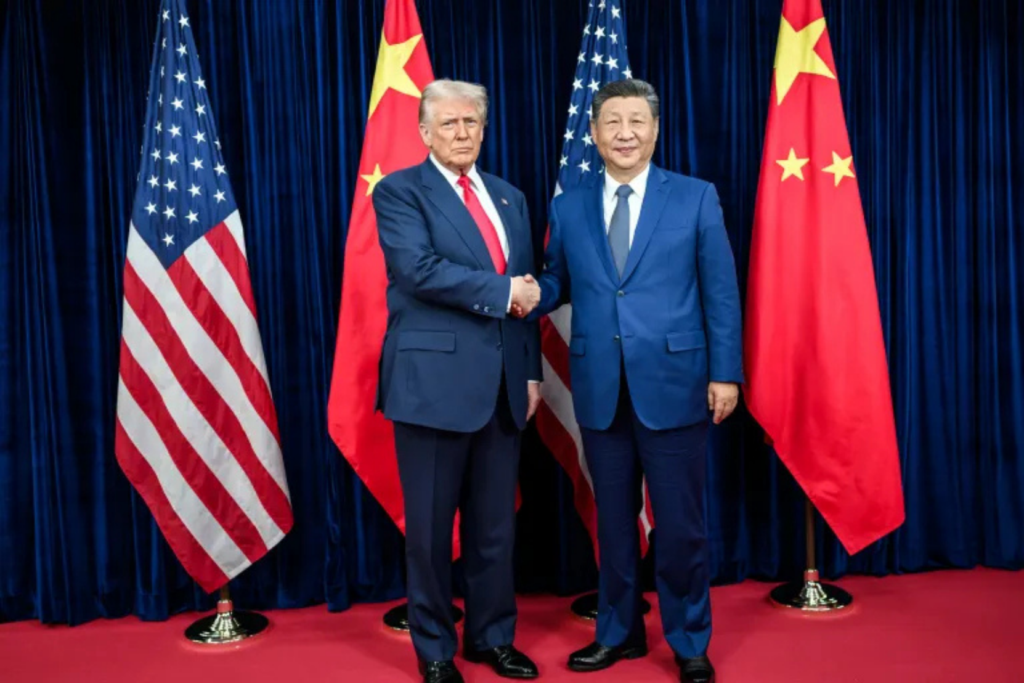
As President Donald Trump hosts Chinese Communist Party Secretary Xi Jinping for a state visit Wednesday through Friday, the U.S. faces a fundamentally different China than it did 15 years ago.
The pre-Xi China was a deal-making, reform government intent on providing economic benefits for its citizens, characterized in a 2009 “Saturday Night Live” sketch as Obama’s banker and an exasperated creditor to America.
Since 2012, when Xi took the reins, the government has traveled in the opposite direction, ditching market reforms as it builds a redoubt against its population, while widespread dissatisfaction with the economy simmers.
Critics fear the change may put America’s deal-making president at a disadvantage, while for Xi, it’s a remarkable reversal for a man whose liberal father was purged by Chairman Mao, only to return and help build the reform economy that made China rich.
For sure, China remains a manufacturing powerhouse, selling goods across the globe. The problem, however, is that for all its export strength, domestic demand has slowed.
Huang Yiping, a member of the monetary policy committee of China’s central bank, warned that even as China excels at creating supply, the domestic economy is lagging.
“The contradiction between total demand and total supply may not disappear quickly in the short term, and may even persist for some time,” he told a meeting of bankers this week.
And much of that weakness was built into the system by Xi and his communist technocrats, as they attempted to trade slower growth for more regime stability.
“China’s weak consumption is rooted in structural features of the economy; a weak labor market, a persistent real estate crisis and limited social safety nets,” wrote the Mercator Institute for China Studies (MERICS) in July. “These show no sign of easing.”
Protests over unpaid wages jumped 60% in the four months prior to the 2026 lunar New Year, while Reuters reported urban unemployment among youth hit 18.9% in August.
But nothing highlights how bad the economy is more than the real estate sector, which, when combined with infrastructure, equals about a third of domestic economic demand.
MERICS notes that the sales value of new housing sold has fallen by 60% since 2021.
For comparison, during the U.S. housing crash – which caused the worst economic disaster in America since the Great Depression – the national home-price index fell 25.54% from 184 in 2007 to 137 in 2012.
What’s especially amazing is that Xi and his government set about purposefully driving down the value of the real estate market.
“Houses are for living in, not for speculation,” said the Chinese Communist Party chairman when embarking on the real estate reset.
Xi was willing to impose enormous economic losses in pursuit of structural and political stability at the top and force his compatriots to accept the losses for years.
And they have largely acquiesced.
It’s more remarkable when you consider 70% of Chinese household wealth is held in real estate.
Homeownership is even more central to the Chinese Dream than it is to the American Dream.
Homes are Chinese 401(k)s.
Instead of maximizing generational wealth and emphasizing consumption, Xi has increasingly directed resources toward state-controlled industries, technological self-sufficiency and national security.
Experts fear that what Xi is really after is remaking the Chinese economy so that it can sustain a long war.
On Oct. 1, a new edict will take effect, “essentially harnessing all enterprises – whether public, joint venture or private – as well as schools, civil infrastructure, the populace and relevant technologies to support national defense,” notes Larry M. Wortzel, a senior fellow in Asian security at the American Foreign Policy Council.
Wortzel said China has watched the difficulties Russia had mobilizing for its war in Ukraine while studying U.S. and Iranian lessons from their war in the Middle and Near East, helping Xi himself consolidate power any time he decides crisis conditions allow.
“Moreover, Mr. Xi is about to visit the United States,” said Wortzel, “making the timing of the law a clear signal to Washington of China’s national interests and willingness to defend them.”
Reuters reported the Chinese head of state will propose a grand bargain with Trump: in return for Chinese help in ending the Iran war, the U.S. must agree to end arms sales to Taiwan.
China considers Taiwan part of the country, although Taiwanese note it’s a separate country, with a separate national identity.
Still, Xi has made success in reclaiming Taiwan part of his desired legacy.
The Wall Street Journal reports that Beijing sees Trump’s transactional approach as an opening to weaken Taiwanese confidence in Washington, particularly by getting Trump to say something that will weaken Taiwanese confidence in U.S. support.
That might seem like a hard sell to a president who sold more arms to Taiwan than any other chief executive, as the White House was careful to point out to reporters.
China will claim that President Ronald Reagan previously agreed to reduce arms sales to Taiwan in a 1982 agreement.
But that commitment was always conditioned on a peaceful China pursuing a peaceful reconciliation with Taiwan.
That’s a difficult argument to sustain as Xi builds a war machine that looks like it’s pointed directly at Taipei’s coast.
In either event, the memorandum shows that even as China changes, America can change as well.