Op-ed: Grade inflation allegations remind us why parents, not teachers, should primarily drive their children’s education
A school district has made headlines for all the wrong reasons – namely, that teachers have been facing administrative pressure to inflate students’ grades against their professional…
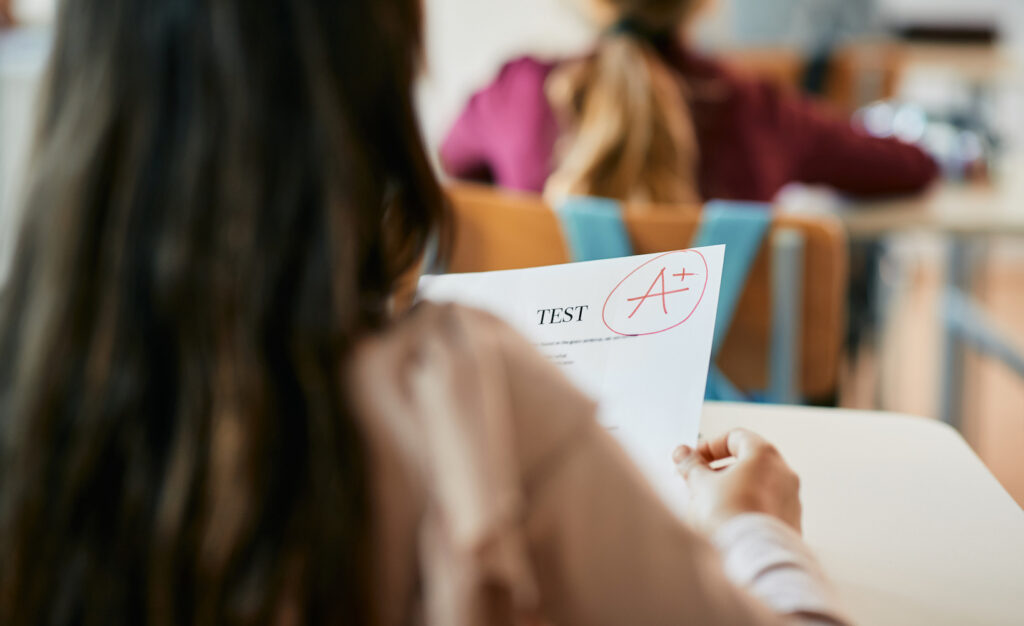
A school district has made headlines for all the wrong reasons – namely, that teachers have been facing administrative pressure to inflate students’ grades against their professional standards.
“I was told to change the grade (of a student),” said Samira Hardcastle, former Teacher of the Year at Metro Nashville Public Schools. “I did not think that it was ethical, and so I did not. I refused.”
We’re not arguing whether Hardcastle’s allegations are correct, although the sheer number of educators raising concerns – including former McGavock High School teacher Tara West, among others who wanted to remain anonymous – suggests Hardcastle has plenty of company.
Instead, the debate over grade inflation raises a bigger question about the public education landscape – what defines “success” in student learning and who is best equipped to determine whether success has happened?
‘Not the mere creature of the state’
Traditionally, the U.S. has recognized parents as controlling their children’s education – not the government.
When the colonies began their revolution against the British Empire, “the large majority (of students) were mainly home educated, and this included both instruction in reading, writing, and arithmetic and faith, morals, and interpersonal relationships or social skills,” according to the Homeschool Freedom website.
Even 150 years later, this philosophical bedrock had been so firmly established that the U.S. Supreme Court alluded to it in the 1925 case of Pierce v. Society of Sisters:
“The fundamental theory of liberty upon which all governments in this union repose excludes any general power of the state to standardize his children by forcing them to accept instruction from public teachers only. The child is not the mere creature of the state. Those who nurture him and direct his destiny have the right, coupled with the high duty, to recognize and prepare him for additional obligations.”
The best public school educators have tended to agree with this, too.
“God has equipped all of us as parents to know what’s best for our children,” said Sarah VanDerVliet, a former public school teacher of 17 years in South Dakota.
“In the Bible, it talks about generational learning and how grandmas and grandpas would teach, and great-grandmas and grandpas would teach. I think as a society, as a culture, we’ve kind of gotten away from that.”
Now the founder of Buffalo Christian Homeschool Academy, VanDerVliet believes all parents – even those who don’t homeschool – should feel qualified to teach their children.
“I’ve seen these students know who they are, have confidence in who they are, knowing that Jesus loves them and how to use their faith as a light in this world.”
Additionally, these parents are best equipped to know when children are struggling or even failing to meet academic benchmarks – much more so than overworked teachers trying to manage 20 students or more.
Such was the experience of Katie Mathews, a Missouri mom who realized her stepson was functionally illiterate as a sixth grader even though he had been attending public school.
“When we first got custody of him, the longest book he said he’d read was about 13 pages,” she said. “It was distressing. I felt terrible for him.”
After she withdrew him and homeschooled for several years, Mathews’ stepson is now thriving.
“He’s a voracious reader,” she noted. “He reads novels and he reads as fast as I can, almost. … He’s making better personal decisions too. He’s less impulsive. He had these symptoms of them saying he was on the spectrum or having ADD. And I just think a lot of that sometimes is attention and nurturing.”
‘The students can’t read’
Compare this customized, one-on-one learning experience with the reality of too many children today – an appalling lack of attention from those supposed to be teaching them basic skills such as literacy and math.
“According to the Nation’s Report Card, in 2024, only 28 percent of eighth graders were deemed proficient in math, compared to 39 percent who were rated ‘below basic,’” Heartland Institute’s editorial director Chris Talgo wrote recently.
“In science, 31 percent achieved proficiency while 38 percent were ‘below basic.’ Likewise, average eighth grade reading scores are down 5 points since 2019.”
How did we get here? Talgo, a former public school teacher, blames the “government-run monopolies, often steered by teachers’ unions and other leftist political groups” that he says have dominated schools for years.
“The students can’t read, and even that doesn’t stop school employees from leading them in walk-outs from their classes to protest whatever is the cause du jour.”
We can’t lay all this blame on teachers, though. Much of recent taxpayer spending on public education has gone to shore up non-teaching positions, which ballooned by the following percentages from 2002 to 2023:
- student support services (125%)
- instruction coordinators (118%)
- administrative support staff (43%)
- administrator positions (39%)
- guidance counselors (28%)
- principals and assistant principals (23%)
“Since 2019, the total number of public school staff has risen from 6.5 million to 6.8 million, but teachers fill less than half of all open staff positions,” Talgo observes. “And they are now outnumbered by non-teachers on staff – 3.6 million to 3.2 million.”
‘A disservice to society as a whole’
However, it now behooves this massive bureaucracy to keep churning out “graduates” – simply to cover the continuing costs of moving students, as with any other industrial pipeline, through the system.
“(My former Chicago) high school, according to its website, employs a ‘chief communications officer’ and ‘director of business services,’” Talgo laments. “The administrative team organizational chart looks more like a Fortune 500 company than a local public high school.”
Unfortunately, the ultimate victims resulting from this systemic failure of education turn out to be – drum roll, please – the rest of us. All of society.
“Imagine someone who just whimmed their way through, you know, medical school and they are doing your open-heart surgery,” Hardcastle explains of the problem with grade inflation. “These people are your politicians, your police officers, your doctors, and it’s just – it’s doing a disservice to society as a whole.”
Hardcastle’s commonsense approach to education is refreshing and something all parents should consider as they remember who is ultimately responsible for raising the next generation.
Perhaps VanDerVliet said it best: “We want students to be smart consumers and be self-sufficient, and understand freedom and their rights.
“I want the next generation to be able to take care of me when I can’t.”