1619 Project founder says she ‘failed’ daughter by choosing public schools
Nikole Hannah-Jones, founder of the 1619 Project, which argues that America was founded on racism and white privilege, is now admitting she “failed” her daughter by sending her to a low-income,…
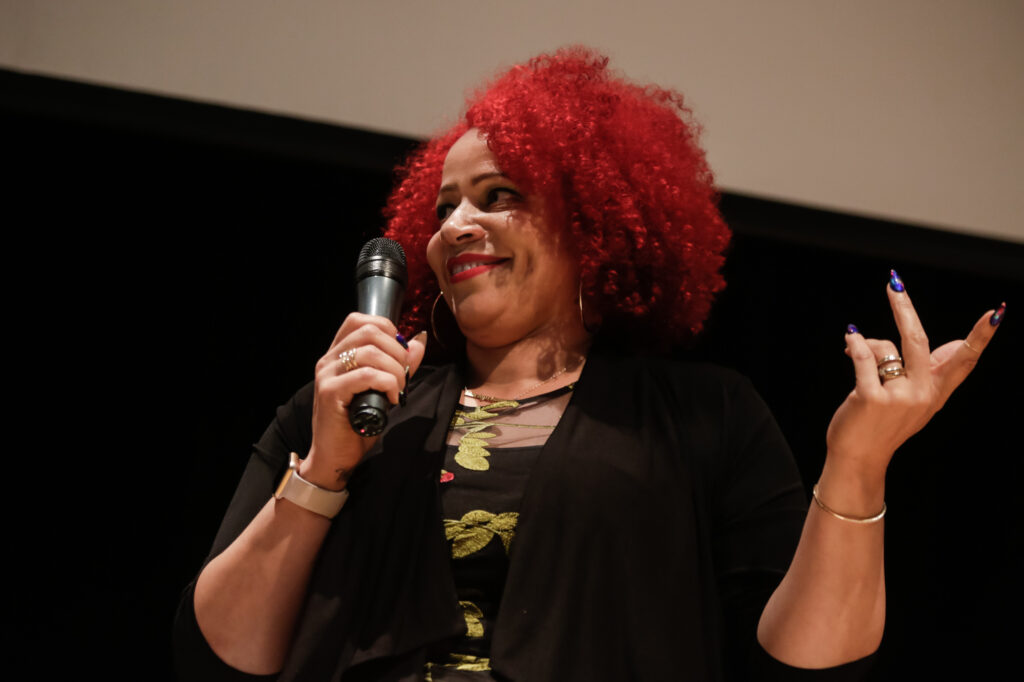
Nikole Hannah-Jones, founder of the 1619 Project, which argues that America was founded on racism and white privilege, is now admitting she “failed” her daughter by sending her to a low-income, academically poor school.
In a New York Times piece published Sunday, Hannah-Jones describes her 16-year-old daughter, Najya Hannah-Jones, flouncing into the passenger seat next to her mom and blurting an accusatory question: “Did you know my school was bad like this when you decided to put me here?”
“Najya was asking what I’d accomplished by not choosing the ‘best’ school for her. And the honest answer is, I don’t know,” Hannah-Jones writes. “When it comes to the choices my husband and I have made about public education, these days I feel that I failed both my values and my child.”
Hannah-Jones spends the majority of her essay explaining the educational decisions she and her husband made and why they continued to stick with them despite the poor and often detrimental results. She said she and her husband decided to enroll Najya in a “poor black” school to align her education with Hannah-Jones’ own reporting and ideals against educational segregation by class and income.
“So, like the generations of black parents who came before us, Faraji [her husband] and I felt an obligation to make educational decisions based on the collective good and not just our individual advantage,” she writes.
The couple enrolled Najya at Public School 307, “a segregated, high-poverty school across from the Farragut housing projects in Brooklyn.” They hoped this choice would “help improve it [the school] for all the children there” and result in “upending the status quo,” she writes. Hannah-Jones even publicized this parental decision, writing a piece in 2016 for the New York Times Magazine that featured kindergartener Najya on the cover.
“Even a decade later, parents still share with me how my essay led them to make similar educational decisions for their children,” she writes.
Daughter’s learning loss
But a decade later, her daughter is not so convinced.
“So you had money to send me to one of the best schools, and you chose not to?” she said in Hannah-Jones’ recent piece. “Because other kids are disadvantaged, you didn’t want to put me in a great school?”
Hannah-Jones detailed the immediate effects she and her husband saw from their decision. In early elementary school, Hannah-Jones explained how she watched teachers disregard students’ outright misbehavior, leading to even more chaos. Najya was a stellar student, earning perfect grades, until her mother began reviewing her work and found “none of them were graded.” Even worse, she discovered blatant errors in both Najya’s math and English handouts, she writes.
Hannah-Jones said she contacted Najya’s teachers and principal multiple times but never received a response. Teachers were simply apathetic or altogether absent from the classroom, she explains.
During Najya’s elementary education, Hannah-Jones had founded the 1619 Project and continued advocating for racial equality in education, which, for her, opposed school choice and private education. She even said in an interview in 2021 that parents should not decide what their children are taught in the classroom.
“I don’t really understand this idea that parents should decide what’s being taught,” she told NBC News. “I’m not a professional educator. I don’t have a degree in social studies or science. We send our children to school because we want them to be taught by people who have expertise in the subject area. And that is not my job.”
So, Hannah-Jones and her husband stuck with their idealistic battle against the education system and continued their method in the selection of Najya’s middle school: Urban Assembly Unison School.
In contrast to Hannah-Jones’ parental education decisions, many public-school teachers enroll their children in private schools so they can get “the best possible education,” Heartlander News previously reported.
But, unlike many union advocates and politicians, who publicly decry systemic racism and inequality in education but send their own children to private schools, Hannah-Jones remained consistent with her public ideals.
“But what did it do?” Najya asks in Hannah-Jones’ NYT piece. “Putting me in this school didn’t change anything. I was not trying to be in this type of environment. It makes no sense.”
Najya’s new middle school, however, was no better. She complained to her mom that misbehaving kids were rewarded for the slightest good behavior or correct answer while the obedient kids were ignored. By then, Najya and her friends had also discovered the poor academic performance of their school but couldn’t begin to understand how far behind they really were.
Hannah-Jones decided to allow Najya to choose her high school, and her daughter proposed a list of top schools that “were heavily white and screened their students, the type of public schools I had spent my career arguing against,” Hannah-Jones writes.
“Across the country, I’d lectured about how educational inequality is systemic, but that this fact did not absolve each of us of our individual choices,” she writes. “And in the end, I could not even sustain the cause within my own family.”
While Najya got into her top school, she quickly struggled with the loads of homework and academic performance, Hannah-Jones writes, explaining that her daughter never learned “the skills of independent study” because she never before had homework. Najya continually failed her algebra exams and eventually took an assessment to discover gaps in her education, including a lack of early elementary concepts.
“After an assessment, the center’s director called me in and told me that Najya knew very little algebra and had huge gaps in many of the building blocks of math that she should have learned in elementary school, like mastery of long division and fractions,” Hannah-Jones writes.
Her piece ends with a tense “apology” between mother and daughter, but Najya is mostly appreciative that her mother is beginning to see how her public advocacy work harmed her own child.
“Sometimes I wish instead of always thinking about other kids, you would have thought about me. I never really got the education I wanted,” she tells her mom in the piece.
And while Hannah-Jones admits her education decisions for her daughter did not bear the desired results of “ending the status quo,” she never retracts her underlying principles for those decisions: Parents should fight the failing education system by remaining in it instead of prioritizing their child’s well-being and future.
“But for all of our justifications, including mine, an undeniable verity remains,” she concludes. “As long as we continue to rescue our own children from the failing schools where we allow other people’s children to languish simply because those children have been born black and poor in a nation of racism and riches, there is no absolution here. Not for me. Not for you. Not for any of us.”
Hannah-Jones does not “grapple” with “the folly behind her decision” and still “finds a way to blame ‘racism,’ despite seeing firsthand the results of her ideology on her daughter,” Christopher Rufo, senior fellow at the Manhattan Institute for Policy Research, said in a post on X.
School choice offers hope
Heritage Foundation research fellow Corey DeAngelis told Heartlander News the solution Hannah-Jones so desperately seeks is school choice, but she still opposes these “programs that help kids get better opportunities.”
“If she actually wants to help other kids, she should fight for the funding to follow the student,” he said in a message. “School choice is an equalizer. Trapping kids in failure factories only exacerbates inequality. You do not fix public schools by locking children in them without accountability. You fix them by giving them a reason to change their ways.”
But instead of reconsidering her arguments, Hannah-Jones paints herself “as a virtuous equity warrior” in the NYT piece, putting “herself and her leftist ideology before everything, even her own children,” DeAngelis continued.
“Parents should put their kids first,” he said. “They should not sacrifice them to a failing government school system because of ideology. Forcing children to stay in segregated government schools based on ZIP code does nothing to help them. It is not the job of families to fix broken schools. The school system exists to meet the needs of students, not the other way around.”
(Image credit: Nikole Hannah-Jones, Associação Brasileira de Jornalismo Investigativo, CC BY 2.0 https://creativecommons.org/licenses/by/2.0, via Wikimedia Commons)