Outburst flood sweeps away Nepali border town with 862 missing, including 63 Americans
Nepali authorities say 862 people, including an estimated 63 Americans, are feared missing or dead in Nepal after a flood destroyed a peaceful river valley south of China.
Surveillance…
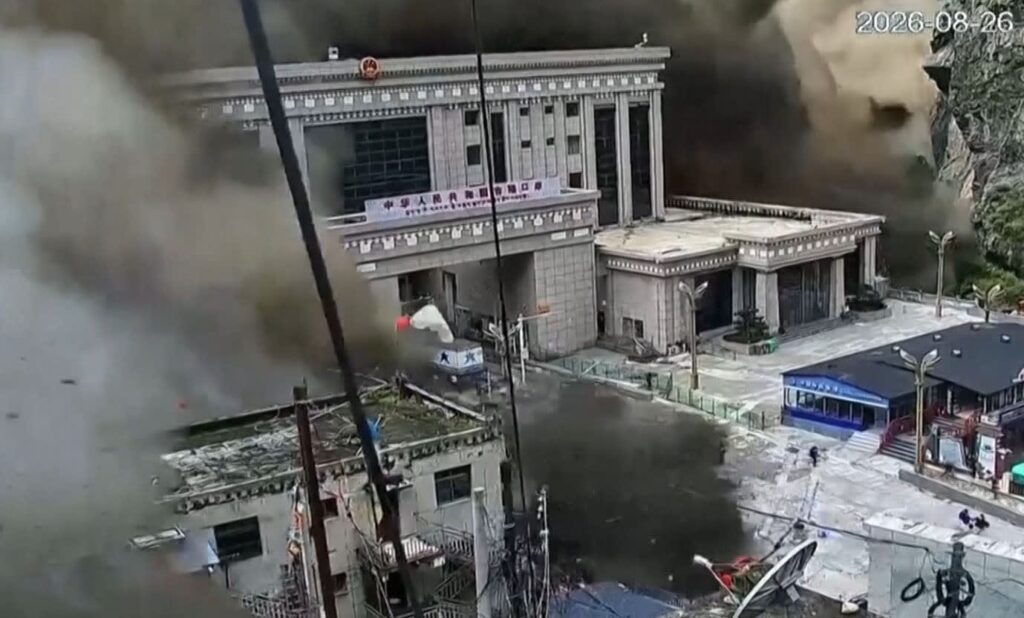
Nepali authorities say 862 people, including an estimated 63 Americans, are feared missing or dead in Nepal after a flood destroyed a peaceful river valley south of China.
Surveillance video from the scene shared by NBC News shows people attempting to flee on foot being swept away by water towering several stories above them; bridges being swept away like toys; and whole villages being swallowed by water.
“We express our solidarity and are united in prayer for the Nepali people following the devastating floods,” wrote Secretary of State Marco Rubio on social media. “@StateDept stands ready to support the Government of Nepal with needed humanitarian assistance.”
ABC News reported the U.S. State Department has not yet confirmed the number of Americans affected by the flooding.
“We are closely tracking developments and remain in close contact with Nepali authorities,” said the U.S. Embassy in the country.
In a separate announcement, the State Department said it was providing $500,000 worth of aid “through its global award with Catholic Relief Services.”
The exact cause of the flooding is still under investigation, but so far experts believe a glacier detached from the Himalayas on the Chinese side of the border in Tibet and crashed into the floor of the river valley, causing the flood.
CNN reports that simultaneously with the flood, the U.S. Geological Survey (USGS) measured a 4.4 earthquake in the area where the glacier sheared. But later, the USGS said it was more likely that the earthquake-like shocks were caused by the impact of the glacier on the valley floor.
The USGS said the force of the impact could create the volumes of water seen in the flood.
Others are doubtful.
“What is hard to reconcile is the gargantuan volumes of water that we see in these absolutely horrific videos,” Daniel Shugar, a geologist at the University of California, who’s part of a group studying the causes of the disaster, told CNN.
Nepali authorities disagreed with the USGS assessment, reported Onlinekhabar, a major privately-owned Nepali digital news outlet.
The country’s Flood Forecasting Division today released a report based on sensor data, which noted a lake had formed behind a glacial dam. The earthquake occurred at 8:37 a.m. local time, after which huge volumes of water rushed in from the Tibetan side, presumably from the lake.
By 8:50 a.m., data was no longer transmitting from the closest hydrological station in Nepal.
Sometimes when glaciers shear, they release huge amounts of water from liquid trapped behind the glacier that acts as a dam.
The process is known as an outburst flood.
The dramatic video from yesterday’s flood centers around Gyirong Port, the border crossing between Nepal and China.
However, the exact place on the Chinese side where the flooding began has not yet been determined.
“We are unable to contact the Nepali side, and the Chinese also have no authentic information about what triggered the massive outburst,” said Laxmi Prasad Niraula, Nepal’s consul general in Lhasa, Tibet, as reported in the Kathmandu Post. “We suspect it may have been a glacial outburst, but that has not yet been confirmed.”
China said it has been unable to reach authorities on their side of the border, and denied accusations that they did not give Nepal adequate notice of the flood, calling the complaints “fake news.”
The Kathmandu Post said Chinese and Nepali authorities had been negotiating to set up an early warning system to alert both countries when outburst floods occur, but so far they have not come to an agreement.
Last year, Nepali citizens called for an early warning system after a summer outburst flood, which started 35 kilometers or almost 22 miles away on the Chinese side of the border, destroyed Rasuwagadhi, a similar Nepal-China gateway city, with over two dozen killed or missing.
“The current condition of Rasuwagadhi is not just a natural disaster—it is a harsh test of our state systems, our disaster preparedness, and our commitment to citizen safety,” said Onlinekhabar.
The media outlet called for long-term relief from the natural disasters, including resettlement of populations outside the river valleys.
Nepal said the current search efforts have been slowed by the lack of air assets to search for survivors, while noting rescue personnel are among the victims.
“Security personnel themselves are missing in large numbers,” Ratindra Khatri, a retired Major General of the Nepal Army and an expert in emergency and disaster management, told Onlinekhabar.
He added, “The flood risk persists. Yet, they remain active in search and rescue.”