College student seeks scholarships in lawsuit, petitions SCOTUS to overturn religious discrimination decision
The U.S. Supreme Court may have the chance to overturn a 2004 decision that blocked scholarship funds for students with religious majors thanks to a…
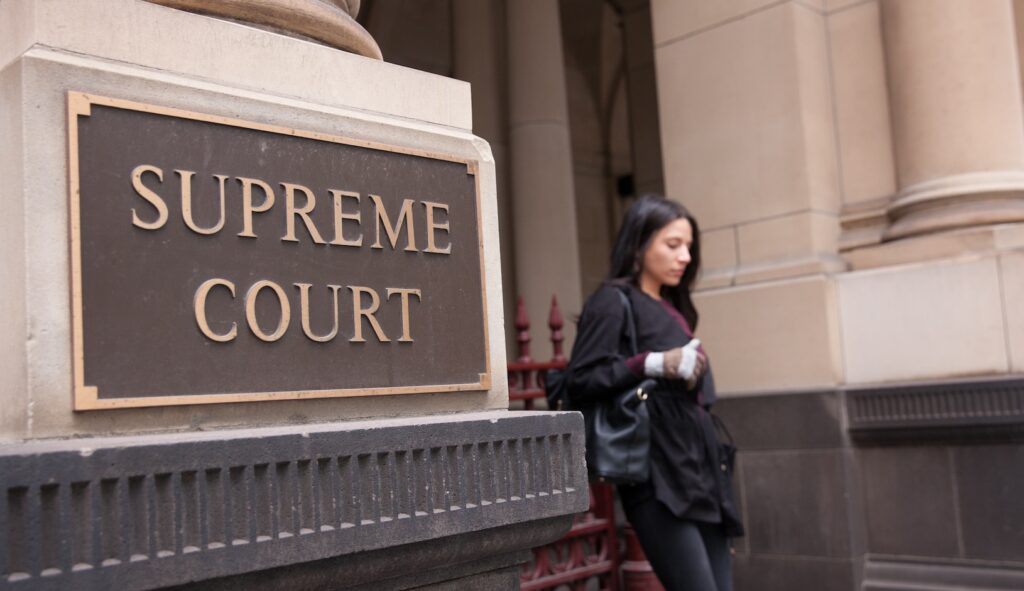
The U.S. Supreme Court may have the chance to overturn a 2004 decision that blocked scholarship funds for students with religious majors thanks to a new petition.
The latest case involves a college student in Virginia who lost funding when she switched her major to a religious focus, according to a court petition filed Tuesday.
“The government can’t deny publicly available benefits because a student’s major is too religious. That’s religious discrimination. It’s wrong, and it’s unconstitutional,” Alliance Defending Freedom Senior Counsel John Bursch, vice president of appellate advocacy, said in a press release from First Liberty Institute, which joined the lawsuit and petitioned the Supreme Court to hear the case.
Bethany Hall, a student at Liberty University, applied for the Virginia Tuition Assistance Grant (VTAG) in February 2023 and qualified for an annual $5,000 scholarship. But when Hall changed her major from Music Education to Music and Worship, she lost the scholarship.
“The school is just complying with state regulations because she attends Liberty University, which is a Christian university. But that’s not the problem because she was going to get the scholarship at Liberty University when she was just studying music,” President of National Legal Foundation Steve Fitschen, who is representing Hall, told Heartlander News in an interview. “So it’s not the school that’s the problem. It’s the major. When she changed her major to one involving ministry, that’s when she lost the money.”
Locke v. Davey 2004
In its defense, Virginia cited the 2004 Supreme Court case, Locke v. Davey, that ruled Josh Davey, a college student in Washington state, could not receive a state scholarship for his double major in pastoral ministries and business management/administration, according to the opinion.
“And the subject of religion is one in which both the United States and state constitutions embody distinct views – in favor of free exercise, but opposed to establishment – that find no counterpart with respect to other callings or professions,” Chief Justice William Rehnquist wrote in the opinion. “That a State would deal differently with religious education for the ministry than with education for other callings is a product of these views, not evidence of hostility toward religion.”
Rehnquist argued, “there is room for play in the joints,” between the establishment clause and the free exercise clause of the First Amendment, adding that education for religious professions differs from education for secular professions. The choice remains up to the individual student, he said.
“And it does not require students to choose between their religious beliefs and receiving a government benefit. The State has merely chosen not to fund a distinct category of instruction,” Rehnquist wrote.
Only two justices dissented from Rehnquist’s opinion: Justices Antonin Scalia and Clarence Thomas, who still sits on the high court and may hear Hall’s parallel case this fall.
The Locke decision, however, shocked the country and legal experts, Fitschen told Heartlander News, adding that legal precedent indicated the opposite decision should have occurred.
“People have been scratching their heads for 20 years,” Fitschen said.
No scholarship for Hall’s religious major
In 2025, Hall filed a lawsuit – nearly identical to Davey’s, more than 20 years later – and attorneys knew her case had to reach the Supreme Court to be victorious.
“We sued, knowing we would have to lose in the district court, knowing we would have to lose in the court of appeals because only the Supreme Court can overturn its own precedents,” Fitschen said.
Even Judge Julius N. Richardson of the Fourth U.S. Circuit Court of Appeals ruled against Hall with complete transparency that Locke was wrongly decided and should be overturned. But he recognized that lower courts must apply the Supreme Court’s ruling until that reversal, according to First Liberty’s press release.
“Locke ‘betrays the founding generation’s commitment to religious liberty, and the Supreme Court should formally overrule it’ and ‘is a stain on our Free Exercise Jurisprudence,’” Richardson said, as quoted in the petition. “But until this Court ‘formally buries’ Locke, ‘lower-court judges must keep applying it.’”
‘Poetic Justice’ after 20 years
Fitschen noted that Richardson previously clerked for Chief Justice Rehnquist from 2004-2005, and yet strongly disagrees with the justice’s opinion in Locke v. Davey.
“Locke ‘betrays the founding generation’s commitment to religious liberty’ and ‘rested on bad history and bad reasoning,’” Richardson said, as quoted in the petition.
Davey, the student in the original 2004 case, is now one of the attorneys representing Hall, Fitschen said, calling the overlap “poetic justice.”
“Locke was wrong when it was decided, and this Court’s subsequent caselaw has further eviscerated its fatally flawed foundation,” the petition argued.
Numerous states have adopted similar scholarship restrictions for religious majors, including Alabama, Florida, Illinois, Ohio and Michigan. As it stands, Locke forces students to choose between “government-preferred degrees” and scholarship programs, setting a “religious calling” in tension with “education assistance,” the petition argued.
“Some students, unsure of their calling, might allow the State’s anti-religious standards to influence them toward a secular profession,” attorneys wrote in the petition. “Others, like Ms. Hall, will follow their faith and lose benefits available to their peers. Either way, they will suffer constitutional harm that this Court should stop now.”
The Supreme Court only accepts 1% of petitions to present as oral arguments in the fall and spring 2026-2027 term, Fitschen explained, but added that he was hopeful the court would accept this case because of the historical scrutiny toward Locke.
“Locke v. Davey has been criticized since the day it came out by some of the best First Amendment scholars in the land, and the criticism has never let up for 20 years,” he said. “So, we’re about as confident as you can be with a 1% chance.”