‘What a grift!’: How Biden quietly cut Wall Street in on his biggest green giveaway
Three days before President Donald Trump’s inauguration, the Biden administration approved changes that let a green energy nonprofit route $2.65 billion in taxpayer money to four funds managed by…
Three days before President Donald Trump’s inauguration, the Biden administration approved changes that let a green energy nonprofit route $2.65 billion in taxpayer money to four funds managed by Wall Street firms in a move that limited government oversight, according to sources and records reviewed by Heartlander News.
Sources said the firms’ involvement does not appear to match what the grantee originally told the Biden administration it would do with the taxpayer money. The Trump Environmental Protection Agency (EPA) told Heartlander News that the Biden EPA approved a “substantive” last-minute workplan and budget changes for the grantee, which flipped the program’s deployment model “on its head” and allowed the nonprofit to circumvent statutory limitations.
The Biden EPA’s landmark $27 billion Greenhouse Gas Reduction Fund (GGRF), created in 2022 to finance green energy projects in low-income communities, is now under investigation by the agency’s inspector general, the Department of Justice (DOJ) and the FBI after it reportedly awarded billions to politically-connected nonprofits.
The Trump EPA froze a vast majority of the program’s funding and cancelled the grants once Administrator Lee Zeldin took charge of the agency, though the funds had already been transferred to the four subgrantees managed by the firms before the freeze, the agency said.
Documents reviewed by Heartlander News reveal that one grantee under the program, the Coalition for Green Capital (CGC), asked the Biden administration for expedited approval to revise its workplan and budget days before Trump’s inauguration. CGC then routed over half of its $5 billion award out of the third-party financial agents approved by the Biden EPA and into the four subgrantees managed by the Wall Street firms, parking the funds outside the agency’s direct oversight, the Trump EPA confirmed.
The four major firms – StepStone, Brookfield, Apollo and Energy Capital Partners – each manage one of the four subgrantees, according to CGC’s filings with the EPA.
Brookfield and Apollo have over $1 trillion of assets under management, dwarfing the $2.65 billion routed to the entities they manage.
Subawards appear on USASpending.gov for Brookfield’s CGC Renewable Credit Mobilization Fund, Apollo’s CGC Clean Energy Mobilization Fund, Energy Capital Partners’ CGC Clean Energy Mobilization Fund and StepStone’s CGC Clean Energy Investment Mobilization LLC, all dated Jan. 31, 2025.
According to USASpending.gov and documents, the Brookfield and Apollo entities each received $450 million, while $300 million and $1.45 billion went to the Energy Capital Partners and StepStone vehicles, respectively.
A former senior EPA official, granted anonymity to speak candidly, told Heartlander News that given the agency’s two-year timeline to implement the program, the official believed EPA had assumed that grantees like CGC wouldn’t misrepresent their ability to manage the money or “just transfer billions to private equity firms.”
“It’s just incredible that someone would do that with government funds,” the official said.
Brookfield, Apollo and Energy Capital Partners did not respond to Heartlander News’ multiple requests for comment, and CGC did not respond to a request for an on-the-record comment.
A spokesperson for StepStone said it does not comment on specific client investments, mandates or ongoing proceedings, and that it carries out its work consistent with its fiduciary responsibilities and the law.
‘Not in line with the original spirit of the award’
When it notified the agency of the transfers, CGC told the Biden EPA it would retain veto and consent rights over the funds’ investment decisions, according to emails included in court documents.
CGC’s annual report to EPA, published June 29, discloses that its “strategic financial partners” – the four firms – manage the funds, though CGC helps to both “source and shape investments” and confirm that the investments are aligned with the GGRF program’s requirements.
Under the statute governing the GGRF program, nonprofits like CGC could make two kinds of investments with the awarded money: direct investments, where the grantee itself funds qualified projects, or indirect investments, where the grantee funds other nonprofit or public entities that in turn invest in projects. A “qualified project” is defined as any project or technology that avoids or reduces greenhouse gas emissions and air pollution in partnership with the private sector, according to the statute.
For-profit companies, such as private equity firms, are excluded from receiving indirect investments under the statute.
CGC wrote to EPA on Jan. 15, 2025, that its workplan described subawards to “financial intermediary subrecipients,” and that the entity receiving such an award “may” itself be a qualified project.
However, CGC told the EPA that its approved budget didn’t clearly distinguish between the two budget categories, so it asked the agency to approve a change before they made the transfers.
The last-minute edits meant that CGC could classify its transfers to the funds as “financial assistance to qualified projects,” which was interpreted at the time as a direct investment and not an indirect investment, EPA spokesman Mike Bastasch told Heartlander News.
Bastasch added that pre-approval of the subawards was not required under the Biden-drafted terms and conditions in CGC’s approved workplan, but that the Biden EPA’s blessing of the workplan edits was “another example of the Biden EPA, by design, willfully exploiting the rules of an already-flawed program, which allowed CGC to circumvent limitations placed on indirect investments.”
“To be clear, the Trump EPA would have never approved such an agreement, and it only further demonstrates the deliberate recklessness of the previous administration’s decisions,” Bastasch continued. He said that all funds must be returned to the Treasury pursuant to the grant terminations and the repeal and rescission of the GGRF by Congress, and that the agency
“retains the option to pursue additional remedies for noncompliance, including recovery of unallowable costs.”
Bastasch said the “Trump EPA does not view these transfers as a minor procedural reclassification. Prior to its repeal by Congress, the purported purpose of the GGRF program was to help low-income Americans, not to prop up major Wall Street firms.”
Additionally, the agency confirmed that the “Emerging Manager Fund of Funds strategy,” as described in a CGC report submitted to the EPA Feb. 27, 2026, is “not in line with the original spirit of the award.”
‘Head Scratcher’
CGC’s narrative proposal states that it “has the people, the immediate and longer-term pipelines of investment opportunities in qualified projects, and the programs” to meet the Biden EPA’s goals for the GGRF program.
The proposal states that CGC and its partners had “developed a six-month pipeline of qualified projects” and that over half of it originated with CGC itself.
Emails obtained by Heartlander News show a Trump EPA staffer in June 2025 calling the transfers a “head scratcher,” acknowledging that they appear to have undermined the oversight structure established by the Biden EPA.
The staffer puzzled over CGC’s purported “pipeline,” asking if the firms themselves were considered to be the pipeline and that it was “hard to fathom” Apollo could already have projects “teed up” just two months after CGC’s request for proposals for financial partners opened in November 2024. He then asked to review CGC’s workplan.
CGC noted in its June report that the “strategic financial partners” were chosen as part of its request for investment proposals that opened in November 2024.
Eric Soskin – who served as a federal inspector general under both Trump and former President Joe Biden – told Heartlander News that vulnerability to waste, fraud and abuse is not unique to the GGRF, but that CGC’s distribution of funds to the four aforementioned subgrants “appears quite different from what is described in the workplan.”
Soskin noted that Congress and the EPA established certain objectives and detailed standards for obtaining the taxpayer funds, and that CGC’s workplan currently hosted on the agency’s domain “depicts CGC as a sophisticated investment firm capable of meeting those standards and objectives, with specific investment ready projects and the management capacity to deliver on them.”
“What matters most is the design, implementation, and application of controls and other risk mitigation activities, tailored to the specifics of the program,” Soskin said. “And when the recipient of funds changes how a program is carried out in a significant way, it is likely to impair the ability to conduct ongoing oversight of whether the funds are being used properly or are resulting in fraud or waste.”
‘Note who’s not involved’
On Jan. 15, 2025, CGC requested “prior approval” from the Biden EPA for the “transfer of funds budgeted for participant support costs to other budget categories,” according to emails found in court documents. The emails suggest that CGC had previously notified the agency of the transactions as early as Jan. 10, 2025.
CGC sent the EPA a document outlining transactions it intended to undertake on Jan. 16, 2025, reasoning that investing in the subgrants managed by the firms would “provide CGC with the ability to leverage partner pipelines … [and grant] access [to] each partner’s rigorous due diligence capabilities, proprietary analytics, and industry expertise.”
CGC added that it was submitting the request “as part of the final due diligence and review of these transactions” and out of “an abundance of caution,” asking EPA to confirm that CGC “had the authority it needed.” It insisted to the EPA that the transfers were not “last-minute proposals.”
Jan. 17, 2025, was the last full weekday of the Biden administration.
Email records from Jan. 16-17, 2025, show EPA staff moving the request forward and noting CGC would need to send a proposed revision to its workplan and the associated budget table.
One EPA staffer wrote in an internal email that though the program understood that the suggested changes were aligned with the initial workplan and budget, CGC would accomplish the workplan goals “through a different financial mechanism.”
“In the Biden EPA’s understanding, external fund managers hold voting rights on investments and CGC holds consent rights to determine whether an investment is a qualified project,” Bastasch said. “Note who’s not involved – the American people!”
‘What a grift!’
The Trump EPA froze the Citibank accounts where most of the GGRF funds were being held and Congress rescinded the program’s funding through the One Big Beautiful Bill Act (OBBBA).
CGC and several other grantees filed lawsuits against the EPA and Citibank following the freeze, claiming there is no legal justification to withhold the funds and that the Biden EPA acted appropriately in distributing them.
An appeals court intervened to stay an earlier ruling that would have forced the agency to release the frozen funds. Litigation has continued since, with the full D.C. Circuit ruling Tuesday to affirm the lower court’s block on EPA’s grant termination order. The decision was fractured and further complicated by OBBBA’s repeal of the underlying statute.
The EPA told Heartlander News that it is reviewing the judgement and considering next steps.
The case could ultimately reach the Supreme Court.
Zeldin has repeatedly lambasted the program and the Biden EPA’s handling of taxpayer dollars, frequently referencing a video covertly recorded by the conservative activist group known as Project Veritas, in which a Biden EPA staffer compared the agency’s haste to distribute funds ahead of the transition to “throwing gold bars off the Titanic.”
When asked if there might be referrals to the FBI or the DOJ over alleged “self-dealing,” Zeldin told Just the News on June 1 that “the referrals have been made,” but did not elaborate as the investigations involving other “three-letter agencies” are ongoing.
In its FY2024 single audit, required for nonprofits that spend a significant amount in federal grant dollars, CGC disclosed it received a DOJ grand jury subpoena on March 6, 2025, and a civil investigative demand on June 30, 2025. Both sought documents and information tied to the GGRF investigation, and CGC said in the audit that it is cooperating with the DOJ’s probe.
“The obvious blind spot created by this oversight scheme was one of the main reasons the Trump EPA moved quickly to freeze the funds, and eventually, terminate the grants,” Bastasch said. “EPA’s limited ability to conduct direct oversight was totally unprecedented and left the program open to self-dealing, conflicts of interest, waste and unqualified recipients.
“The Biden EPA seemed to think allowing politically connected passthroughs to send billions to private equity firms was somehow in the interests of the American people. What a grift!”
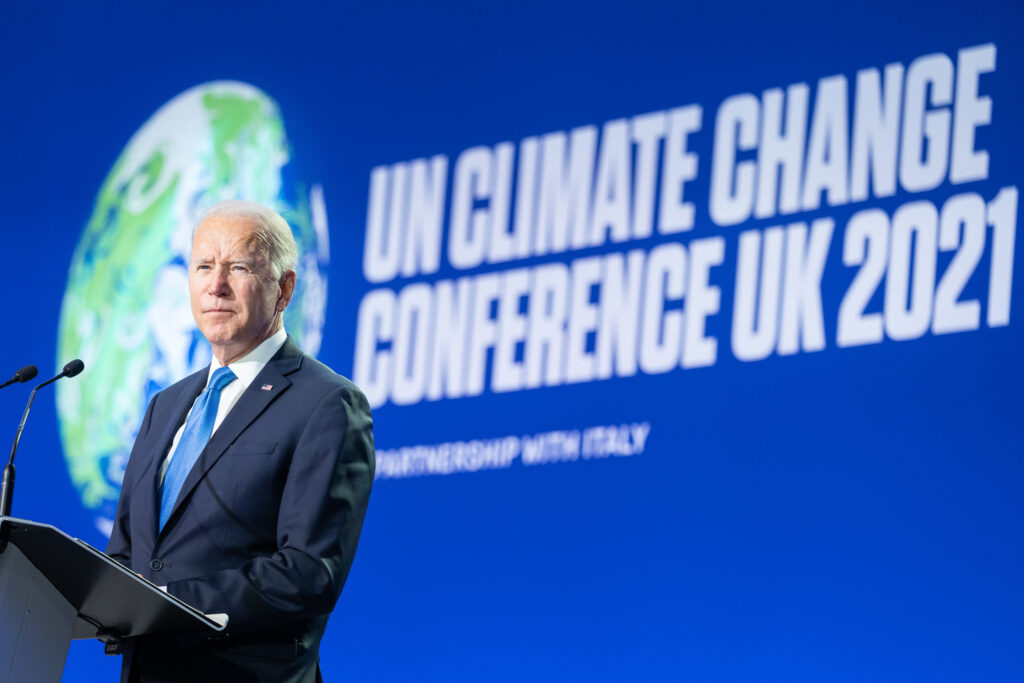
Photo credit: Biden White House (Flickr)