Op-ed: Mandating more recess in public schools should be encouraged, not condemned
A recent news commentary has decried what it calls an “asinine requirement” by Oklahoma lawmakers to double the minimum amount of recess for elementary grades.
“You know a…
A recent news commentary has decried what it calls an “asinine requirement” by Oklahoma lawmakers to double the minimum amount of recess for elementary grades.
“You know a law won’t be good when the most thought-provoking question a lawmaker faces during the vetting process is whether he liked jump-roping or four square better at recess,” frets Jeanelle Stecklein, Oklahoma Voice editor.
“Lawmakers apparently conveniently forgot — or didn’t understand — that they’ve already been micromanaging schooldays so much that tacking on 20 minutes poses a major challenge for administrators and school boards across the state.”
Wow. Just 20 minutes can do all that damage?
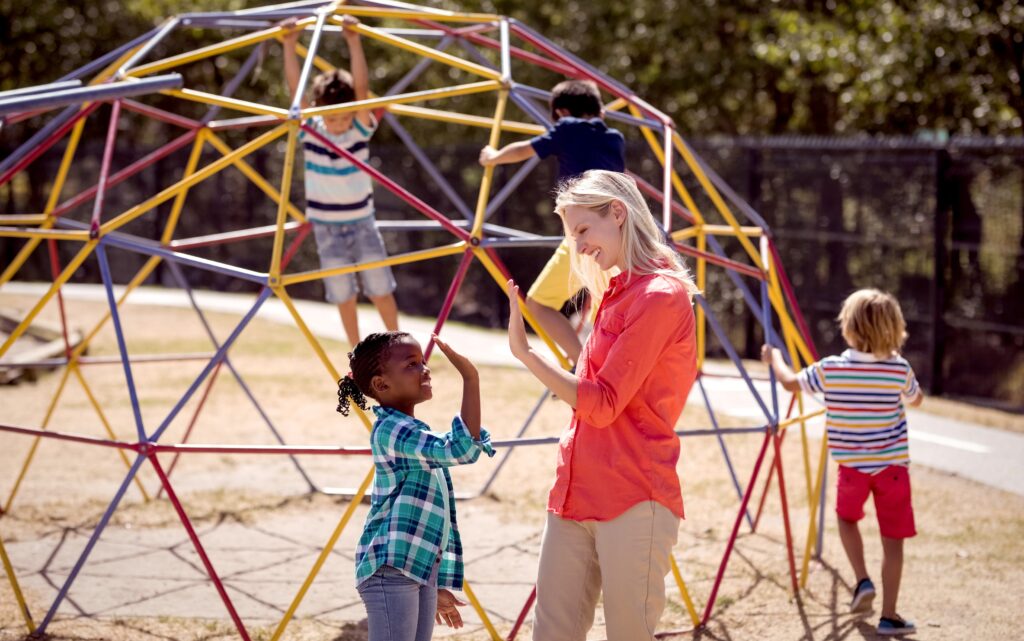
If so, how can we revamp this ridiculous micromanagement so we can free up children to enjoy more recess – which evidence has shown can increase learning outcomes, improve mental and physical health, and strengthen our communities?
Proven benefits of recess
As previously noted in Heartlander News, recess provides “an essential but often overlooked role in children’s physical, emotional and intellectual development,” according to U.S. News & World Report.
The amount of time spent in recess matters, too.
“One study of fourth graders in Fort Worth, Texas, found that children who had just come back to school after the COVID-19 lockdown and had 45 minutes of daily recess had significantly less of the stress hormone cortisol after a three-month period than students who had 30 minutes of recess,” the report explained.
Surely squeezing in 15-20 minutes of extra free time is worth lower stress levels in our students?
“The way our brains work, you can’t go hours at a time and retain and store information in working memory,” said William Massey, associate professor of kinesiology at Oregon State University. “You need time away to process it.”
Not only does recess help with learning retention, but it also increases attentiveness and reduces behavioral disruptions, according to the Centers for Disease Control and Prevention.
Let’s not forget the physical health benefits, too – thinning out childhood obesity and even cardiovascular risk.
“At least 20 minutes of recess daily, along with 150 minutes of physical education a week, make a measurable difference in children’s weight,” U.S. News & World Report notes.
Stecklein quoted Sen. Ally Seifried, R-Claremore, as saying “kids aren’t meant to sit all day” in a statement even as Stecklein then berated lawmakers for passing the bill doubling recess time to 40 minutes from the previous 20.
However, it turns out Seifried is right.
A 2015 study from Experimental Psychology found sitting for more than 8 hours a day can cause future health problems for children.
“The consequences of excessive sedentary (behavior) are not well understood in the child, but there is growing evidence that with increasing sedentary time, cardiovascular risk in childhood also increases,” it concluded.
Wrenches in the works – or ‘less is more’ opportunities?
The commentary is notably silent on whether more recess will benefit students. Its main complaint involves administrative, logistical challenges.
“Oklahoma law requires that schools provide 1,086 hours of instructional time each school year, so school administrators carefully set their schedules to align with the requirements,” Stecklein writes.
“Legislators’ extra 20 minutes of mandated recess time is forcing schools that provided less to lengthen their existing school days or create new ones to make it work — without the financial support from legislators to do so.”
Here’s a novel idea: why not trim back all this “instructional time,” which smacks of busywork instead of actual educational effectiveness?
Before the 1800s, most children in America and around the world used to learn primarily in the home.
Any outside school attendance tended to be a few hours spread throughout an average of – can you imagine? – 80 days each year, according to the HomeschoolFreedom.com website.
However, under the compulsory public-education model introduced by Horace Mann and others, children increasingly suffered longer, time-bloated schedules intended for crowd management, not learning.
“Schools were designed … to be instruments of the scientific management of a mass population,” argued the late John Taylor Gatto, who accepted the 1990 New York City Teacher of the Year award with a compelling speech, “Why Schools Don’t Educate.”
“Schools are intended to produce through the application of formulae, formulaic human beings whose behavior can be predicted and controlled.”
Thirty-six years later, his observations have only increased in relevance – including his note that Massachusetts’ state literacy rate was 98% before compulsory education, but “never again reached above 91%” after so-called “education” became required.
In other words, we had better literacy before public schools, not afterward.
Stecklein views the stipulation that recess not be considered “instructional time” as “an additional wrench into the works” that can cause unintended repercussions, such as longer schooldays or additional ones.
Her point of working out more logistical details ahead of the upcoming school year is a good one.
However, the solution isn’t to view the entire bill as a “debacle,” but to explore how those 1,086 hours of instructional time could be re-evaluated.
After all, homeschoolers achieve better learning outcomes than their public-school peers in fewer hours, according to studies cited by the Home School Legal Defense Association (HSLDA).
“Instructional differences between traditional classrooms and homeschools show that homeschools can accomplish standard progress in smaller amounts of time,” wrote HSLDA’s Director of Research, Stephen Duvall, Ph.D., in 2024.
“In as little as 2 hours, homeschoolers can engage in the same amount of strategic learning behavior as public-school students experience in an entire school day.”
HSLDA researchers compared this to public schools where students demonstrated “important learning behaviors … about 16 minutes per hour” out of an entire school day.
“Undoubtedly, this represented a very inefficient use of classroom time,” Duvall concluded wryly.
Indeed – time that could be much better invested in recess.
“Lawmakers are forcing us all to invest money to pay for more recess, which they don’t even consider to be instructional time?” Stecklein laments. “No district has extra money (lying) around to pay for this, but if they did, why are legislators not investing in literacy, math, science or social studies initiatives?”
Well, so far all these initiatives haven’t proven effective in boosting our students’ increasingly dismal academic performance.
Take Oklahoma again as an example. In a recent survey of the state’s public schools, more taxpayer money didn’t equal to a better education.
“Even in many of Oklahoma’s highest-funded school districts, based on per-student revenue, less than half of the funding goes to instruction, and academic outcomes remain poor,” wrote Ray Carter for the Oklahoma Council of Public Affairs (OCPA).
“Despite very high per-student revenue, less than half of the students in many of those districts achieve proficiency or better on state tests – and often far less than half of students.”
Enough handwringing over recess, which is making a comeback nationwide, not just in Oklahoma.
Instead of trying to paper over an already bloated school schedule, let’s focus more on “just” play – which, as the much-loved Fred Rogers explained, is “serious learning … the real work of childhood.”