Analysis: Netanyahu, Zelensky meetings with Trump highlight U.S. war manufacturing deficiencies
President Donald Trump hosted separate meetings Tuesday with Israeli Prime Minister Benjamin Netanyahu and Ukrainian President Volodymyr Zelensky as the wars involving Iran and Ukraine remain…
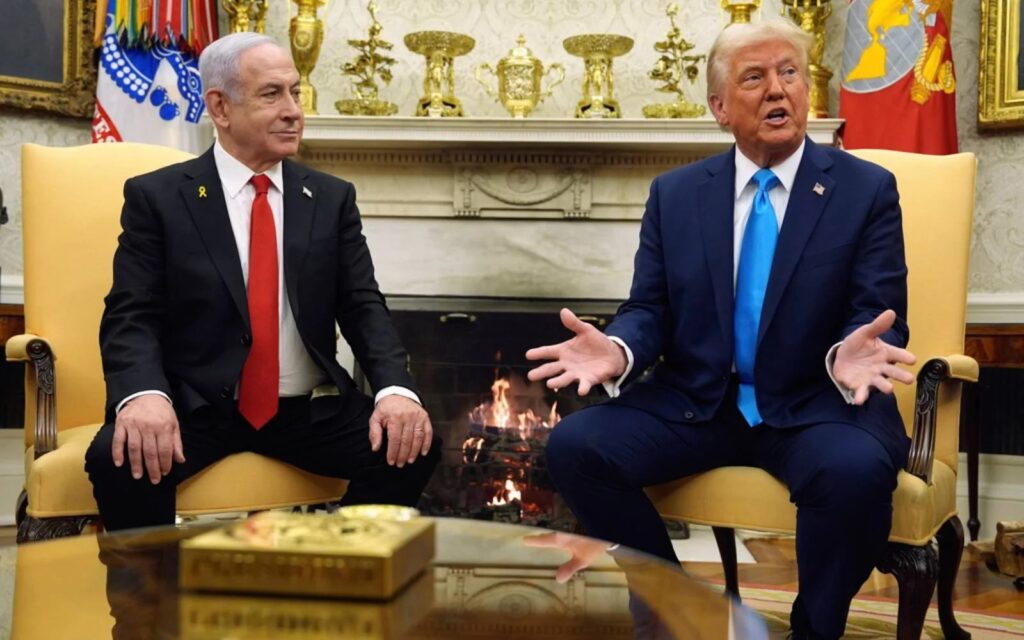
President Donald Trump hosted separate meetings Tuesday with Israeli Prime Minister Benjamin Netanyahu and Ukrainian President Volodymyr Zelensky as the wars involving Iran and Ukraine remain fluid.
The face-to-face meetings with Trump gave each leader an opportunity to press the interests of their countries at a time when U.S. policy toward Iran, Gaza and the Russia-Ukraine war remains under consideration.
Trump characterized the meetings as productive.
But beneath the positive rhetoric looms a warning about whether U.S. manufacturing is prepared to sustain a major war.
“Prime Minister Bibi Netanyahu of Israel, along with myself and Representatives. Had a very good meeting! Obviously, many important subjects were discussed,” the president said on social media.
The relationship between Trump and Netanyahu has been rocky since the U.S. signed a ceasefire with Iran in June, with Israelis accusing the president of failing to secure the hard-won victory at a crucial moment.
Likewise, the meeting with Zelensky was also described in positive terms by Trump, a significant development for a relationship that has also seen tense moments.
“Great Honor to meet with President Zelenskyy of Ukraine. Many things were discussed. The meeting went very well!” Trump wrote.
Each meeting was held at the White House ahead of funeral services for the late Sen. Lindsey Graham, who unexpectedly died earlier this month.
Zelensky described his talks with Trump as “good.”
“Thank you for everything we do together to protect the lives of Ukrainians and advance peace,” the Ukrainian president said on social media.
Zelensky said the two leaders discussed “anti-ballistic systems and anti-ballistic missiles,” with Ukraine seeking a license to manufacture Patriot interceptors, according to the Kyiv Post.
He also told reporters he spoke with American defense contractor Lockheed Martin about expanding production of F-16s, HIMARS and ATACMS, according to media reports.
The issue has strategic significance for Trump and the U.S. and could become another source of tension between Ukraine and the administration.
The U.S. is reportedly running short of expensive air defense interceptors after years of supplying Ukraine and more recently supporting operations in the Middle East.
Previously, the president declared a national emergency, noting American manufacturing has been so hollowed out that it gravely affects the production of national defense materials.
“‘Made in America’ is not just a tagline – it’s an economic and national security priority of this Administration,” the White House said.
The meeting with Netanyahu is symptomatic of those and other tensions caused by the war with Iran, despite the positive framing.
“It was a meeting with full cooperation with mutual support, with understanding on the joint goal that Iran won’t have nuclear weapons, and also other goals,” Netanyahu said in a video, the Times of Israel reported.
The Wall Street Journal reported the meeting with Trump was conditional on Netanyahu showing progress on peace talks involving Gaza and Lebanon.
Netanyahu seemed to understand the stakes, expressing enthusiasm for the talks.
“It was one of the best conversations I’ve had with our friend, U.S. President Trump,” Netanyahu said.
Adding complications to the meetings are concerns that Netanyahu is pursuing an agenda at odds with Trump’s “America First” foreign policy, which rejects wars without a defined end.
“Netanyahu is going to push his agenda, which I don’t think in this instance necessarily is compatible with our interests,” Alex Gray, who served as National Security Council chief of staff during Trump’s first term, told Politico.
The U.S.-Israeli meeting comes against the backdrop of negotiations with Iran in which three competing Iranian factions have emerged, the Institute for the Study of War reported.
One side favors negotiations and compromise in which “at least some regime actors believe the present situation is untenable for Iran.”
The president of Iran told the supreme leader he would step down if the ayatollah rejected the June ceasefire agreement, the New York Times reported.
The other two factions are hard-liners who favor either no negotiations or no compromise.
Heartlander News reported this week that Israel was considering how it could expand the war with Iran if fighting resumes.
Some of the Israeli options expected to be proposed to Trump include expanding airstrikes on infrastructure such as bridges and power plants, using ground troops to seize nuclear material or targeting oil facilities.
But the issue of depleted munitions caused by inadequate U.S. industrial capacity looms over the battlefields in both the Middle East and Ukraine.
Bradley Bowman and Rear Adm. (Ret.) Mark Montgomery, senior directors at the Foundation for Defense of Democracies, wrote in the New York Post that the quantity of munitions matters as much as quality.
“The wars in Ukraine and the Middle East demonstrate that an inventory of expensive long-range precision weapons cannot sustain a modern high-intensity conflict without a deep magazine of affordable, mass-producible munitions,” the experts said.