More than 50 million kids eligible for scholarships – if states join new federal tax credit program
More than 90% of K-12 students nationwide will be eligible to receive scholarship funding under the new federal Education Freedom Tax Credit (EFTC), which takes effect in 2027, a new…

More than 90% of K-12 students nationwide will be eligible to receive scholarship funding under the new federal Education Freedom Tax Credit (EFTC), which takes effect in 2027, a new report finds.
The program has broad potential impact, but whether all states will choose to participate remains to be seen.
The tax credit, passed in last year’s One Big Beautiful Bill Act, expands school choice by allowing nonprofit scholarship granting organizations to aggregate contributions of up to $1,700 each into awards for public, private and charter school students. Some homeschool students are also eligible, depending on state rules.
The American Federation for Children, which bills itself as America’s largest school choice advocacy organization, released a report Tuesday detailing the number of children who could benefit from the new program.
“No one has really put out an estimate of how many children could benefit,” AFC Senior Fellow Patrick Graff told Heartlander News in an interview. “And we are the American Federation for Children, after all, so, at the end of the day, we really care about children and families and their ability to access an education that works best for them.”
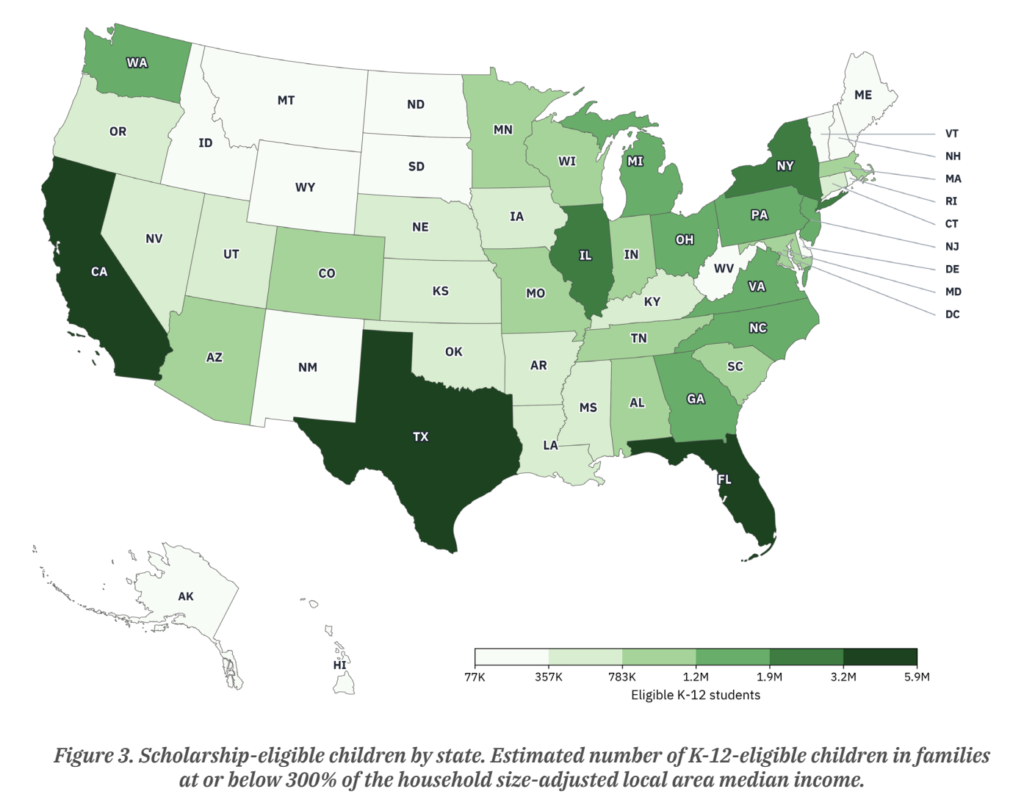
Graff’s report found an estimated 51.7 million children, or 91.7% of the nation’s K-12 population of 56.4 million, would qualify under the program’s rules, which allow families at or below 300% of their local median income to participate.
The awards can be used by students in a variety of educational settings, including public and private school, and for various expenses.
“For some families, this could mean using scholarships to pay for private school tuition at a school they choose. Other students will benefit from buying the equipment or uniforms needed for a career training program at a secondary school,” the U.S. Department of Education said in a summary about the program. “Other families may seek a scholarship for tutoring or for afterschool enrichment programs. The options are expected to vary in line with students’ unique academic needs, the focus of a particular SGO, and the educational opportunities available to students.”
Graff said he hopes his report will inspire state leaders to take advantage of the program.
“I think the big piece is that my report really lays out the number of families and children that stand to benefit from this new opportunity,” he said. “I really think policymakers should think carefully about how to serve the long-run interests of the families in their state, and to retain these dollars for the future of both their kids’ development in their state, but also their future workforce and their economy within their state.”
One issue Graff documented is the approximately 800,000 homeschool students who would not qualify because of how their states classify homeschoolers. If those students qualified, 93.1% of U.S. children would be eligible, Graff found.
What’s also at stake is about 20 million children who live in the 19 states that have not yet indicated that they will participate. California alone accounts for 5.9 million of those children.
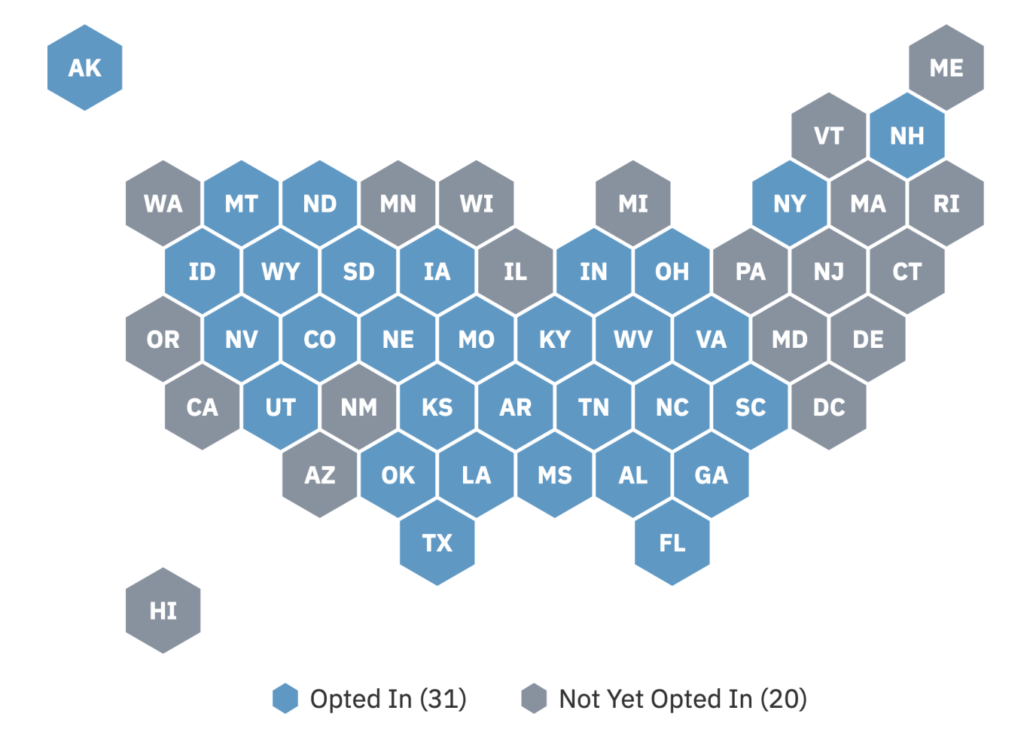
“There’s a lot of kids kind of waiting on the sidelines, and I think putting numbers to that will really be a benefit to both advocates and scholarship organizations who are thinking about how best to encourage their states to act as this comes online,” Graff said.
The EFTC allows states to determine their own scholarship eligibility and application process, such as how they classify homeschool students.
“When this law was crafted, I know that they were very intentional about not wanting to dictate to scholarship organizations what they can and can’t do in terms of granting scholarships, but are really leaving it up in some ways to the market of donors to decide where are their donations going to go the furthest to help kids and building it that way,” Graff said.
AFC launched an affiliated nationwide organization, the AFC Scholarship Fund, to help serve smaller states without SGOs, Graff explained.
“From our perspective, we started this up because we want this to spread as far as possible,” he said. “We want as many kids to be able to take advantage of this opportunity.”
Additionally, donors can give outside of their own state, he said, adding that he hopes the initial year grows national interest and commitment.
“So, I think hopefully a lot of them will take advantage of the opportunity,” he said.
Nationally, more than 1.5 million students participate in school choice programs across 34 states, a number expected to rise with the launch of the new tax credit.