10 states ‘medal’ in latest school choice rankings
EdChoice’s latest education freedom rankings awarded 10 states gold, silver or bronze status.
The Friedman Index, named for EdChoice founders Milton and Rose Friedman, “is a comprehensive…

EdChoice’s latest education freedom rankings awarded 10 states gold, silver or bronze status.
The Friedman Index, named for EdChoice founders Milton and Rose Friedman, “is a comprehensive and easy-to-understand measure of the availability of private K–12 educational choice across the United States,” the organization said.
It analyzes the percentage of students eligible for school choice programs, the amount of funding available and how that funding compares with average spending per public school student, and the amount of flexibility families have to use the funding.
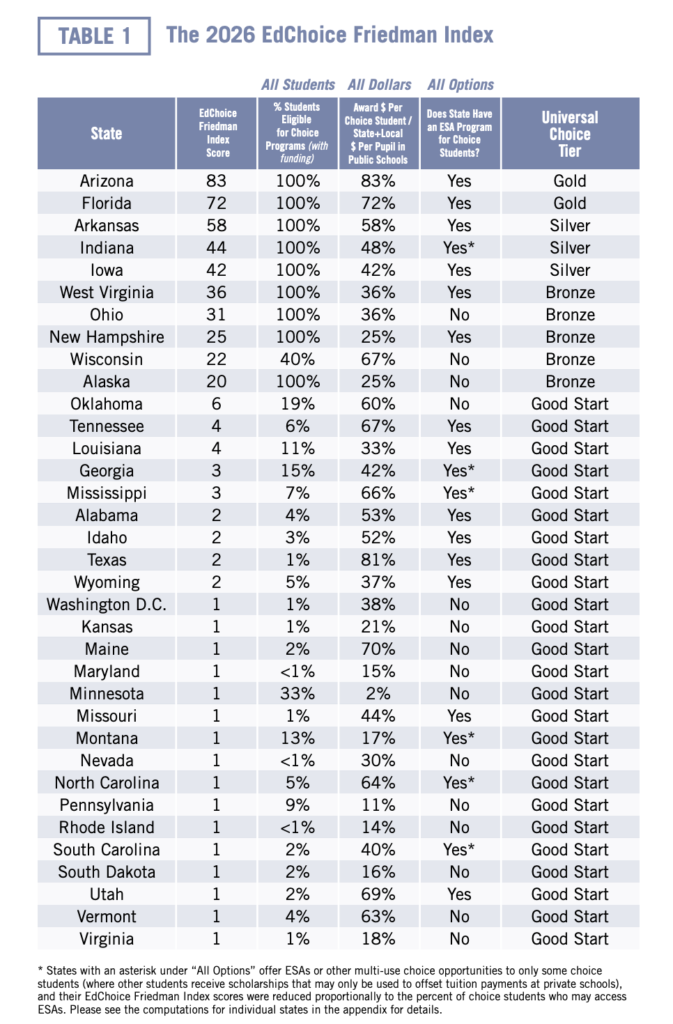
In the rankings, Arizona and Florida received gold status, followed by Arkansas, Indiana and Iowa with silver and West Virginia, Ohio, New Hampshire, Wisconsin and Alaska with bronze.
“The Index assesses how well each state enables families to direct education funding toward the options they deem best, whether public or private,” reads a summary of the latest findings.
“Arizona’s score of 83 reflects that all children in the state are eligible to participate in and actually receive funding from a choice program (‘All Students’), and that all children may access a multi-use ESA, where their parents may use their award dollars to access approved educational services outside of school walls (‘All Options’).”
The report noted that many states have moved toward offering “universal choice,” but some lack funding or have limitations that prevent their programs from achieving true universality.
While the medal states received a 20 or higher on the Friedman Index, the next nine states – Oklahoma, Tennessee, Louisiana, Georgia, Mississippi, Alabama, Idaho, Texas and Wyoming – received scores ranging from six to two. Less than 20% of students in those states can receive school choice scholarships based on eligibility and available funding.
Rounding out the rankings, 14 more states and Washington, D.C., earned a Friedman Index score of one because their school choice programs are limited to specific populations, such as students with disabilities or students in low-performing schools, or because funding covers only a small portion of the state’s students.
These states include Kansas, Missouri, Pennsylvania and North Carolina, although lawmakers in Missouri and other states approved funding increases this year for their choice programs. The EdChoice rankings were based on 2025 data.
The list ends with 16 states that have no private school choice programs. These are concentrated on the East and West coasts and include California, Connecticut, New York and Washington. Midwestern states include Illinois, Kentucky and Nebraska.
While the rankings highlighted Florida and Arizona as school choice leaders, several states with large school choice populations fared poorly. North Carolina has more than 100,000 school choice students but received a score of one on the Friedman Index because its funding covers only 5% of the state’s students.
Texas, which approved a $1 billion school choice program that will launch this year with 100,000 scholarships, received a score of two because its ESA covers just 1% of students in the state. But the program offers school choice students about $10,000, or 81% of the funding public school students receive, which helped improve the state’s ranking.
States that increase school choice grants to the level of public school funding will move up in the assessment, as will states that convert existing programs to ESAs to give families more autonomy over how funds are spent, EdChoice said.
While EdChoice is nonpartisan, the rankings reflect a political divide. Of the top 20 states, all are red or purple, meaning Republicans control all or at least one branch of government. No blue, or Democrat-led, state received an index score greater than one.
Conversely, of the 16 states without school choice programs, all are blue except North Dakota and Nebraska, which are red, and Kentucky, which has divided government.
Nationally, more than 1.5 million students participate in school choice across 34 states. A new federal school choice program starts in January and should expand those numbers.