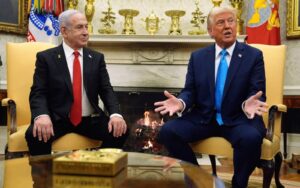
Vance’s Israel broadside opens new fault line for VP in Trump world
Vice President JD Vance accused elements of the Israeli government of financing a campaign to turn American conservatives against President Donald Trump’s effort to reach a peace agreement with…
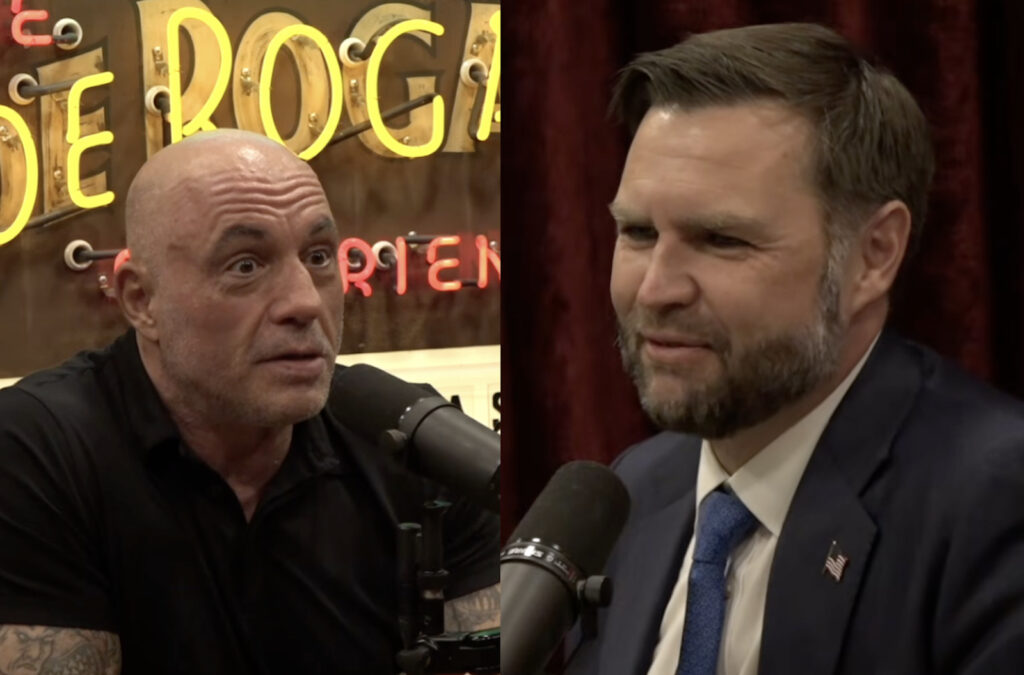
Vice President JD Vance accused elements of the Israeli government of financing a campaign to turn American conservatives against President Donald Trump’s effort to reach a peace agreement with Iran.
Vance made the comments while appearing on a podcast with controversial host Joe Rogan.
Speaking Wednesday during a nearly three-hour interview, Vance described a “very discreet, extremely well-funded campaign” by Israel aimed at derailing negotiations between Washington and Tehran.
“There are some people within their system we know beyond a shadow of a doubt who are manipulating and trying to change American public opinion to keep the war going on indefinitely,” Vance said. “Again, not toward any objective, but just indefinitely.”
The vice president cited a Time magazine report detailing an Israeli government-backed public relations campaign operated by Brad Parscale, Trump’s former campaign manager.
Parscale’s firm reportedly received a contract worth approximately $1.5 million per month to improve Israel’s standing among American conservatives and push favorable messages through digital media and online influencers.
Vance emphasized that Israel is hardly the only foreign government attempting to influence American policy. He also cited Qatar, Russia, France and the U.K. as countries trying to influence the U.S., describing such efforts as a normal part of international politics.
“It’s just sort of the nature of the beast,” he told Rogan.
His objection, he said, begins when foreign advocacy affects the judgment of American officials.
“We should be thinking, ‘What is in the best interest of the United States of America?’” Vance said.
What likely chafed Vance most is that he was the point person in the failed negotiations with Iran, which ended five days ago as both sides resumed strikes.
He told Rogan he especially objected to being portrayed by fellow conservatives as someone who takes his marching orders from Tucker Carlson or Qatar.
Carlson has been outspoken in his opposition to the Iran war. Some have accused Carlson of antisemitism, charges that Vance can ill afford to stick to him.
Qatar has been Iran’s main supporter among the Gulf states.
Critics have also accused Qatar of buying Republican “influencers” through luxury travel and access, as well as seeking broader influence with U.S. institutions.
Vance claimed that some conservatives with influence do not have an alternative to war, similar to his claim that some Israelis do not have a strategic objective but instead want to drag the war out indefinitely.
“You have to read between the lines a little bit because if you look at what [former Vice President] Mike Pence or some of the conservative hawks – people who voted for us but have been very critical of me, very critical of the administration – if you actually look at what they’re proposing, they just want the military campaign to go on forever and they can’t actually identify what it is that they’re trying to accomplish,” Vance said.
Pence was outspoken in his criticism of the cease-fire deal. But outside of certain liberal media circles, Pence has limited influence among Republican voters.
Israeli officials have argued that the Trump administration’s agreement with Tehran failed to resolve concerns about Iran’s nuclear program, ballistic missiles and support for regional terrorist groups.
Candor on the Epstein files
Vance also defended the administration’s handling of the release of the Epstein files.
“I say this with all candor,” he told Rogan. “We absolutely screwed up the comms of the Epstein files.”
But Vance noted that while the communication was clumsy, the larger problem was that the original investigation and prosecution were mishandled.
“Look, the original sin of the Epstein investigation, and obviously I’m biased here, but it was not what Donald Trump and the administration did in 2025,” Vance said. “It was – you have to go back to 2007, 2008, the original Alex Acosta investigation of Jeffrey Epstein, where he basically dropped the federal charges.”
Vance’s views on Israel and Iran are unlikely to sit well with evangelical Christians, national-security conservatives, Jewish Republicans and other Trump supporters who regard Israel as America’s most reliable ally in the Middle East.
The Washington Examiner made the case that Vance’s Rogan appearance was aimed at “reconnecting with low-propensity voters” who are skeptical of foreign wars.
But the language Vance deployed was also unusually personal.
Vance accused people supported by the Israeli campaign of attacking him “obsessively” and responded, “Go to hell” and “I represent Americans first.”
That language may strengthen Vance’s position with voters who see him as resisting foreign pressure.
But it may also deepen concerns among Americans who believe he is turning a legitimate disagreement over Iran policy into an unnecessarily broad accusation against fellow conservatives.
According to a Harvard Harris poll released in July, 82% of Republicans approved of Trump’s handling of the conflict; 87% supported renewed force, sanctions and blockades if Tehran threatened the Strait of Hormuz; 83% said the United States had the upper hand; 70% said Iran’s attacks justified a military response; 77% believed Iran was buying time; and 72% said Tehran was violating the cease-fire.