Analysis: CNBC quality-of-life rankings by state overwhelmed by real-life statistics, Republican outrage
Republicans are pushing back on CNBC’s latest Top States for Business rankings, arguing the network’s quality-of-life score relies on a cherry-picked list rather than measures that…

Republicans are pushing back on CNBC’s latest Top States for Business rankings, arguing the network’s quality-of-life score relies on a cherry-picked list rather than measures that reflect where Americans and businesses are actually choosing to locate.
The rankings have also ignited political debate.
The network incorporated a quality-of-life category into its overall business rankings, using measures such as the percentage of uninsured residents, transgender bathroom access, abortion access, voter ID laws and labor practices.
Those progressive categories helped produce a list of the “10 worst states to live in for 2026, per CNBC,” all of which are led by Republican governors.
California Gov. Gavin Newsom, a Democrat and expected 2028 presidential candidate, seized on the findings.
“Notice something in common?” a social media post from Newsom’s office asked. “All led by Republicans – many suffering from California Derangement Syndrome.”
The numbers and recent migration trends, however, tell a different story.
The worst-ranked states for quality of life, according to CNBC, with overall business rankings in parentheses:
50. Tennessee (9)
49. Texas (4)
48. Indiana (10)
47. Georgia (7)
46. Louisiana (47)
45. Utah (16)
44. Missouri (38)
43. Alabama (21)
42. Arkansas (28)
41. Oklahoma (39)
Critics noted the quality-of-life score bears little relationship to CNBC’s own overall business rankings.
Four of the five lowest-ranked quality-of-life states still finished in CNBC’s top 10 for business, while six of the 10 lowest-ranked states placed in the top half overall.
That may reflect the network’s methodology.
It assigned 290 points to quality of life – more than the cost of doing business (285), technology and innovation (245), business friendliness (225), access to capital (105), education (100) and cost of living (50).
“Each category is weighted based on how frequently states use them as a selling point,” CNBC said in explaining its methodology.
Texas vs. California
The healthcare category illustrates the criticism.
Texas lost points because 16.7% of its residents lack health insurance.
California’s uninsured rate is 5.9%.
Still, California ranked only 29th in quality of life and 17th overall for business.
Those results also come with dramatically different costs to taxpayers.
Texas appropriated approximately $29.8 billion in state general revenue for Medicaid during the 2026-27 biennium, or about $14.9 billion annually.
California budgeted $44.9 billion in state general fund spending for Medi-Cal during the 2025-26 fiscal year – nearly three times Texas’ annual state spending.
Critics argue the uninsured rate therefore reflects government healthcare spending as much as it reflects quality of life.
Migration patterns also tell a different story.
Heartlander News previously reported that Americans continue moving to lower-tax, Republican-led states at higher rates than to many states with more progressive policies.
“Seven of the top 10 growth states currently feature Republican governors, and nine of those states went red in the last presidential election,” U-Haul said. “Conversely, nine of the bottom 10 growth states feature Democrat governors, and seven of those states went blue in the last presidential election.”
The National Taxpayers Union, citing IRS migration data, reported that one taxpayer moves to Florida or Texas every two to three minutes, while one leaves California every 1 minute, 44 seconds.
An NTU analysis of IRS data found five of CNBC’s 10 lowest-ranked quality-of-life states – Texas, Tennessee, Georgia, Alabama and Oklahoma – ranked among the nation’s top 10 destinations for domestic migration, bringing tens of billions of dollars in taxable income with them.
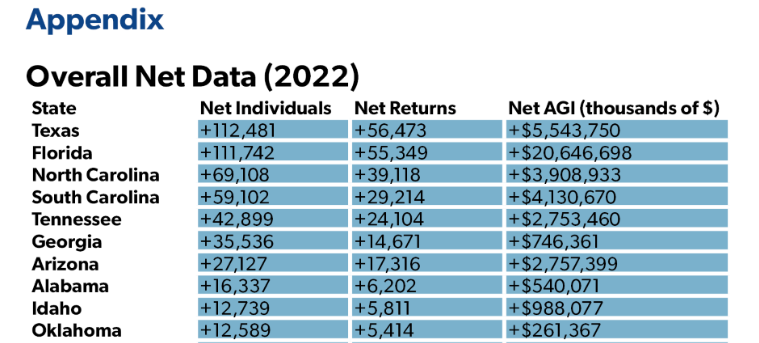
Business investment follows a similar pattern.
Starbucks announced a $100 million Southeast corporate office in Nashville, Tennessee, which CNBC ranked last in quality of life.
The expansion is expected to create 2,000 support jobs while generating about $250 million in annual salaries and $100 million in office leases over the next five years. The Seattle Times reported that the company also expects to save tens of millions of dollars annually in Washington state business taxes.
Migration data likewise favor Tennessee.
Washington lost 10.7 residents per 10,000 people through domestic migration in 2025, while Tennessee gained 43.6 residents per 10,000, according to Visual Capitalist.
“If Tennessee was really the worst state to live in, people wouldn’t be moving there in large numbers, which they are,” Gov. Ron DeSantis, R-Florida, and a possible 2028 contender, said on social media.
“Typical nonsense.”