New Hampshire governor signs legislation requiring parental notification on gender identity in schools
New Hampshire Gov. Kelly Ayotte has signed legislation requiring school employees to answer parents’ written questions about their children truthfully.
Senate Bill 430 requires credentialed…
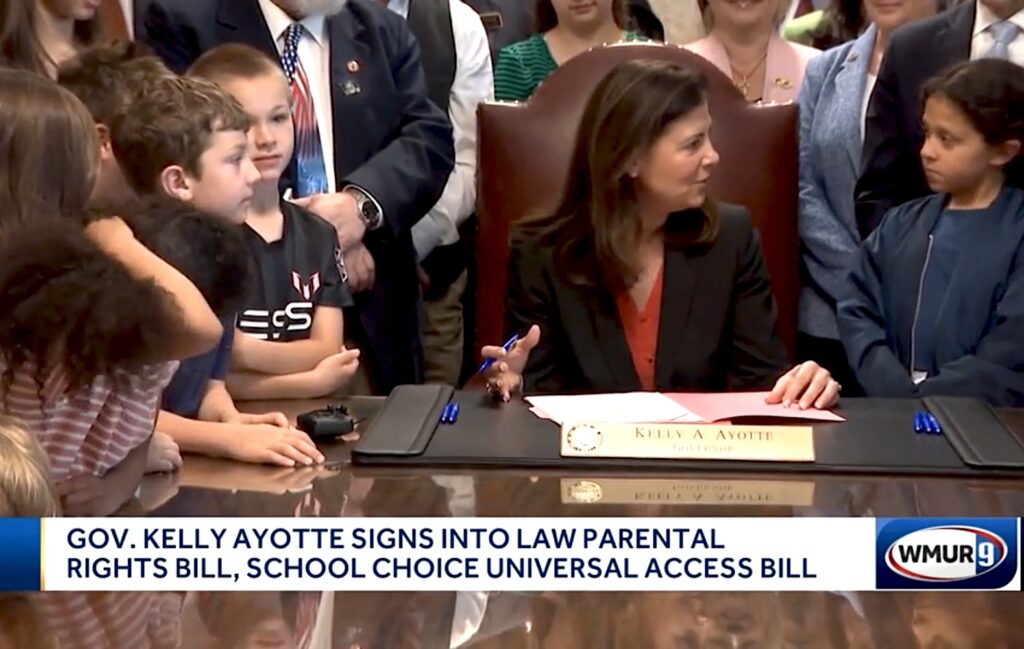
New Hampshire Gov. Kelly Ayotte has signed legislation requiring school employees to answer parents’ written questions about their children truthfully.
Senate Bill 430 requires credentialed school employees to respond to parents’ written questions within 10 business days. The answer must be “complete and honest” unless state or federal law prohibits disclosure or the employee believes disclosure would put the child at “imminent risk” of abuse or neglect.
The new law takes effect Jan. 1, 2027.
The measure, called the Honesty and Transparency in Education Act, comes after years of conflict in New Hampshire over whether schools may keep a child’s claimed gender identity hidden from parents.
In 2024, the New Hampshire Supreme Court sided with Manchester schools after a mother sued over a policy that prevented staff from disclosing a student’s gender transition to parents without the student’s consent.
Chief Justice Gordon J. MacDonald wrote for the court: “While parents may have a fundamental right to decide whether to send their child to a public school, they do not have a fundamental right generally to direct how a public school teaches their child.”
State Sen. Tim Lang, R-Sanbornton, sponsored the bill and said it gives parents a basic right to honest answers.
“In the end, this is a straight process bill,” Lang said. “When a parent asks a question of the school, they should get an answer in a reasonable amount of time, and the answer should be honest and truthful.”
The law says the State Board of Education must update the educator code of ethics and code of conduct by June 30, 2027. After that date, the state may investigate and discipline educators who violate the rule.
Supporters say the bill restores a basic principle: Parents should not have to fight a public school to learn what is happening with their own child.
Lang also said hiding information from parents can make it harder for a family to help a child in trouble.
“If you don’t tell the parent, the parent can’t watch for the signs of self-harm,” Lang said.
The law follows other parental-rights measures in New Hampshire. In 2024, then-Gov. Chris Sununu signed a law requiring schools to give parents two weeks’ notice and an opt-out option for lessons on sexual orientation, gender, gender identity and gender expression.
Ayotte, a Republican, has a mixed record on transgender-related bills. She signed a 2025 law banning some transgender procedures for minors, including hormone therapy, puberty blockers and chest surgeries. However, she vetoed bathroom and locker room bills last year and this year.
“I made it clear that this issue needed to be addressed in a thoughtful, narrow way that protects the privacy, safety, and rights of all Granite Staters,” Ayotte said. “Unfortunately, there is minimal difference between Senate Bill 268 and the bill I vetoed last year, which Gov. Sununu vetoed the year prior.”
New Hampshire is not alone. Several states have passed laws requiring some form of parental notice or consent when a student seeks to change names, pronouns or gender identities at school. Indiana, Iowa, Ohio, South Carolina, Tennessee and West Virginia have passed such laws. However, California went the other way in 2024, when Gov. Gavin Newsom signed legislation blocking schools from adopting parental-notification policies.
In March, the U.S. Supreme Court issued a preliminary order against California policies that keep parents in the dark about their child’s gender transition at school, as Heartlander News previously reported. The Trump administration is also investigating whether California’s law violates parents’ rights under the Family Educational Rights and Privacy Act.
The New Hampshire law puts the state on the side of parents who say public schools should not keep major information from families – those legally and morally responsible for children.