
(The Sentinel) – The decision by the Kansas State Board of Education (KSBOE) in 2025 to lower proficiency standards predictably produced artificial achievement gains in the 2026 edition of “A-F Grades for Kansas Schools” released annually by the Kansas Policy Institute (KPI), of which The Sentinel is a subsidiary.
KPI’s news release reminds readers, “The A–F system converts complex state assessment data into familiar letter grades, offering a transparent alternative to Kansas’ official school report cards, which often use technical labels that are difficult for parents to interpret. The newly revamped website also makes it quick and easy for families to find their school district and their child’s individual school building, putting meaningful information at their fingertips.”
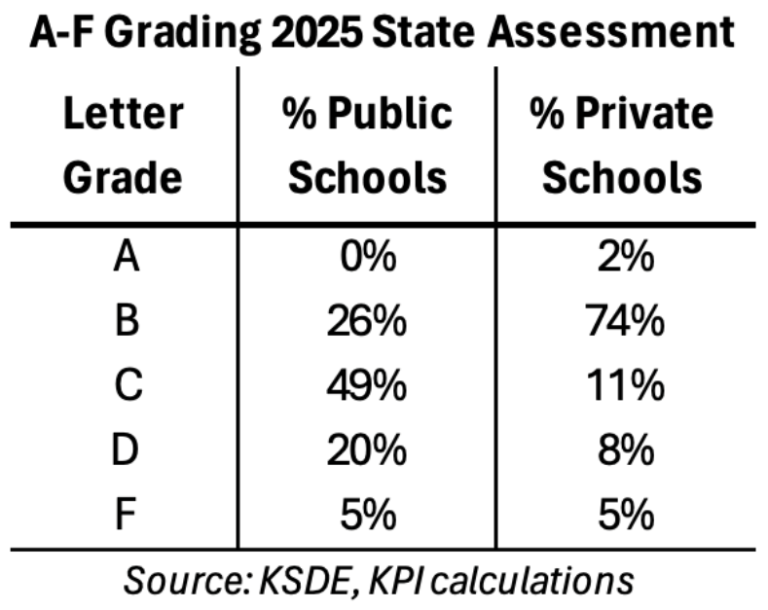
A-F Grades based on the 2024 state assessment, when the state had high standards, had 0.2% of public schools getting an “A,” 18% had a “B,” 44% with a “C,” 33% with a “D,” and 5% got an “F.” Scores from the 2025 state assessment, based on lower proficiency standards, are somewhat better but still relatively low: 26% with a “B,” 49% with a “C,” 20% with a “D,” and 5% receiving an “F.”
Only one school, Westwood View Elementary in the Shawnee Mission School District, earned an “A”.
The news release recalls that this is not the first time that a KSBOE decision on proficiency standards has affected state assessment results. In 2015, a decision to raise standards based on U.S. Department of Education guidelines resulted in 8th grade reading proficiency nosediving from 85% the previous year to 30%.
KPI President James Franko warns against reading too much into the A-F Grades results.
“Kansans will see some higher grades this year, but it’s important to understand why,” Franko said. “Lowering proficiency standards makes results look better on paper, but it does not mean students are better prepared in reading and math.
“Real progress comes from raising expectations and accurately measuring results. We do students no favors by creating the illusion of improvement. Our state and local elected officials need to make real progress; the goal is not to use clever accounting to paper over a real academic tragedy.”
KPI developed the “A–F Grading of Kansas Schools” project to equip families, taxpayers, and policymakers with accessible, actionable information.
“Transparency is essential to accountability,” Franko said. “When parents and policymakers can clearly see how schools are performing, it creates the opportunity and the urgency for meaningful improvement.”

