Analysis: Andy Burnham to inherit Labour’s mess as U.K. prime minister after Keir Starmer resigns
Keir Starmer became the seventh British prime minister in 10 years to resign Monday, clearing the path for Andy Burnham to become the new leader.
The question voters in the UK are asking is…
Keir Starmer became the seventh British prime minister in 10 years to resign Monday, clearing the path for Andy Burnham to become the new leader.
The question voters in the UK are asking is simple: Is this genuine change or just a new face on the same failed project by the ruling Labour Party?
“Even if we have a change of prime minister now, and that looks increasingly likely – what is going to follow?” asked Sir Mel Stride, a Conservative MP, who said Labour isn’t going to change.
Burnham, 56, is the self-styled “King of the North” – a nickname derived from Game of Thrones – who was born and raised in the northwest of England and studied at Cambridge, Fortune reported.
Burnham’s political rise was swift.
He became a parliamentary researcher at 24, a special adviser at 28 and entered Parliament at 31. Over 16 years as an MP, he served in the governments of Tony Blair and Gordon Brown, rising to health secretary and later mounting two unsuccessful bids for the Labour leadership, CNN noted.
In 2017, Burnham left Westminster to become the first elected mayor of Greater Manchester, a position he held until resigning this month after winning a parliamentary by-election in Makerfield.
He won with almost 55% of the vote, a majority of more than 9,200 votes. That was enough in the safe Labour seat for Starmer’s remaining Cabinet support to evaporate within hours.
“Everyone knows that politics isn’t working,” Burnham said in victory. “Everyone can feel that the country isn’t where it should be. Tonight could, just could, be the turning point.”
Burnham’s political brand is built around what he calls “Manchesterism,” the same kind of democratic socialist policies guiding municipal candidates in America, such as New York City mayor Zohran Mamdani.
Burnham’s masterpiece is the Bee Network, a subsidized transportation network for Manchester, paid for by British taxpayers.
In practice, Burnham’s philosophy is government control of integrated transport and devolution of power from Westminster by sending money directly to communities for local control, similar to how block grants are used in the U.S., with oversight by a single metro-area mayor in the UK.
“There is a question about the extent to which the growth we have seen in the city and the levels of private investment we have seen, how much people benefit from that growth,” said Dr. Sarah Longlands, chief executive of the Manchester-based Centre for Local Economic Strategies.
More than a third of children in Greater Manchester are growing up in poverty, Longlands said.
That compares with 31% of children nationally who live in poverty in the UK, according to the House of Commons.
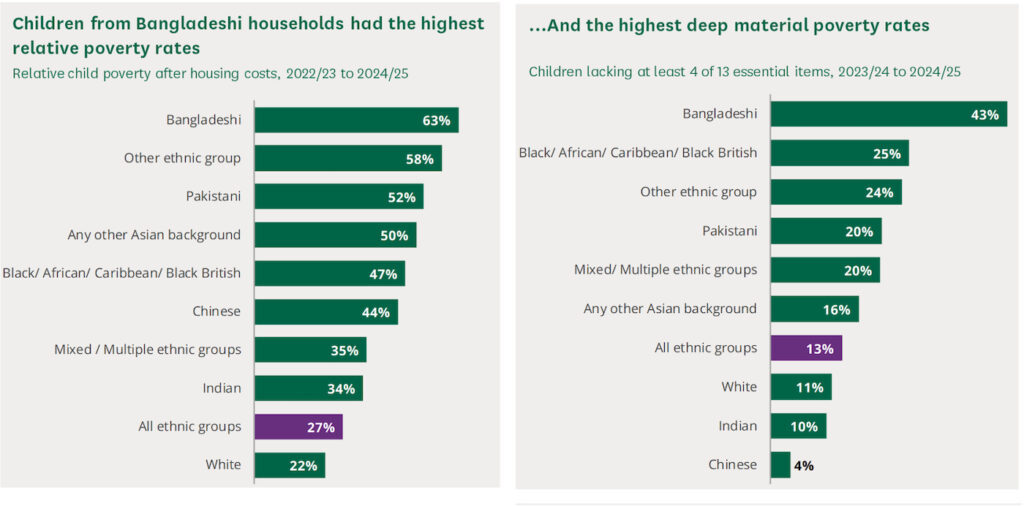
The breakdown of children living in poverty by ethnic group, as provided by the government, highlights the immigration challenge Britons are facing:
- Bangladeshi 63%
- Other ethnic group 58% (likely includes Arab, Afghan, Iranian and other Middle Eastern groups)
- Pakistani 52%
- Any other Asian background 50%
- black/African/Caribbean/black British 47%
- Chinese 44%
- mixed/multiple ethnic groups 35%
- Indian 34%
- all ethnic groups 27%
- white 22%
Labour seems to understand the issue yet, surprisingly, will not address it with solutions.
That may be because when there are enormous pots of money used to fight poverty, there is enormous incentive for poverty to remain persistent.
Britons “see a state that they pay taxes toward, yet it is proving unable to stop a flow of dinghies across the channel,” Labour Home Secretary Shabana Mahmood said recently. “And they see a state that is paying billions toward hotels [housing immigrants] like the one near them.”
Even allies note that the Burnham program is not materially different from policies Starmer’s government was already pursuing.
Manchesterism can actually be described as Starmerism writ large.
“There are some real similarities and continuities of argument,” Mathew Lawrence, founder of Common Wealth and a Burnham supporter, told CNN. “It’s not necessarily a radical break, but it is a big acceleration.”
The structural problem Burnham inherits demonstrates his political problem.
Labour won its historic 174-seat majority in July 2024 with just 33.7% of the vote, the lowest share of any modern prime minister, on the second-lowest turnout since 1918 – a parliamentary supermajority with no genuine public mandate or enthusiasm behind it.
The Spectator called it a “Potemkin landslide” and noted “the next five years in British politics will be thrillingly unpredictable.”
The bond markets have already registered their skepticism, with the 10-year bond trending upward year to date since Starmer’s fate was sealed.
Britain’s fiscal position – a welfare state running out of money, a defense commitment under NATO pressure and a bond market that ended a previous prime minister in 45 days – creates immediate problems for Burnham, just as it did for his predecessor.
President Donald Trump, who has made no secret of his contempt for Starmer, delivered a characteristic verdict Monday.
“He failed badly on two very important subjects- IMMIGRATION AND ENERGY,” Trump said via social media about Starmer.
Burnham now inherits a party that has consumed two consecutive leaders.
He has a majority that has certainly eroded, an opposition movement that is sitting back watching Labour self-destruct, and a set of structural problems – demographic, fiscal, cultural – that a municipal philosophy developed in Manchester is poorly equipped to address.
As The Spectator noted in 2024, “It would be deeply misleading to take this parliament as a proxy for UK public opinion.”
The same can be said for the prime minister.
(Image credit: Created with Gemini AI)