
Kansas lawmakers want to make federal school choice tax credits available to the state’s families, though it’s unclear whether the governor will allow it.
Both the Kansas House and Senate approved final versions of the state’s Education Freedom Tax Credit this week, which would allow Kansas to opt in to President Donald Trump’s school choice program.
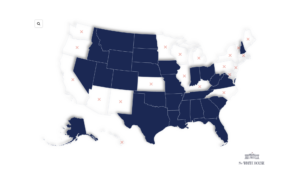
White House map of the states opted in to Trump’s school choice program as of March 18.
Trump’s Working Families Tax Cut Act, also known as last year’s “One Big Beautiful Bill,” expands education freedom and school choice by allowing federal tax credits to be used as scholarships.
This financial aid opportunity would open the door for parents to send their children to private schools who otherwise wouldn’t be able to afford it. It would also allow students to utilize private tutoring or other individualized educational support services.
“Our glorious American future depends on the next generation’s ability to learn, lead, and innovate,” Trump said in a proclamation about the school choice program. “I will always be a champion for the right of every parent to be the steward of their children’s education, and together, we will never waver in putting our parents first, our children first, and America first.”
States have to individually opt into the program for families to be able to receive the tax credits. Kansas House Bill 2468 would let Kansans do just that, allowing federal tax money to be used in a scholarship capacity.
“Every one of our neighboring states have opted-in to President Trump’s school-choice program,” Senate President Ty Masterson wrote in a statement after the Senate approved the bill.
States with Republican governors quickly opted in. But Kansas Democrat Gov. Laura Kelly is widely expected to veto the measure – and the House in particular may not be able to come up with the 84 votes needed to override a veto.
“Laura Kelly and the [Democrats] have stood in the way of this funding being delivered to our students, but today, the Kansas Senate took real action to deliver this life-changing funding that will give low-income families the same freedom to choose the best educational paths for their children as higher income families. When I’m governor, we will not have to overcome these types of obstacles.”
Many Kansas residents testified in favor of the bill, declaring the need for families to have more education options and choices.
“H.B. 2468 expands educational flexibility for Kansas families at a time when parents need every available tool to place their children in learning environments that meet their unique needs,” Kansas Family Voice President Brittany Jones wrote in her testimony. “This is a child-centered, family-centered model.
“It is not about elevating one type of schooling over another; it is about empowering families to make the best decision for their children. Parents are best positioned to know and raise their children, and educational institutions should serve as partners in that responsibility.”
“Research indicates that humans make nearly 35,000 decisions each day, yet our current system restricts tax-paying citizens from deciding where their children attend school unless they can afford to do so,” citizen Debbie Herrman testified.
Those in opposition to the bill claim public schools need the money more than private institutions and that special education, which is already struggling from lack of funds, would suffer even more. Critics also argue the scholarships would only benefit a small portion of the community since the “vast majority” of Kansas students attend public schools.
However, homeschooling mother-of-five Nikki Chubb and her husband used their own money to launch a hybrid school because their public-school district failed to provide the education their children needed. She argued there’s an increasing demand for schooling beyond public education.
“What began as a small effort has grown rapidly: our homeschool group is overflowing, and our hybrid school has doubled enrollment in just one year,” she wrote. “The demand is undeniable. Families in western Kansas are searching for better educational opportunities, but many simply cannot access them without financial support.”
The Kansas Policy Institute advocated in favor of the bill and cited a poll it conducted last year that showed 75% of Kansas parents and grandparents think Education Savings Accounts (ESAs) – accounts where public funds can be used as scholarships – should be available to all students.
“Those numbers were remarkably consistent across self-identified ideology and party affiliation,” Kansas Policy Institute President James Franko said. “We often hear that ‘rural Kansas’ doesn’t want school choice, but this poll makes clear that rural Kansans want the same educational freedom as do Republicans, Democrats, and Kansans from seemingly every walk of life.”
Both the Senate and House approved a final version of the bill this week and now it’s pending Kelly’s veto decision.
Kentucky lawmakers, faced with a similar Democrat governor veto of the school choice opt-in, managed to override it this week.

